On 2 June 2026, Defence Intelligence of Ukraine Head Major General Oleh Ivashchenko briefed President Volodymyr Zelensky on Russia's summer 2026 air campaign priorities. The DIU assessment named "Ukrainian companies demonstrating progress in the development of all types of missile technologies" as the new target priority. The pivot was structural: the Russian Aerospace Forces target matrix had shifted from civilian energy infrastructure designed to break population morale toward the manufacturing base behind Ukrainian sovereign deep-strike capability. Sixteen days later, on 18 June 2026, Ukrainian forces executed the largest aerial assault on Moscow since the war began, striking the Gazprom Neft Kapotnya refinery fifteen kilometres from the Kremlin with a mixed-munitions package of FP-1 propeller drones, AN-196 Liutyi long-range platforms, and the new Bars turbofan drone-missile. Defence Ukraine's analysis of the deep-strike campaign and the Russian budget traced the strategic effect of this campaign at the macroeconomic level. This piece traces the industry behind it.
The Industrial Map
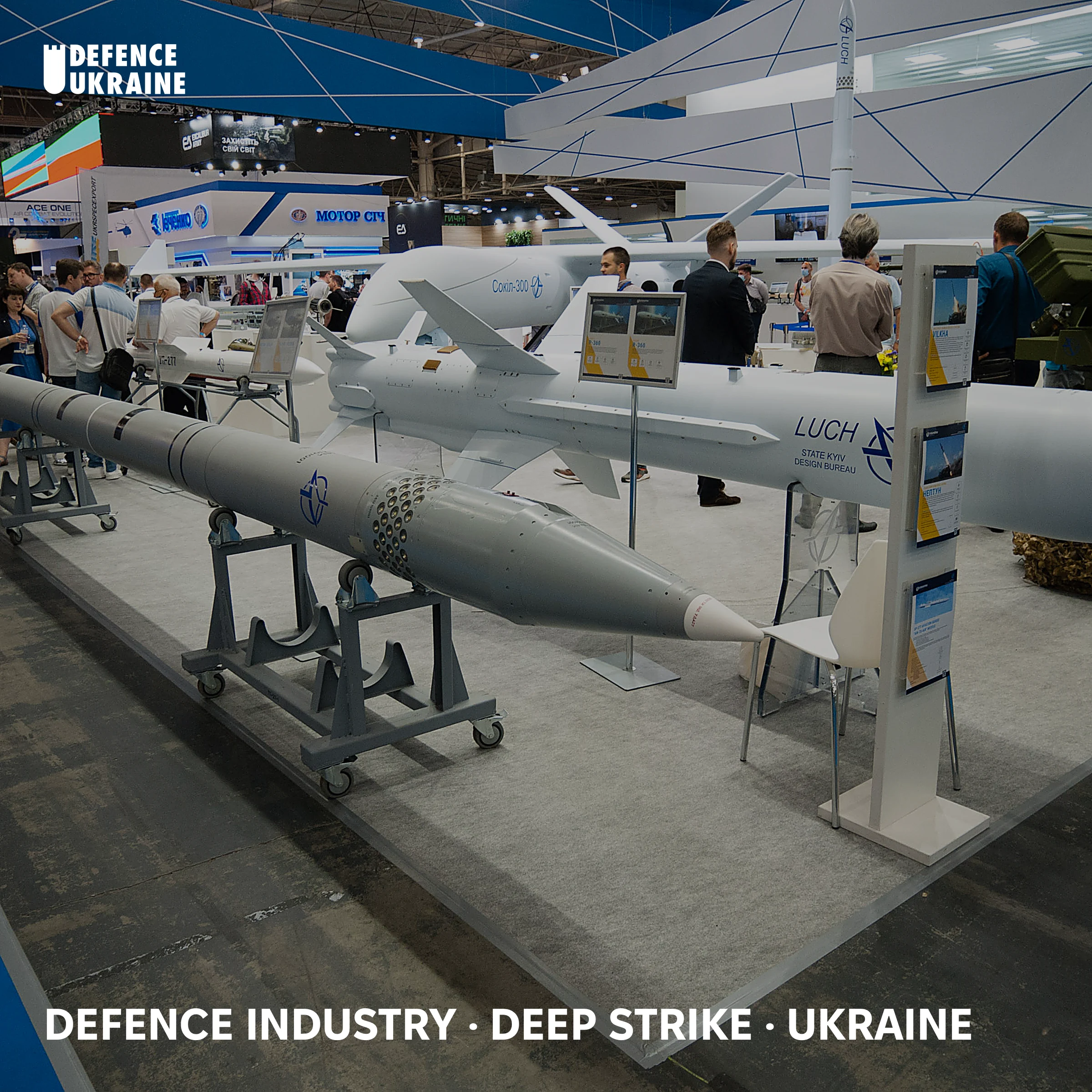
Ukrainian long-range strike production is now bifurcated. The state-owned legacy stack operates under the Ukroboronprom umbrella through three core enterprises. The Luch Design Bureau, founded in 1965 and led by General Director Oleh Korostelyov since 2003, develops the R-360 Neptune anti-ship missile and its land-attack Long Neptune variant; in August 2024, Foreign Minister Andrii Sybiha confirmed Luch also developed the Palianytsia turbojet drone-missile. In June 2026, Luch entered a co-development agreement with European missile prime MBDA for the Neptune-2 deep-strike platform. Pivdenmash, the Dnipro-based heavy aerospace plant, retains sovereign ballistic capability through the Hrim-2 / Sapsan short-range ballistic missile programme. Antonov, the heavy-lift aviation specialist, has converted to mass uncrewed-systems production of the AN-196 Liutyi long-range strike drone, and is the only Ukrainian state manufacturer to have cleared European Union Part-21 aircraft production certification.
The private sector emerged after 2022. Fire Point, founded in mid-2022 and led by co-founder Denys Shtilerman and CEO Iryna Terekh, with former US Secretary of State Mike Pompeo on its advisory board, scaled to a workforce above 500 by 2025. Fire Point produces the FP-1 and FP-2 propeller long-range drones, the FP-5 Flamingo cruise missile, and the FP-7 / Freya ballistic interceptor. Triada Robotics, valued at approximately $10 million in mid-2026, focuses on high-speed jet drone-missiles, with the Bravo turbojet platform in pre-series production and active joint-venture discussions with Lockheed Martin and Northrop Grumman. PARS operates at the other extreme of the distribution, crowdsourcing assembly of the Trembita pulsejet cruise missile to civilian volunteers in commercial workshops. The Brave1 Marketplace catalogue lists over 800 certified products from accredited Ukrainian defence manufacturers.
The Platform Catalogue
The Antonov AN-196 Liutyi is the workhorse of the campaign. It is a propeller-driven, dual-boom drone with 1,000 to 2,000 kilometres range, recently upgraded to a 75-kilogram warhead, with manufacturer-reported unit cost around $200,000. Confirmed strike record includes the Saratov oil refinery (November 2024 and October 2025), an offshore Lukoil platform in the Caspian Sea (December 2025), the Ukhta refinery 1,700 kilometres from the border (February 2026), and the VNIIR-Progress defence plant in Cheboksary (May 2026).
The Long Neptune is the ground-strike evolution of the missile that sank the Russian cruiser Moskva in 2022. Range now exceeds 1,000 kilometres with a 260 to 350 kilogram warhead. The platform struck the Tuapse refinery in March 2025 and was used in the April-May 2026 campaign that suspended operations at the Rosneft Tuapse complex. Domestic unit cost is approximately $1.5 million, an order of magnitude below the Storm Shadow it functionally substitutes for.
The Fire Point FP-5 Flamingo is the Ukrainian sovereign answer to the Western cruise-missile shortage. Manufacturer-reported range is 3,000 kilometres with a 1,150-kilogram warhead, propulsion via Soviet-era AI-25TL turbofan engines refurbished from global stockpiles. Production targets are aggressive (CEO Terekh stated a goal of seven missiles per day by end of 2026), but the system is highly visible on radar and has accuracy challenges; a February 2026 strike on an ammunition depot near Kotluban saw five of six Flamingoes reportedly intercepted by Russian air defences. The platform has nonetheless struck the FSB outpost in Crimea and the Votkinsk machine-building plant.
The "rocket-drone" class trades cruise-missile payload for subsonic turbojet penetration speed at one-fifth the cost. Palianytsia, developed by Luch and powered by the Czech-Ukrainian AI-PBS-350 jet engine, entered serial production in late 2024 and struck Russian ammunition depots in Voronezh oblast. Peklo entered serial production with 100 units delivered late 2024, using terrain-contour matching and controlled reception pattern antennas to resist Russian electronic warfare. The Bars turbofan drone-missile was the primary vector in the June 2026 strikes on the Novokuybyshevsk petrochemical plant and the Moscow Gazprom Neft refinery.
The Trembita pulsejet costs as little as $4,000 per unit. Its rudimentary pulsejet engine generates a thermal and acoustic signature so loud and visible that the platform operates partly as a deliberate decoy for expensive Russian surface-to-air missiles, clearing airspace for precision strikes. The Hrim-2 / Sapsan ballistic missile (Mach 5.2, 300 to 500 kilometre range, classified production rate) provides Ukraine's sovereign hardened-target capability and conducted its first successful combat test in mid-2025.
The Financing Architecture
Domestic procurement runs through Brave1, the state-backed defence-technology platform that has evolved into a digital marketplace. Frontline units earn e-Points for verified Russian targets struck and exchange them for drones, electronic-warfare modules, and unmanned ground vehicles from the certified manufacturer catalogue. By 24 June 2026, Defence Minister Mykhailo Fedorov reported over 400 combat units had used the system to procure more than 500,000 uncrewed assets. The Ministry of Strategic Industries assesses total Ukrainian Defence-Industrial Base capacity at $55 billion in mid-2026, with $35 billion dedicated to long- and medium-range strike systems. Ukrainian state weapons procurement runs at approximately $10 billion. The $45 billion delta is what foreign financing fills.
The Danish Model is the principal foreign-financing architecture. Denmark pioneered the framework in 2024 of Allied capital financing weapons production inside Ukrainian factories rather than purchasing from depleted Western stockpiles. The 2024 cycle delivered €590 million from Denmark, Sweden, Iceland, and the European Peace Facility. In 2025 the European Commission appointed Denmark as implementing actor for €830 million derived from frozen Russian asset windfall profits. The 2025-26 cycle is projected to reach €1.3 billion routed primarily into long-range strike drones, missile systems, and artillery. Germany operates a parallel bilateral channel: a €400 million-plus package finances Ukrainian production of Bars cruise missiles, Liutyi drones, and Flamingo systems for direct Ukrainian deployment, sidestepping the political cost of exporting German Taurus missiles. The United Kingdom announced on 18 June 2026 a £752 million package, financed via the Extraordinary Revenue Acceleration loan backed by Russian assets, to procure 150,000 Ukrainian-produced drones. Defence Ukraine's analysis of the European procurement standard now built around Ukraine-tested combat data covered the wider architecture; the Diehl Defence integration of IIR seekers into Fire Point's Freya programme is the case that demonstrates Western prime sensor stacks combining with Ukrainian airframes.
At the macro-European level, Defence Ukraine's first-year tracker of SAFE and the Ukraine Support Loan covered the €150 billion loan framework's 65 per cent EU/EEA/EFTA/Ukraine origin rule that counts Ukrainian-manufactured value as European-equivalent. Antonov has cleared EU Part-21 aviation compliance and Ukroboronprom has aligned with NATO Allied Quality Assurance Publications standards. The smaller Brave1 SMEs that the BraveTech EU mandate is designed to accelerate still face multi-year AQAP certification timelines, which is the principal bottleneck between the catalogue's existence and its scaled European procurement.
The Russian Targeting and the Industry's Response
The 2 June DIU brief was the formalisation of a shift Russian operations had already begun. Pivdenmash has sustained repeated Russian cruise and ballistic missile strikes since 2024; the Verkhovna Rada extended special operating rules for the enterprise through 2027 to protect it from wartime bankruptcy under strike pressure. On 14 August 2025, the Russian Federal Security Service and Ministry of Defence issued formal public claims that they had destroyed the Sapsan production base; Ukrainian officials disputed the destruction but did not deny the strike. President Zelensky publicly confirmed in mid-2026 that Russian strikes had degraded the production rate of Fire Point's FP-5 Flamingo. The Pavlohrad Chemical Plant, the historical centre for solid-fuel rocket motor production essential to the Sapsan and FP-7 programmes, sits within Russian cruise-missile reach from the eastern front line.
The industry's structural response has been deliberate decentralisation. Final integration is dispersed across dozens of micro-sites hidden in civilian industrial parks and subterranean facilities. Fire Point operates a covert facility network across multiple regions. PARS distributes Trembita assembly to civilian volunteers in commercial workshops. Domestic component sovereignty is partial but expanding: approximately 70 per cent of Peklo subsystems are now domestic, the FP-5 Flamingo uses domestically manufactured filament-wound fibreglass for its monocoque fuselage, and warhead manufacturing has localised through either domestic high-explosive casting or systematic repurposing of stockpiled Soviet-era FAB aerial bombs. The technological ceiling remains imported: turbojet and turbofan engines (Fire Point's AI-25TL refurbishment supply is finite; the AI-PBS-350 is a cross-border Czech-Ukrainian programme through PBS Velká Bíteš), satellite-navigation chipsets with controlled reception pattern antennas, and precision optical seekers (the Diehl IIR seeker for Freya being the most visible bilateral case).
Strategic Implications for Ukraine
The June 2026 cycle has clarified the industry's strategic position more than any previous quarter. Three implications follow.
- The targeting confirms the strategic effect. Russia's reallocation of cruise-missile production toward Ukrainian missile manufacturers is the empirical confirmation that the deep-strike campaign matters. Western analysts assess that approximately 20 per cent of Russian oil refining capacity has been knocked offline by Ukrainian strikes through mid-2026, with Russian oil production declining for six consecutive months and Moscow forced to import refined fuel by sea. Ukrainian strikes beyond 100 kilometres from the border have doubled year-on-year, projecting over 800 strategic strikes in 2026. The Kremlin would not allocate scarce Iskander-M monthly production to dispersed Ukrainian assembly sites unless it assessed those sites as strategically consequential.
- The $45 billion delta is the structural constraint. Ukrainian DIB capacity at $55 billion against state procurement at $10 billion leaves $45 billion in idle factory lines that only foreign financing can activate. The Danish Model accounts for €1.3 billion in the 2025-26 cycle. The German bilateral channel funds another €400 million-plus. The UK 18 June package commits £752 million for 150,000 Ukrainian drones. Collective UDCG commitments reached $4 billion at the 35th meeting. The architecture exists. Whether it scales fast enough to absorb the full $45 billion gap is the test the next twelve months run. The bottleneck is not Ukrainian production capacity. It is the Allied capital allocation rate against the European certification timelines that gate it.
- The export pivot is what the AQAP gap solves. Defence Ukraine's analysis of Rheinmetall's four-factory programme inside Ukraine covered the prime-led onshoring model. The Ukrainian-prime export model is the symmetrical inverse: Ukraine sells battle-validated tactical systems (one-way attack UAVs, electronic-warfare modules, fibre-optic drones) to European NATO allies in exchange for hard currency reinvested in non-exportable strategic systems like Sapsan. The ten Ukrainian defence export centres announced in February 2026 are the institutional vehicle. The G7 Evian statement of 17 June and the 35th UDCG anti-ballistic coalition language of 18 June are the political envelope opening this pathway.
Conclusion
Zelensky's standing public mandate is 30,000 long-range strike drones and 3,000 cruise missiles produced in 2025-26. Fire Point's roadmap targets seven Flamingoes per day by year-end. MBDA's Neptune-2 co-development with Luch, and the UK's preliminary "Nightfall" ballistic missile programme tailored for Ukrainian requirements, both signal that Western prime contractors are now extending their sensor and integration stacks to Ukrainian airframes rather than the reverse. President Zelensky's statement at the 35th UDCG that European anti-ballistic co-production is expected to yield deployed results by winter 2026-27 commits the framework publicly. The Ukrainian missile industry is what Russia has now formally identified as the target it cannot let scale. The architecture, financing, and political envelope determine whether the Russian re-targeting succeeds or whether the industry crosses the threshold to sovereign strategic capability at scale.
Defence Ukraine's pre-summit primer on the 7-8 July Ankara NATO Summit covers what the summit's Ukraine track must deliver to formalise the anti-ballistic coalition by winter and to document procedural language extending licensing for Ukrainian production into the European procurement pipeline.
Defence Ukraine's analysis of Russian air-defence depletion under Ukraine's deep-strike campaign covers the exchange-cost economics and the historical precedents (Vietnam Linebacker II inversion, Israeli SEAD, Houthi-Saudi Abqaiq-Khurais 2019) that suggest what the next twelve months answer. The Ukrainian missile industry documented here is what the deep-strike offensive relies on.
Defence Ukraine's analysis of the Ankara NATO Summit outcomes traces the summit's answer for the Ukrainian production base: the Patriot licence Trump announced is a 2027-2028 story bound by 24-month PAC-3 and 30-month solid-rocket-motor timelines, which makes the Diehl-Fire Point Freya interceptor the strategic bridge across the gap.