In October 2023, Rheinmetall AG established Rheinmetall Ukrainian Defense Industry LLC, a joint venture with the state-owned Ukrainian Defense Industry holding 49 per cent against Rheinmetall Landsysteme's 51 per cent. The maintenance hub the venture opened in June 2024 now services Leopard main battle tanks, Marder infantry fighting vehicles, Fuchs armoured transports, and Skynex and Gepard air defence systems. Since then the company has signed contracts for an artillery shell plant (July 2024), a tank-ammunition joint venture with Ukroboronprom (May 2024, signed in Madrid), and the delivery of five Lynx KF41 infantry fighting vehicles for the Ukrainian Armed Forces (December 2025). By the end of 2025, the corporate narrative had formally expanded to four announced factories: armoured vehicle assembly, artillery ammunition, air defence systems, and a dedicated gunpowder and propellants plant. Rheinmetall now has the deepest onshore industrial footprint of any non-Ukrainian defence prime in Ukraine.
What the footprint actually looks like in May 2026 is the question this analysis tracks. The four-factory announcement is the headline. The artillery plant that has not yet broken ground despite a 24-month timeline expiring this summer is the analytical anchor. Romania's €2.6 billion Lynx selection on 30 April 2026, made the same month Rheinmetall reported Q1 2026 sales of €1.938 billion and an order backlog of €73 billion, gives the Ukrainian onshoring its commercial logic and its supply-chain competition. And the bilateral channel by which Germany finances Ukrainian production directly, sitting alongside but largely separate from the EU Security Action for Europe (SAFE) framework, is the political model on which the entire footprint rests.
The Four Factories and the Maintenance Hub
The maintenance hub is operational. Rheinmetall Ukrainian Defense Industry's facility in western Ukraine has run since June 2024 and currently services the full German-supplied armour stack and the two air defence systems (Skynex 35mm anti-aircraft and Gepard) most consequential for protecting other Rheinmetall assets in country. The hub operates both as battlefield repair capacity and as a proof-of-concept that the Ukrainian workforce can handle advanced German optronics, drivetrain systems, and telemetry. By the time the Lynx assembly line approaches break-ground, the workforce that will operate it will already have spent two years inside the Rheinmetall production system.
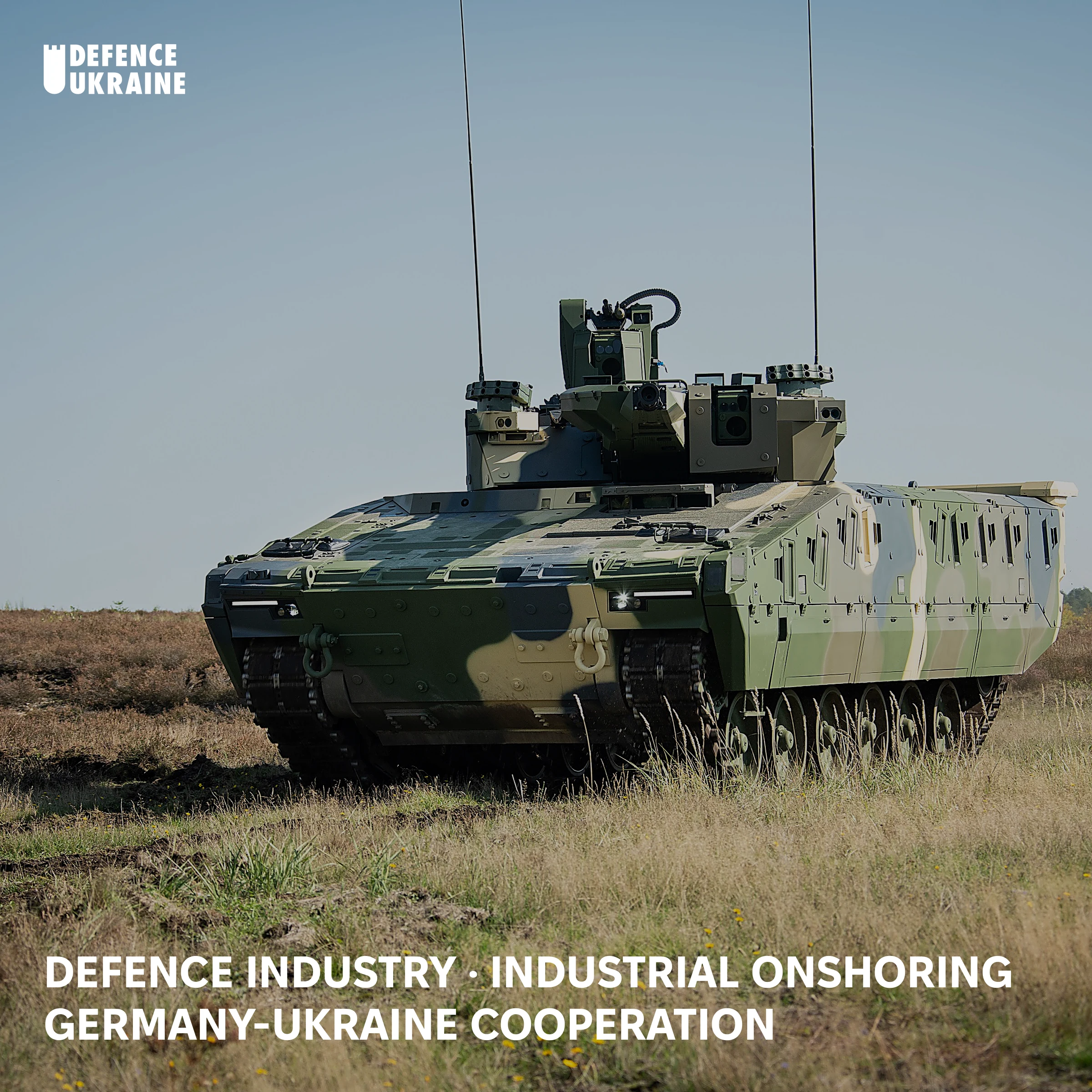
Of the four announced factories, the Lynx infantry fighting vehicle line is the most concrete. A December 2025 contract worth a mid double-digit million euros, financed entirely by the German federal government, delivers an initial five vehicles in early 2026. The Ukrainian configuration carries Rheinmetall's two-man Lance 2.0 turret with a 35mm autocannon, layered active, passive, and reactive armour, and accommodates a crew of three and eight dismounts. The first five are assembled in Germany; CEO Armin Papperger has stated that establishing a full-scale Ukrainian production line is economically viable only at procurement volumes of 200 to 300 vehicles. Until that order is signed and financed, the Ukrainian assembly facility remains an announcement rather than a production line.
The third announced factory targets air defence systems. The strategic logic is not commercial expansion. Without dedicated on-site production of 35mm AHEAD airburst munitions for Skynex and Gepard, the other three factories sit exposed to Russian Shahed and Geran loitering munitions. The air defence factory is a self-protective overlay for the rest of the footprint, not a stand-alone business line. The fourth factory, dedicated to gunpowder and propellants, addresses the chemical-synthesis bottleneck that has constrained European artillery output across the war. Rheinmetall's 2024 acquisition of the German nitrocellulose producer Hagedorn-NC has insulated its German lines; the Ukrainian gunpowder plant would close the equivalent loop inside Ukraine, completing the artillery kill chain from chemical synthesis through propellant manufacture, shell assembly, and final delivery to Ukrainian fire units.
The Unbuilt Plant
The artillery shell plant signed in July 2024 has not been built. The contract committed to a 24-month timeline targeting initial production by summer 2026. As of May 2026, the site has been identified but ground has not been broken. The summer 2026 production target is unachievable.
Rheinmetall's recent industrial track record makes the delay analytically conspicuous rather than ordinarily slow. The company built a new ammunition plant at Unterlüß in 15 months and a 30mm production line in Hungary in 18 months. A 2.5-year stagnation on the Ukrainian plant is not a function of engineering or capital intensity. The official explanations have shifted across the past year. In August 2025, Rheinmetall cited "Ukrainian bureaucracy". By November 2025, the public narrative attributed the delay to the Ukrainian side requesting a change in the planned location. By early 2026, Papperger stated that the site had been identified but that "regulatory issues" remained unresolved and the project was "waiting for civilians to complete the work". In parallel, the political freeze on the €60 billion Ukraine Support Loan throughout the first quarter of 2026 left Papperger publicly noting that Rheinmetall held warehouses of artillery ammunition and FV-014 Raider loitering munitions that Kyiv could not buy because the funding line was blocked.
The reading consistent with the timeline data is that physical construction in a contested wartime environment with imported capital, layered regulatory approvals, site-hardening requirements against Russian targeting, and dependence on multilateral funding cycles is the binding constraint. Announcement velocity is high. Construction velocity is not. Defence Ukraine's first-year tracker of SAFE implementation covered the EU disbursement schedule's structural lag against Ukrainian wartime tempo; the Rheinmetall artillery plant is the Rheinmetall-shaped version of the same problem.
Romania, the Earnings Call, and the Supply-Chain Question
The 30 April 2026 Romanian Lynx selection is the parallel demand stream that gives the Ukrainian onshoring its commercial logic and its competitive headache. Romania ordered 298 Lynx KF41 vehicles to replace its Soviet-era MLI-84 fleet, with 232 financed via the EU SAFE programme and 66 via the national defence budget. The selection beat the BAE Systems CV90, the Hanwha K21, and the GDELS ASCOD 2, driven by local production commitments to Romanian firms including Automecanica Mediaș and Romtehnica. The total programme is valued at €2.6 billion (roughly $4 billion).
Rheinmetall's Q1 2026 earnings call on 7 May 2026 confirmed the financial-signal picture. Consolidated sales reached €1.938 billion, an 8 per cent year-on-year increase; the operating result rose 17 per cent to €224 million; the order backlog reached €73 billion. Approximately €300 million in expected Q1 deliveries shifted into Q2, comprising roughly €200 million in tactical trucks and €100 million in powder production delayed by acceptance testing on explosives. The arithmetic for Ukraine is sharper. Ukraine's stated 2026 artillery requirement is 1.2 million 155mm shells. Rheinmetall's confirmed offer is 100,000 extended-range (60-kilometre) shells delivered out of German production, around 14 per cent of the company's current European output of 700,000 rounds per year. The European capacity expansion targets one million rounds annually by the close of 2026 or 2027. The gap between Ukrainian requirement and combined European supply is what the four-factory Ukrainian footprint is designed, eventually, to close.
The Romanian order alters the industrial calculus. If Ukraine secures financing for the 200 to 300 vehicle Lynx run that triggers Ukrainian assembly, it competes directly against Romania, Italy, and Hungary for the same Tier-1 and Tier-2 component allocations: optics, advanced armour plating, engine blocks. Rheinmetall's announced fourth-factory gunpowder line in Ukraine and the Hagedorn-NC vertical integration in Germany are the two structural responses to the equivalent contention on the artillery side. Whether the supplier base can serve a Ukrainian Lynx programme alongside Romanian, Italian, Hungarian, and current German Bundeswehr orders without significant delay is the open commercial question.
The Bilateral Channel and the SAFE Pathway
The political model underpinning Rheinmetall's Ukrainian footprint is bilateral, not multilateral. The December 2025 Lynx contract is funded entirely by the German federal government. The Liutyi deep-strike drone contract Germany signed with Antonov for over €100 million in July 2025 follows the same pattern. The Dutch government's funding of 150 Milrem Robotics THeMIS unmanned ground vehicles, with assembly at VDL Defentec in the Netherlands, is the analogue from a different capital. Defence Ukraine's analysis of the European MALE UAV gap and Ukrainian industrial substitution traced the broader pattern: when European member states treat the relationship as direct procurement rather than as multilateral aid, capital reaches Ukrainian or Ukrainian-integrated production at speed.
SAFE supplies the medium-term funding pathway. The May 2025 SAFE regulation imposes a 65 per cent EU/EEA/EFTA/Ukraine origin requirement on financed equipment, with Ukrainian-manufactured value counted alongside German, French, or Spanish for compliance purposes. Rheinmetall's Ukrainian-assembled Lynx vehicles and locally produced 155mm shells will clear that threshold cleanly. SAFE Phase 1 disbursed €38 billion across eight member states in January 2026; Poland confirmed an additional €43.7 billion on 2 May 2026. SAFE Phase 2 opens before 31 December 2026. The €60 billion military portion of the Ukraine Support Loan, frozen for the first quarter of 2026 by a Hungarian veto and unblocked in late April 2026 after the Hungarian election, begins flowing in Q3 2026. Rheinmetall's Ukrainian programmes are eligible for both funding lines, though the artillery plant's track record argues that disbursement availability and construction availability are governed by different timelines.
The political stakes in Berlin sit above the funding mechanics. The cross-party defence consensus among the SPD, Greens, and CDU/CSU that has held since 2022 underwrote the December 2025 Lynx contract. The agreement between the CDU/CSU and SPD in 2026 to exempt defence spending above 1 per cent of GDP from the constitutional debt brake, and the proposed €500 billion infrastructure fund, give Berlin the sovereign capital to bilaterally finance Ukrainian production even when multilateral EU mechanisms fail or stall. That fiscal headroom is the structural answer to why the bilateral channel currently outperforms SAFE: not because SAFE rules are wrong, but because Germany has the surplus capital and Brussels has the procedural lag.
The political stakes in Kyiv sit alongside. Russia has named Rheinmetall infrastructure inside Ukraine as a "legitimate target", in the words of Kremlin spokesman Dmitry Peskov, and German and US intelligence services thwarted a Russian assassination plot against Papperger in mid-2024. The "Built in Ukraine" framing of the Ukrainian Ministry of Strategic Industries treats domestic production as the foundation of post-war reconstruction and a future export base. Rheinmetall has hedged the headcount question by investing €300 million in a new German ammunition factory creating 500 local jobs at the same time as it expands inside Ukraine. The dual-track expansion is the implicit promise that holds the German Bundestag consensus together. The contrast with the offshore-assembly model represented by Quantum Frontline Industries' production line near Munich, which delivered its first batch of Linza 3.0 bomber drones to Ukraine in April 2026 after Quantum Systems acquired a 10 per cent stake in Ukraine's Frontline Robotics a year earlier, is structural: heavy onshore prioritises sovereign Ukrainian capability and mass; offshore assembly prioritises speed and security; both will operate in parallel through 2027.
Strategic Implications for Ukraine
- The four-factory model is a template, not a finished product. Rheinmetall has the deepest onshore footprint of any non-Ukrainian prime, and the headline announcement is genuinely consequential. But three of the four factories exist as commitments rather than as production lines. The maintenance hub is operational. The Lynx assembly line awaits a 200-to-300-vehicle order. The artillery plant has not broken ground. The air defence and gunpowder facilities are at earlier stages still. Ukrainian and European policymakers treating the announcement volume as production capacity overestimate the supply by the gap between commitment and construction. The next twelve months are the test of whether the commitments convert at the velocity the contracts implied.
- The construction-velocity gap is the structural lesson for SAFE Phase 2. The Rheinmetall artillery plant's 2.5-year delay against a stated 24-month timeline is empirical evidence that physical infrastructure in a wartime environment, even with proven primes and committed capital, runs slower than the EU funding architecture's modelling assumes. SAFE Phase 2 procurement design, due to open before 31 December 2026, needs to price in this lag. Specifically, the Czech Ammunition Initiative's continued willingness to source from outside the 65 per cent EU/Ukraine origin perimeter is the hedge against the construction risk on the European onshoring side. Without parallel non-EU procurement lines, a SAFE Phase 2 architecture built on the assumption that onshore Ukrainian production will close the EU shell shortfall is structurally fragile.
- The political infrastructure may matter more than the physical infrastructure. Cross-party German defence consensus, the 2026 debt-brake exemption above 1 per cent of GDP, the proposed €500 billion infrastructure fund, and the bilateral channel by which Germany funds Ukrainian production all sit on the political side of the equation. None of these are guaranteed to outlast the current parliamentary majority or the current chancellorship. The Rheinmetall model is dependent on the bilateral channel for its near-term financing and on SAFE eligibility for its medium-term sustainability. If either side of that dual-track funding architecture loses political support, the four-factory commitment loses its capital. Defence Ukraine's analysis of the €60 billion Ukraine Support Loan structure covered the precarity of unanimity-dependent EU mechanisms; the bilateral channel is no less precarious, just precarious in a different way.
- The "Built in Ukraine" question is the medium-term commercial question. The Rheinmetall facilities are designed for scale that will exceed Ukrainian peacetime consumption (the artillery joint venture is now publicly targeted to "far exceed" 150,000 shells annually). Post-war, those facilities will either continue producing for the Ukrainian Armed Forces, pivot to European export, or both. Each pathway reshapes the competitive dynamics of the European defence market and the relationship between Rheinmetall's Ukrainian operations and its German production base. Whether the German political consensus holds when Ukrainian-assembled Rheinmetall hardware starts undercutting German-assembled Rheinmetall hardware on the European export market is the question that will eventually test the dual-track expansion promise. Defence Ukraine's coverage of the broader Germany-Ukraine defence industrial cooperation traced the early phases of this relationship; the Rheinmetall four-factory model is its most concrete operational manifestation.
Conclusion
Rheinmetall's Ukrainian footprint is the most operationally consequential case of European prime contractor and Ukrainian industry integration. It is also a useful case study in the limits of onshoring. The maintenance hub works. The first five Lynx are arriving. The Q1 2026 financials are strong. The Romanian €2.6 billion Lynx contract gives the platform the European-scale demand stream that supports a Ukrainian production run if the order materialises. None of those facts dissolve the structural problem that an artillery plant signed in July 2024 with a 24-month timeline remains unbroken ground in May 2026. Whether the SAFE Phase 2 procurement cycle, the Q3 2026 disbursement of the Ukraine Support Loan, and the continued political support in Berlin convert the four-factory announcement into four operational facilities is the test of the next eighteen months. The German bilateral channel will probably get there. Whether it gets there at the velocity the contracts implied is the question Rheinmetall, the German government, and the Ukrainian Ministry of Strategic Industries have not yet publicly answered.
Defence Ukraine's analysis of Ukraine's air-defence pivot to Europe covers the parallel onshoring debate on the air-defence side, where the Fire Point and Diehl Defence Freya programme has hit the Mindich corruption shock that the Rheinmetall four-factory model has so far avoided.
Defence Ukraine's analysis of the European procurement standard built around Ukraine-tested combat data places the Rheinmetall four-factory case inside the wider European co-production catalogue and the BraveTech EU Phase 2 mandate now driving procurement assessment.
Defence Ukraine's analysis of the Ukrainian missile and long-range strike industry covers the symmetrical inverse model: Ukrainian-prime production financed through the Danish Model and bilateral German, UK, and Norwegian contracts, with Western prime contractors now extending sensor stacks into Ukrainian airframes through partnerships like Diehl-Fire Point Freya and MBDA-Luch Neptune-2.
Defence Ukraine's pre-summit primer on the 7-8 July Ankara NATO Summit names the Rheinmetall artillery plant slip as the visible operational lag against bilateral political commitment heading into Ankara, where the test is whether announcement converts into signed procurement.