The Russian federal budget deficit for the first five months of 2026 reached 6.01 trillion rubles, approximately $81.4 billion. The figure is up 98 per cent year on year. Federal oil and gas revenues fell 29.8 per cent over the same period to 2.98 trillion rubles, while wartime expenditures rose 17 per cent to 20.79 trillion rubles. The Russian Ministry of Finance figures, published in early June 2026, are the clearest single measure of where Ukraine's deep-strike campaign now sits.
Defence Ukraine's analysis of the 1-2 June 2026 saturation salvo on Kyiv traced the demand-side consequences of structural Patriot exhaustion. This piece is the supply-side complement. The Ukrainian Armed Forces' deep-strike campaign against Russian oil and gas infrastructure, which the Ukrainian Ministry of Defence describes as "long-range sanctions", has moved past the threshold at which it could be analysed as tactical pressure. May 2026 was the heaviest deep-strike month of the year. The cumulative effect, compounded by Western sanctions cutting Russian operators off from replacement refining equipment, is now degrading the Russian fiscal model.
The May Campaign and the St Petersburg Strike
The Ukrainian General Staff confirmed 18 successful strikes against Russian oil and gas facilities between 1 and 31 May 2026, the highest monthly total of the year (Euromaidan Press, 4 June 2026). The Unmanned Systems Forces commander, Major Robert "Madiar" Brovdi, characterised the cumulative effect on 20 May as "permanent disruption, by the numbers". The May targeting pattern broadened from primary crude distillation units to pumping stations, transshipment terminals, and maritime fuel hubs. The Lukoil-Nizhegorodnefteorgsintez (NORSI) facility in Kstovo was struck twice in May, the fourth time in seven months. The Ilsky refinery in Krasnodar Krai, struck again on 2 June, has now been hit at least sixteen times since 2022 (Kyiv Independent, 2 June 2026).
The strike on the St Petersburg Oil Terminal on 3 June, hours before the opening of the St Petersburg International Economic Forum (SPIEF), put the campaign onto international front pages. The Institute for the Study of War confirmed one large petroleum reservoir destroyed, six others structurally damaged, and two technical overpasses hit (ISW, 4 June 2026). Pulkovo Airport restricted airspace, mobile data services were cut across the city, and a United States delegation led by Rodney Mims Cook Jr. attended SPIEF as the city's largest northwestern oil-handling complex burned. President Vladimir Putin acknowledged the strikes publicly on 4 June: "to our regret, some of them break through" (Associated Press). The admission, made on the sidelines of the forum Russia uses to project economic invulnerability, was the rhetorical surrender of the Russian narrative of intact territorial defence.
What "Forty Per Cent" Actually Means
President Volodymyr Zelensky stated on 1 June 2026 that approximately 40 per cent of Russia's primary refining capacity had been disabled (Ukrinform). The headline figure is widely cited; it is also widely misread. Independent energy-market analysis distinguishes between cumulative nameplate capacity affected and simultaneous effective throughput loss.
Reuters' mid-May calculation placed Russian crude processing offline at approximately 700,000 bpd across 16 disrupted sites, roughly double the disrupted capacity at the same point in 2025. S&P Global Commodity Insights estimated that 12 per cent of Russia's total refining capacity was completely offline by March 2026, up from 7 per cent in January. Bloomberg and OilX pegged May 2026 processing volumes at 4.58 million bpd, a 13 per cent year-on-year decline. JPMorgan analysts calculated a structural 500,000 bpd decline, equating to a 10 per cent decline in absolute national throughput. The International Energy Agency cut its 2026 forecast for Russian refining throughput by 150,000 bpd, reducing the baseline to 5 million bpd, and directly cited the escalation of Ukrainian attacks as the cause.
The Vakulenko distinction is the strongest empirical counter to Zelensky's figure. Damage to an atmospheric-vacuum distillation column at a given facility does not perpetually shut down the entire refinery; lighter fractions are lost but heavier products can still be produced. Sergey Vakulenko, a non-resident scholar at the Carnegie Russia Eurasia Center, assesses that simultaneous real-time effective throughput loss sits at 13 to 17 per cent. The 38 to 40 per cent figure aggregates the total processing potential of every facility hit since 2024.
George Voloshin's forecast in The Insider's article 286463 explains why the gap matters less over time than the headline reading suggests. Western sanctions prevent Russian operators from acquiring replacement processing valves, sensors, and AVT components from European or American manufacturers. Operators are cannibalising functioning equipment to repair damaged units, structurally degrading the industry. Voloshin projects a sustained 25 per cent shutdown over the next six to twelve months. The headline cumulative figure converges over time with the effective throughput figure as substitution closes the gap from below.
The Budget as the Clearest Measure
The Russian Ministry of Finance's January-May 2026 report quantifies the strategic consequence. Oil and gas revenues' share of the federal budget, which sat above 50 per cent across 2011 to 2014, has compressed to approximately 23 per cent in the 2025 to 2026 period (bne IntelliNews). The 29.8 per cent year-on-year drop in those revenues for January to May 2026 indicates the campaign's effect is now compounding through a tax architecture explicitly designed around refining downstream output.
The structural mechanics matter. The Mineral Extraction Tax (NDPI) applied at the wellhead, the Tax on Additional Income (NDD), corporate income tax flows from Rosneft and Gazprom, and refined-product export duties together comprise the architecture. A "tax manoeuvre" over recent years gradually reduced export duties and replaced them with NDPI, on the assumption that operators would refine crude rather than export it raw (Carnegie Endowment, 2026). With refining capacity now constrained, Russia exports higher volumes of unrefined crude at the G7 price cap. Ural crude averaged $64.4 per barrel through the first half of 2026, sustained at a structural discount via shadow-fleet sanctions evasion costs and the monopsony purchasing power of India and China (Re:Russia, 2026).
The pressure is showing up in second-order effects. Russian fuel shortages now affect approximately 60 regions, prompting emergency rationing in occupied Crimea, Sevastopol, Kursk, the Moscow region, and St Petersburg (The Insider, June 2026). Deputy Prime Minister Alexander Novak appealed to Prime Minister Mikhail Mishustin to lift the 2016 ban on monomethylaniline as a motor fuel additive for six months. The compound is a known carcinogen banned for documented public-health risks. The Promsyrieimport agency is contracting gasoline imports of approximately 150,000 tons per month from China, South Korea, Singapore, and Belarus, subsidised through the federal damper mechanism. The Russian civilian fuel queue is the bystander effect of a campaign aimed at the war-funding apparatus, not its target. The damper subsidies haemorrhage federal reserves while the strikes continue.
The Weapons Mix and the Industrial-Base Question
The current Ukrainian deep-strike inventory is built around indigenous platforms because Western prohibitions on the use of supplied munitions against Russian territory remain in force. The Trump administration continues to prohibit the MGM-140 ATACMS, the Storm Shadow and SCALP-EG cruise missiles, and the Ground-Launched Small Diameter Bomb against Russian targets. Defence Ukraine's analysis of the Western MALE drone gap covered the broader pattern: Ukraine has had to substitute attritable mass for exquisite Western platforms across the strike spectrum.
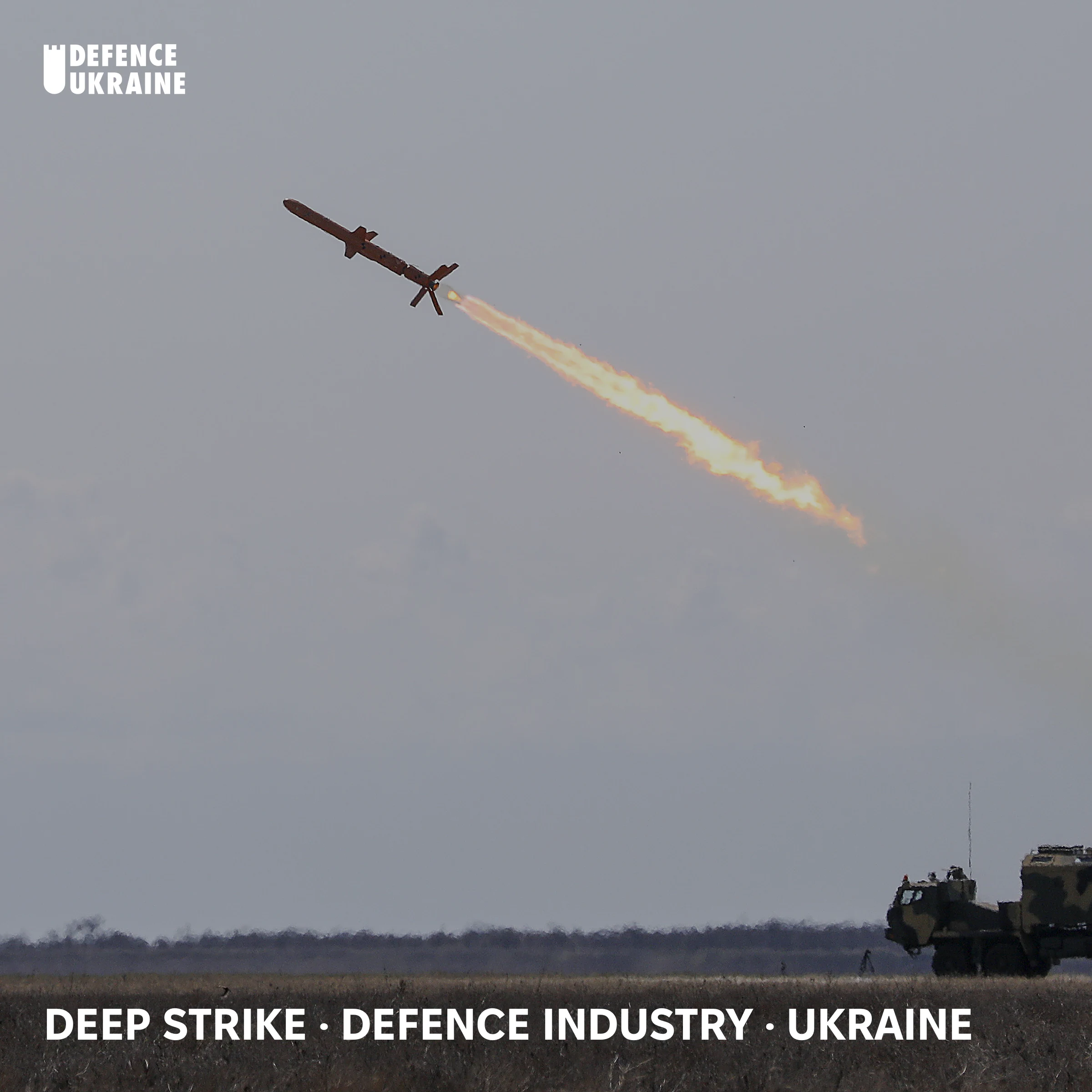
The May-June 2026 campaign is carried predominantly by Antonov's AN-196 Liutyi, a UAV cruise-missile hybrid with a 50 to 75 kg warhead and a 1,000 to 2,000 km range. Liutyi swarms have struck most of the central Russian refinery targets through 2026. The R-360 Neptune cruise missile, structurally modified by the Luch Design Bureau from anti-ship to land-attack profiles, struck the Novoshakhtinsk refinery in Rostov Oblast on 31 May (Ukrainian Navy, 3 June 2026). Other documented platforms include the Palianytsia jet-powered rocket-drone (100 kg warhead, 650 km range, revealed at MSPO 2025) and Fire Point's FP-1 deep-strike UAV.
The Fire Point FP-5 Flamingo is the platform around which the most ambitious industrial claims circulate. The missile carries a 1,150 kg warhead to a claimed 3,000 km range and is reportedly the platform behind successful strikes on the Votkinsk plant in Udmurt Republic, which produces the Russian Iskander-M and Kinzhal missiles. Fire Point manufactures approximately 97 per cent of components in-house and has stood up a solid-rocket-fuel plant in Denmark to secure NATO-standard propellants (Second Line of Defense, April 2026). An FP-9 ballistic missile is reportedly slated for fielding by summer 2026.
The Flamingo industrial story has, however, attracted parliamentary scrutiny. Serhii Rakhmanin, a Member of the Verkhovna Rada sitting on the national security, defence and intelligence committee, told NV on 8 June 2026 that the Flamingo had received "crazy, very aggressive promotion" by its corporate developers while being "deployed extremely rarely and not very successfully" in combat. Rakhmanin demanded that the claims for the FP-9 follow-on be backed by "concrete things, concrete steps" rather than corporate press releases. The structural industrial promise of Fire Point's manufacturing model is genuine. The current battlefield reality, on Rakhmanin's parliamentary reading, lags the marketing. Honest accounting matters here: the campaign's effectiveness in May 2026 was carried by Liutyi attritable mass and Neptune cruise-missile adaptation more than by Flamingo strategic-missile saturation.
The legal basis for the campaign is established. Article 52(2) of Additional Protocol I to the Geneva Conventions defines as military objectives those facilities whose total or partial destruction offers a definite military advantage. Casey Biggerstaff, writing for the Lieber Institute at West Point, characterises the consensus position: "oil installations of every kind are in fact legitimate military objectives open to destruction". Russian state media framing of the strikes as "terrorism" is propaganda, not legal analysis.
Russia's Counter-Response Is Premeditation, Not Retaliation
The Defence Intelligence of Ukraine (DIU) chief, Oleh Ivashchenko, briefed President Zelensky on 2 June 2026 that Russia had explicitly identified Ukrainian missile developers, particularly the Fire Point production network, as Russia's priority target for the summer 2026 air campaign (Ukrinform). Russia launched a saturation salvo against Kyiv and Dnipro the same night: 73 missiles and 656 drones, including 33 Iskander-M ballistic missiles and 8 Zircon hypersonic cruise missiles. DIU assessments place Russian Iskander-M monthly production at approximately 55 to 60 units. The 33 launched in a single night expended over half of monthly capacity in one operation. This is strategic premeditation aimed at the Ukrainian industrial base, not retaliation for any specific Ukrainian strike. The Kyiv Independent's analysis of 4 June 2026 made the point explicitly: Russian strikes on Ukrainian energy and industrial infrastructure are not "revenge" for Ukrainian refinery strikes. They are an independent strategy with a different target and a different rationale.
On 5 May 2026 Ukrainian strikes hit the VNIIR-Progress plant in Cheboksary, the primary Russian manufacturing hub for the "Kometa" anti-jamming navigation modules used to guide Russian guided weapons through GPS-spoofed environments. Degrading Russian counter-EW production degrades the accuracy of subsequent Russian ordnance against Ukrainian air defences. The supply-chain effect compounds the operational one.
Russian frontline fuel logistics have visibly broken under the campaign. The ATESH partisan network reported on 5 June 2026 that Russian troops on the P-280 "Novorossiya" supply highway from southern Russia into occupied territory have been forbidden from using identifiable fuel tankers. Russian forces are requisitioning civilian vehicles, including bread vans, postal vans, and ambulances, to move 20 to 1,000 litre fuel containers to the front; drivers are forbidden from wearing military uniforms (Euromaidan Press, 5 June 2026). The use of protected civilian transport, particularly civilian medical vehicles, for military fuel logistics is a violation of Articles 37 and 38 of Additional Protocol I.
Strategic Implications for Ukraine
The fiscal mathematics of the campaign have a one-to-two-year horizon. Three implications follow for Ukrainian and European force planners.
- The campaign has crossed from tactical pressure to structural fiscal degradation. Russia is not absorbing the strikes through its standard operational redundancy. The 6.01 trillion ruble January to May 2026 deficit, the 29.8 per cent year-on-year drop in oil and gas revenues, and the 98 per cent year-on-year deficit increase are not statistical noise. The campaign is compounding through a tax architecture designed around refining downstream output. The sanctions-driven cannibalisation thesis (Voloshin) explains why the gap between Vakulenko's 13 to 17 per cent effective throughput estimate and Zelensky's 40 per cent nameplate figure will close from below over the next six to twelve months. The Western policy question is whether to provide additional tools to maintain the campaign tempo through Q3 and Q4 2026, when the fiscal pressure compounds.
- The Flamingo industrial story is real but not yet load-bearing. Fire Point's 97 per cent in-house manufacturing model, the Danish solid-rocket-fuel plant, and the FP-9 follow-on indicate genuine industrial development. Rakhmanin's parliamentary critique on 8 June 2026 indicates the Flamingo's actual combat deployment lags its corporate promotion. The May 2026 campaign was carried predominantly by Liutyi attritable mass and adapted Neptune cruise missiles. European force planners considering procurement parallels through the EDIP Ukraine Support Instrument and BraveTech EU calls now opening should differentiate between the industrial scaling Fire Point credibly represents and the strategic-missile claims that have not yet been fielded at scale.
- The Russian targeting shift to the Ukrainian missile industry is the inverse of Western complacency about the campaign's effectiveness. Russia would not expend over half of monthly Iskander-M production in a single saturation salvo if Moscow assessed the Ukrainian deep-strike capability as marginal. Defence Ukraine's analysis of the 1-2 June salvo covered the demand-side consequences of structural Patriot exhaustion; this piece traces the supply-side complement. The same calculus drives both: Russia perceives the deep-strike capability as a strategic threat and is allocating ballistic stock accordingly. European procurement frameworks providing air defence for Ukrainian industrial facilities now have a direct connection to the campaign's continuity, not merely to humanitarian protection of Ukrainian cities.
Conclusion
Defence Ukraine's analysis of Operation Spiderweb traced the deepest single-strike operation Ukrainian forces have executed against Russian strategic assets. The May to June 2026 campaign is the routinised, systemic version of that capability, applied to the part of the Russian state that matters most for the war's sustainability: the federal budget. Putin's 4 June admission that "some of them break through" was the rhetorical surrender of the Russian narrative of intact territorial defence. The Ministry of Finance's January to May budget report is the material surrender of the Russian fiscal model. The next two quarters will determine whether the campaign's effects compound into a structural break or whether Russian substitution via Asian gasoline imports, emergency additive deregulation, and shadow-fleet crude export stabilises the position. The federal budget is the most consequential battlefield. The campaign that targets it is, by every applicable legal and operational standard, a legitimate one.
Defence Ukraine's analysis of the Ukrainian missile and long-range strike industry behind this campaign covers the manufacturers, the financing architecture, and the 2 June DIU brief naming Ukrainian missile production as Russia's summer 2026 priority target.
Defence Ukraine's analysis of Russian air-defence depletion under this campaign traces the exchange-cost economics: Ukrainian $4,000-$1.5 million strike platforms forcing Russia to expend $500,000-$3.73 million interceptors at a rate CBS News reported as "possibly at an unsustainable rate" per Rob Lee at FPRI.