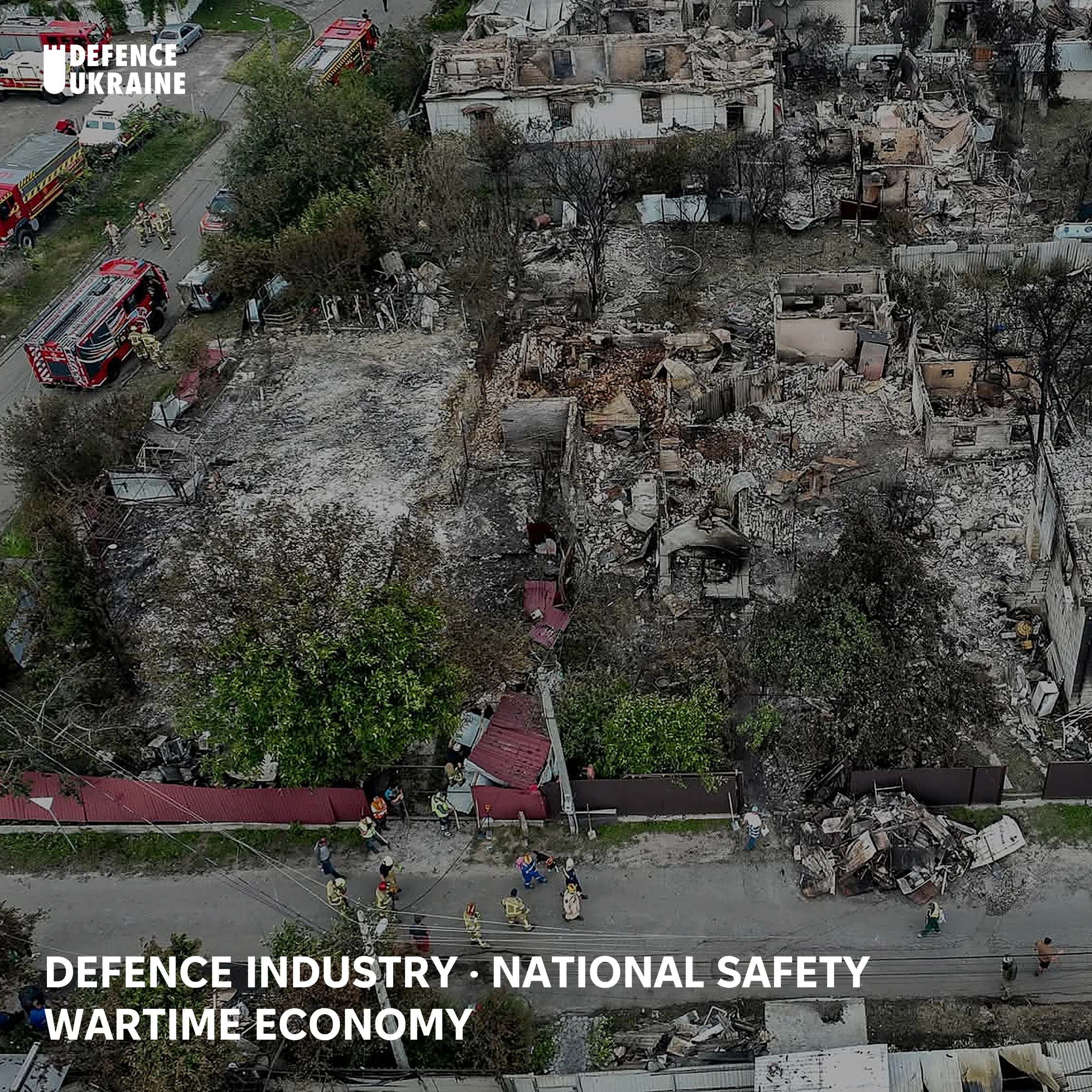
Eighteen metres. Kyiv Oblast prosecutors recorded that exact separation between a state-owned munitions warehouse in Vyshneve and the nearest private house, after a Russian Iskander missile struck the site on the night of 6 July 2026. The missile started the fire. What the blaze reached, and how the exploding ordnance tore through the surrounding streets, killed seven people, injured 29, drove more than 600 residents out of their homes and wrecked roughly 13 hectares of housing on the western edge of Kyiv.
Eight weeks later the pattern repeated, and the human toll proved five times worse.
The Separation Distances Ukrainian Law Already Banned
Kyiv Oblast prosecutors gave precise figures for what they discovered at Vyshneve. Less than 18 metres stood between the ordnance and the closest private house. Around 24 metres separated the depot from the nearest blocks of flats. The buildings housing the inventory, prosecutors said, lacked proper designation for ammunition and held no valid permit documents. Prosecutor General Ruslan Kravchenko's office charged the enterprise's general director and his deputy under Article 367 of the Criminal Code for official negligence, applying the aggravated provisions that govern negligence causing death. Prosecutors asked the court to remand both men in custody without bail.
A single line in the prosecutorial summary captures the core problem behind both disasters: the Russian missile was the initial cause, but the scale of the secondary blast came directly from disregarding basic safety rules.
The regulations in question are not obscure. Ukrainian State Building Norms set standoff distances for explosive storage based on hazard class, net explosive quantity and adjacent population density, requiring major standalone explosive facilities to sit several kilometres from built-up areas. NATO's equivalent standard, the Allied Ammunition Storage and Transport Publication AASTP-1, applies quantity-distance tables where mandatory clearance scales mathematically with explosive weight and hazard division. Under either framework, holding mass-detonating munitions 18 metres from an occupied dwelling is not a marginal breach or a rounding error on a permitted distance. No quantity of high explosive is small enough to make it compliant.
Martial law offers the obvious legal shield. That defence does not appear to exist. Nothing in the prosecutorial filings of July or August points to a wartime derogation suspending siting rules for military explosives, and the charges rest on the baseline that peacetime statutory limits remain binding. That distinction matters more than it looks. A relaxed wartime standard would turn Vyshneve into a policy failure. The lack of one leaves it as a choice by operators to bypass an active rule, solving a storage shortage nobody had funded a lawful answer to.
Eight Weeks Without Action
Around 20:00 on Friday 28 August 2026, a strike hit a storage site in the village of Myla, in Kyiv Oblast's Bucha district. Ukrainian officials described it as a drone strike. Flames ignited stockpiled shells, mines and drones, and secondary detonations continued long enough that the National Police closed the M-06 Kyiv-Chop highway between the 15 and 32 kilometre markers in both directions. Emergency services evacuated more than 370 residents, 59 of them children.
Most of the dead had no connection to the warehouse. Thirty-four of the 38 confirmed fatalities were residents of Dobryi Dim, a care home for elderly and disabled people situated closest to the centre of the blast. Taras Didych, mayor of the neighbouring Dmytrivka community, was killed while trying to get people out. The official count climbed across the weekend, rising from 27 on the morning of 29 August to 37 by that afternoon and 38 by 30 August, with four people still missing. Ukrainska Pravda put the injured at 52.
"Ammunition cannot be stored near homes or other residential areas," President Volodymyr Zelensky said on 29 August, adding that those who had allowed it must answer for their decisions. Investigators opened criminal proceedings for official negligence, the same article charged at Vyshneve.
Who ran the Myla depot remains contested. Ukrainian officials described a Defence Forces facility. The Russian Ministry of Defence claimed the site belonged to the private manufacturer Fire Point and held components for its long-range drones. Ukraine has issued no retraction of its own characterisation, and authorities have withheld the specific unit or logistics command holding the stock on operational security grounds. Prosecutors had not publicly named the operating enterprise as of 31 August.
On 29 August the Ministry of Defence ordered all leaders in the security and defence forces, together with defence industry representatives, to conduct "a full audit of weapons and ammunition storage sites".
Its date makes that ministerial directive the most damaging record in the sequence. Vyshneve happened on 6 July. Dismissals came on 12 July, detentions on 16 July, and the Prosecutor General's office published the 18-metre measurement in the same window. Every institution overseeing the estate knew by mid-July that munitions sat inside the blast radius of occupied housing across the Kyiv agglomeration, and that this was already illegal. Fifty-three days later, a care home two hours' drive from the first site burned down with 34 people inside it. The estate-wide audit was ordered the day after.
Why the Stockpiles Sit Where They Do
Ukraine did not choose this storage estate. It inherited one, and the inherited network was already hazardous. The Soviet arsenal system handed over in 1991 was sprawling, above ground and badly managed, and it destroyed itself twice in peacetime without any help from an adversary: Kalynivka in Vinnytsia Oblast in 2017, which forced 30,000 people out of their homes, and Ichnia in Chernihiv Oblast in 2018. Ukraine responded with a dispersal and hardening programme. The programme was still incomplete when the full-scale invasion began.
The logistical arithmetic then turned against planners from both directions. Russian forces overran, destroyed early, or rendered unusable by proximity to the front major pre-war storage sites in the east and south. At the same time the volume needing storage rose steeply, driven by donated Western artillery ammunition and by the scaling of domestic output that Defence Ukraine has tracked in its analysis of Ukraine's missile industry. Less space, more stock. Commercial warehousing, industrial estates and logistics hubs built for pallets of consumer goods absorbed the overflow.
Most of that emergency capacity clustered around Kyiv, and the rationale is defensible on its own terms. The capital sits under the densest layered air-defence coverage in the country, a concentration examined in Defence Ukraine's assessment of Ukraine's air-defence reserve under saturation attack, and it is the junction of the road and rail network and the centre of gravity for the defence-industrial workforce. Storing munitions where the interceptors are is sound logic for protecting munitions.
It also means, unavoidably, storing munitions where the people are. The best-defended airspace in Ukraine sits directly over some of its densest housing. When a drone gets through, or when debris from an intercept hits a soft-skinned building holding shells, the blast radius is full of flats and care homes. The siting decision optimised for air protection and ignored ground-level exposure.
Dispersal remains the standard doctrinal answer, and its cost is arithmetic. Splitting a 1,000-tonne depot into fifty 20-tonne nodes cuts the loss from any single strike by 98%, and multiplies permitting, guard forces, climate control and transport movements by fifty. No funded national dispersal policy has been published that addresses that multiplication.
Hardening Protects Stocks. Distance Protects People.
A fair counter-argument deserves scrutiny: could any achievable storage architecture have survived these strikes? Almost certainly not. A 9M723 Iskander delivers a penetrating warhead of around 500 kg at terminal velocities that give Kyiv's air defences a few minutes of reaction time. No above-ground warehouse that Ukraine could build quickly and afford at scale survives a direct hit from that.
Which is why Vyshneve and Myla were siting failures rather than protection failures. A direct hit was always going to destroy the stock. The people around it did not have to die. These are two separate problems with two separate solutions, and conflating them has muddied public debate since July. Hardened, bermed, subterranean construction keeps the munitions usable. Remote siting keeps the neighbours alive. Cheap peri-urban warehousing delivers neither, which is why both sites lost the stock and filled the casualty lists as well.
The prosecutions reflect that divide. Nobody has been charged with failing to stop an Iskander. Two men are in custody for where the pallets were.
The Operational Mirror Turned Inward
There is an uncomfortable symmetry here, and stating it plainly is better than avoiding it. Through 2024 and 2026 Ukraine has run a sustained campaign against Russian rear-area logistics, striking arsenals, depots and the refineries analysed in Defence Ukraine's work on the deep-strike campaign against Russian energy infrastructure. The case Ukraine and its partners make for those operations is that destroying stored munitions degrades combat power at the front, forces inefficient dispersal, and costs the adversary more than the strike costs the striker.
That argument does not lose its force when the geography reverses. Myla and Vyshneve were civil-defence catastrophes and successful Russian interdiction of Ukrainian combat power in the same event. Treating them only as atrocities understates what Russia achieved, and understating it makes the fix harder to fund.
Russia has already adapted to the pressure by pulling major depots beyond the reach of the systems hitting them and leaning harder on hardened railheads. Ukraine faces the same requirement with far less territory to retreat into, and with the additional constraint that most of its remaining depth is where its civilians and its industry also are.
What was actually lost at the two sites remains classified. No Ukrainian official or independent analyst has published an assessment of the effect on front-line supply, and the silence is deliberate: publishing the tonnage would hand Moscow a battle damage assessment it cannot otherwise obtain. The consequence for public policy is that the strongest argument for spending money on storage, the operational one, is the argument nobody is allowed to make with numbers.
What Safe Storage Costs, and Who Pays
Hardened and bermed magazines built to AASTP-1 separation standards solve both problems at once, but they are the slowest and most expensive option on the table. They need specialised concrete, heavy plant and multi-year construction programmes, and a national retrofit runs into hundreds of millions of dollars. Ukraine has been pointing its concrete and machinery at front-line fortifications in Donbas, which is a defensible priority and leaves the rear estate unhardened.
Relocation to rural or forested sites is far cheaper and solves the casualty problem rather than the stock problem. The cost lands on the logistics tail: longer runs on worse roads, more fuel, and more convoy movements exposed to aerial interdiction.
Just-in-time delivery from factory or border straight to the front removes the magazine from the equation entirely, and removes the reserve with it. A struck factory or a severed rail line then translates into ammunition starvation at the front within days rather than weeks. That trade between exposure and resilience has not been publicly acknowledged in Ukrainian policy, and it is the trade that determines how much storage the country actually needs.
The funding architecture shows the clearest gap. Direct-financing arrangements pay Ukrainian manufacturers to build weapons inside Ukraine, and the largest of them, examined in Defence Ukraine's analysis of the Danish Model at €1.3 billion, is explicitly structured around production output. So are the EU instruments geared to industrial scaling. None of them pays for a bunker. Every euro that raises output without raising protected magazine capacity widens the gap that produced Vyshneve. Ukrainian defence manufacturers also carry the full war risk on their own inventory, because no commercial insurer writes cover for it, which gives private producers a direct financial incentive to hand finished stock to overburdened state warehouses as fast as they can.
Strategic Implications for Ukraine
The estate deficit reaches well beyond civil defence, and four consequences will shape Ukrainian defence-industrial planning over the next six months.
- Storage is now a production constraint, not just a safety one. A finished shell or drone with nowhere compliant to sit creates a bottleneck at the factory gate. Magazine capacity takes months to build and production lines take weeks to expand, so output growth will keep outrunning protected storage unless capital is committed specifically to the latter. The constraint binds hardest on exactly the categories Ukraine has scaled fastest.
- The 29 August audit is the test, not the announcement. An order to audit is cheap and was already implicitly issued after Vyshneve. What would demonstrate a change is a published methodology, a funded relocation schedule, and evidence that sites failing the audit were emptied rather than noted. Nothing from the July response met that standard in the eight weeks available.
- Donor capital has a hole in it where facility protection should be. The financing instruments that have worked best for Ukraine buy units, not infrastructure. Redirecting even a small fraction of production financing into hardened storage would be politically awkward, because it funds concrete rather than weapons, but it is the intervention with the clearest civilian-casualty return per euro. Whether EU instruments can legally be pointed at it is an open question nobody has yet forced.
- Accountability is running through criminal law rather than estate policy. Two Ukroboronprom executives are in custody and further charges are likely over Myla. Prosecutions establish individual fault, but they do not relocate a single pallet. The institutional churn of the same period, including the Defence Ministry transition and the departure of the Defence Procurement Agency's leadership traced in Defence Ukraine's account of the procurement bench Khmara inherited, left the estate without anyone whose job was visibly to fix it.
Ukraine's storage architecture has not kept pace with either its own output or the extension of the Russian strike envelope, and the two failures compound. There is no rear area left in the sense the pre-2022 estate was designed around, and the peri-urban warehousing that replaced the lost depots was chosen for logistics convenience under an air-defence umbrella that was never going to hold every night.
The measurable tests arrive quickly. Whether the Ministry publishes anything from the audit it ordered on 29 August, whether the Vyshneve prosecutions reach trial, and whether European financing is ever earmarked for magazine construction will all be visible before the end of 2026. So will the ugliest test of all: if a third secondary detonation kills civilians in a populated area this year, the answer is that the Ukrainian state has priced their exposure in as a structural cost of holding a reserve.