Ukrainian lawmakers backed Yevhenii Khmara as Defence Minister on 19 August 2026 with 312 votes, 86 above the 226 needed. Thirteen days later, the civil servant running the body that handles the bulk of the ministry's procurement spending walks out the door. Arsen Zhumadilov tendered his resignation from the Defence Procurement Agency a day after lawmakers voted, taking effect on 1 September. The parliamentary count and the departure letter sit within one narrative, and the vote is the less revealing piece of it.
Khmara inherits a procurement apparatus thrown together at speed by a tight circle of officials who are mostly packing up their offices today. Its survival turns on legal mechanics: how much of the Fedorov-era setup is locked into Cabinet resolutions, and how much depended on the clout of the technocrats who drafted the rules.
The Parliamentary Vote and the Uniform
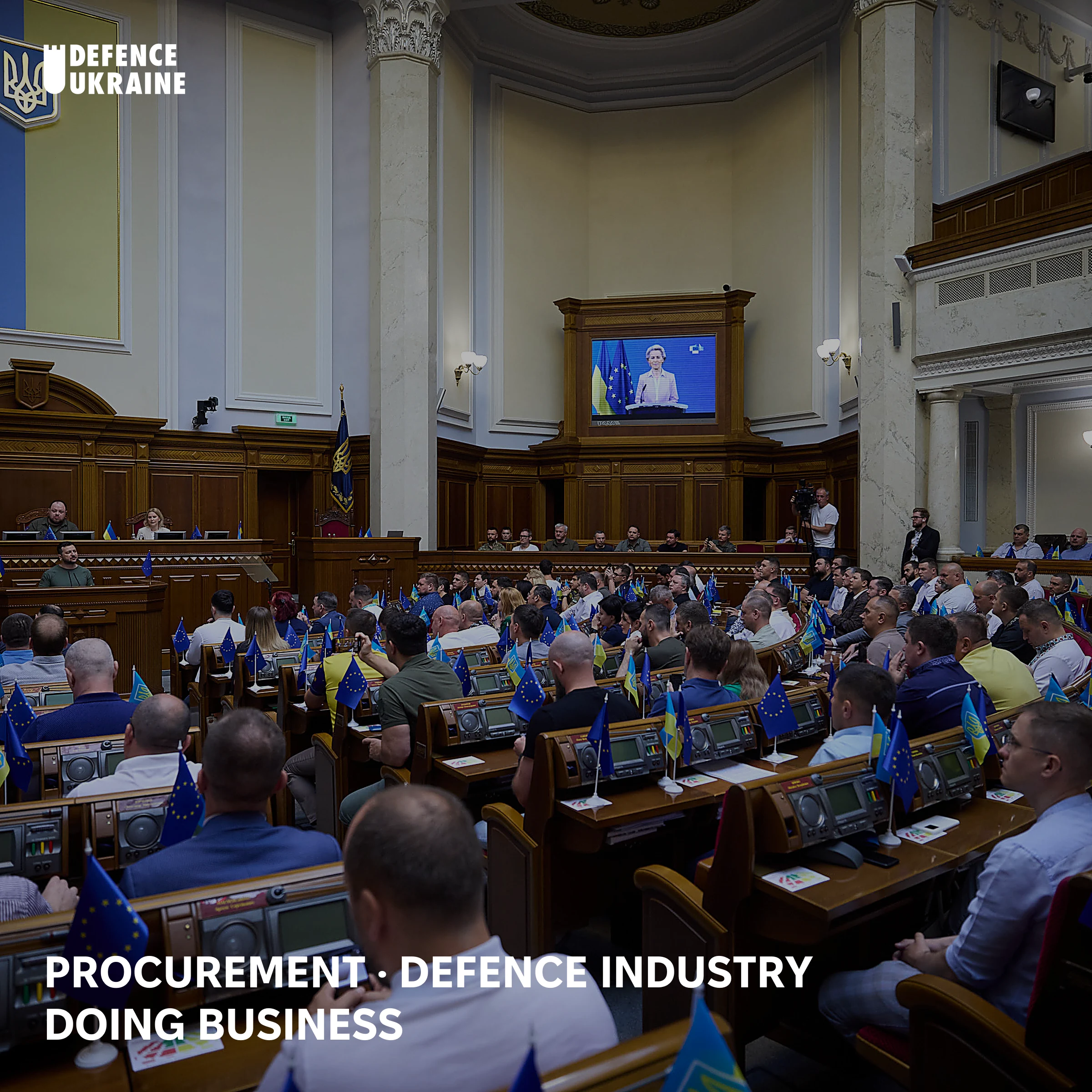
President Volodymyr Zelensky forwarded Khmara's name to the Verkhovna Rada on 18 August alongside acting Foreign Minister Andrii Sybiha's nomination for the foreign affairs brief. Party factions questioned the nominees across five hours that afternoon. The defence committee endorsed Khmara the next morning, before Halyna Mykhailiuk, the President's Representative in the Rada, introduced the nomination from the podium.
The majority was wide. Opposition lawmakers shouted their anger over Zelensky's absence from the hall during a major security vote, while street protesters answered the result with shouts of "Shame", extending the rallies triggered by Mykhailo Fedorov's sacking in July. Neither shifted the tally.
The anticipated stumbling block was his uniform. Under Ukraine's Law on National Security, the Defence Minister must be a civilian, but Khmara was an active Major-General. Media accounts on 17 August framed his rank as an outright legal barrier to the job. It was not. Replying to an MP's question on the floor on 19 August, Khmara said the armed forces had discharged him under Article 26 of the law on military duty through staffing adjustments for top brass. The Ministry of Defence gave the exact legal clause the following day: subparagraph (e) of paragraph 3, part 5 of Article 26, covering generals and admirals who lack an established posting and sit at the command's disposal. The ministry also dismissed claims of any medical discharge, saying Khmara remains in full health for military duties and takes up the ministerial portfolio as a civilian.
Swearing his oath, Khmara defined his priorities by firepower and deep strikes rather than purchasing systems. He told deputies that Ukraine will compel Russia to agree to a just peace using arms and technology, promising a larger arsenal of Ukrainian weapons hitting targets with greater precision. Procurement went unmentioned. That omission matches his remarks since stepping into the caretaker brief in July, offering the clearest signal yet that structural reform has lost its champion on the ministerial floor.
The Bench Empties
Ukrainska Pravda reported on 18 August that officials brought in under Fedorov prepared to follow him out of the ministry. Insiders pointed to a concrete bureaucratic problem: Khmara would assume control lacking both an immediate staff and nominees for top jobs, with vacancies stretching down into department directorates. The story omitted individual names, showing how fluid the departures remained as parliament moved to confirm him.
The walkout is not absolute. Mstyslav Banik, brought in as Deputy Minister in March 2026 to direct digital products and commercial reform, remains in post. He showed his continued presence through action rather than press releases: on 19 August, during the voting session, Banik issued simplified purchasing rules for military logistics, removing requirements to reauthorise supply schedules whenever fuel rates shift, using a 10 per cent indicative price cap as a guardrail. Here was a reform architect rolling out policy adjustments on the day an intelligence-vetted minister took charge.
Khmara has drawn talent from external pipelines as well. Serhii Boiev, named Deputy Minister for European Integration, brings private-sector and global financial experience: management stints at Naftogaz and Ukrgasvydobuvannya, a prior posting as Deputy Minister for Strategic Industries, and early career stops at JPMorgan Chase, Credit Suisse and BCG Ukraine. That is a commercial hire, not a security pick.
The deficit lies lower down. No public records reveal who now directs the departments managing conventional weapons or ties with the domestic defence-industrial base, and the ministry has named no appointees for those desks. For an agency that broadcasts every deputy-ministerial hire on its official wires, complete silence regarding department heads reveals plenty on its own.
Fedorov, for his part, has dropped all pretense of a quiet exit. Releasing a video statement on the night of 18 August, hours ahead of the confirmation vote, he raised alarms over a systemic governance crisis, said the entrenched administrative machine operates by its own rules and resists reform, and charged that parliament serves commercial interests across defence, pharmaceuticals, gambling and taxation. "Because parliament is the heart of Ukrainian democracy, not its wallet," he said. He also used the broadcast to urge restarting elections, maintaining that Russian aggression must not hold democratic processes hostage. An anonymous official in the Office of the President rejected the idea as showing a complete lack of realism.
This dynamic alters the political weight of the departures. A wave of staff walking out after a minister's dismissal looks like routine attrition. That same cohort departing while their ex-boss actively attacks the administration looks like a faction, and will be treated accordingly. The end result is that the specialists Khmara might have tapped to direct purchasing now count, by default, as the opposition's political cadre.
Zhumadilov's Departure and an Incomplete Board
Censor.NET reported on 20 August, quoting journalist Tetiana Nikolaienko, that Zhumadilov filed paperwork stepping down from the Defence Procurement Agency effective 1 September. The outlet cited his personal choice alongside ongoing friction with ministry leadership, noting that the resignation had been considered since early summer. His tenure ran until March 2027. He departs roughly six months early.
The organisation he vacates is the central procurement organ in Ukrainian military contracting. On 1 January 2026, the Defence Procurement Agency absorbed the State Logistics Operator, uniting arms purchases and field logistics under a unified management structure. Operating through the DOT-Chain Defence digital portal, the Ministry of Defence recorded deliveries of over 1.2 million items across 486 combat units during the past year, sourcing 1,181 products from roughly 300 domestic manufacturers and fulfilling requests within six to ten days on average. Defence Ukraine's assessment of Khmara's initial caretaker term identified Zhumadilov's status as the leading indicator of whether purchasing reforms would maintain momentum. That question is now answered.
Finding a successor complicates the picture. Artem Romaniukov, the head of the ministry's digitalisation department, steps in as acting director on 1 September. Under the rules, the agency's Supervisory Board must select a permanent chief through open competition, yet the board currently lacks the ability to stage a contest. Only three members hold seats: state delegates Stanislav Haider and Taras Chmut, alongside a single independent director, Lukasz Stolarski. Two required independent posts, designed to guarantee corporate oversight, sit vacant, and appointing those figures falls to the ministry.
The ministry therefore installs the interim chief directly, while a full director cannot be chosen until the ministry fills the board seats responsible for running the selection. The German Marshall Fund captured the consensus among international backers in an August analysis titled with an unmistakable warning: Ukrainian defence procurement needs stability, not chaos.
Legal Foundations and Ministerial Signatures
The reforms Khmara inherits carry uneven legal standing, and lumping them under one broad "reform architecture" blurs the critical distinctions. Observers usually group four elements: the consolidated Defence Procurement Agency, the DOT-Chain Defence portal, mandatory vetting checks for contractors, and the fast turnaround of the Brave1 catalogue. In order, these stand upon a Cabinet resolution, a Cabinet resolution, a ministerial memorandum, and no statutory basis whatsoever.
The first two pillars are protected. Scrapping the merged agency would require ministers to overturn their own 2026 decree, while the procurement restructuring that unified acquisition under the body remains tied to NATO advisory teams and foreign donor conditions. DOT-Chain is even more resilient. Built on established, audited public procurement code rather than custom ministry software, the platform gained Cabinet clearance to purchase arms in June 2025, operates under pilot authority valid until 24 October 2027, and supplies 486 front-line units within nine days rather than nine months. Any minister attempting to dismantle it would face instant fury from frontline commanders, creating political friction few Ukrainian officials willingly risk.
The vetting screen rests on weaker ground. The YouControl verification framework signed by Khmara's team on 3 August requires integrity checks before signing contracts, but it lives only in a memorandum that a single minister could scrap on paper. In reality no official will tear it up, since dismantling anti-graft safeguards during wartime carries unacceptable political risk.
The fourth pillar lacks any statutory backing, and that is where performance will erode. DOT-Chain's six-to-ten day turnaround was never codified in law. That pace depended on managers ready to issue contracts first and inspect records later, backed by sufficient political capital to weather mistakes. Fedorov's six-month sprint establishing this system delivered results because the leadership traded administrative perfection for rapid field supply. Khmara's career background points toward the reverse priority. The digital tools remain in place; the willingness to push them at speed leaves alongside the outgoing team.
The Corruption File on His Desk
The National Anti-Corruption Bureau and the Specialised Anti-Corruption Prosecutor's Office launched a joint enforcement sweep, dubbed Forrest Gump, on the morning of 19 August, just ahead of the parliamentary vote. NABU claims an organised ring channelled UAH 150 million through a state lender to cover bail for Herman Haluschenko, the former energy minister currently indicted under the Midas probe. Detectives handed suspicion notices to the heads of both the supervisory and management boards at Sense Bank, the nationalised successor to Alfa-Bank Ukraine, while searching the residence of an active lawmaker. All individuals mentioned are presumed innocent, no charges have been tested in court, and Haluschenko denies all allegations in the original prosecution.
The political fallout hit immediately. Following NABU references to an unnamed deputy chief in the President's Office, Zelensky issued Decree No. 734/2026 that afternoon removing Iryna Mudra from her position after agents searched her home.
This investigation does not touch military contracts. Yet it defines the operating environment Khmara enters, shaping his purchasing choices in two distinct ways. It cements the supplier screening requirements in daily practice despite their fragile legal status, since no minister will cancel vendor integrity checks while anti-corruption detectives knock on the President's Office door. It also multiplies the personal legal exposure for any bureaucrat signing off on deals that might later draw prosecutorial scrutiny. That institutional caution, rather than software constraints within verification databases, will drag out procurement schedules over the autumn.
What International Backers Have at Risk
No foreign partner, EU body or multilateral lender has conditioned aid disbursements on keeping specific Ukrainian personnel in office. Up to 21 August, neither Fedorov's ouster nor Zhumadilov's resignation has triggered funding cuts, and the architecture of Western assistance explains that resilience.
The bulk of Western funding bypasses the ministry's direct control. The €140 billion package announced at the Ankara Summit contained far less fresh capital than headlines suggested, and the 2026 allocation of roughly €70 billion flows mostly via state-to-state channels governed by donor-managed oversight. The Danish Model, funding arms assembly directly in Ukrainian facilities, conducts vetting through Denmark's DALO rather than officials in Kyiv. A minister focused on security structures fits that operational setup. The EU's €1 billion drone support tranche, cleared on 15 July under the €90 billion Ukraine Support Loan, enters local manufacturing networks through the BraveTech EU framework on pre-agreed terms.
The real risk is operational. From Fedorov's sacking on 15 July until the 19 August confirmation vote, an interim minister led the department with questionable authority to confirm long-term personnel, leaving routine administrative files to pile up: vendor certifications, regulatory clearances, middle-tier postings. While the parliamentary vote filled the leadership vacuum at headquarters on 19 August, a fresh bottleneck opens at the agency on 1 September, when the contract-signing body loses its chief without an active process to appoint a successor. Both interruptions strike just as autumn and winter procurement cycles get underway, exactly when capital must be committed.
Strategic Implications for Ukraine's Procurement Architecture
The institutional trajectory is clearer than the parliamentary debate suggested. Four outcomes emerge, and the coming sixty days will determine which creates the tightest bottleneck.
- The agency endures; its operating tempo remains the real question. Nothing indicates that Khmara plans to break up the unified procurement agency or scrap DOT-Chain, and the Cabinet resolutions underpinning both make any rollback legally daunting. What lacks protection is the six-to-ten day delivery window, which relies on bureaucrats taking calculated risks before completing every bureaucratic trail. If that delivery timeline lengthens over the autumn, it will provide direct evidence that upfront security vetting has replaced post-delivery audits, and the figures are published every month.
- The Supervisory Board sets the bottleneck, not the minister himself. The agency cannot recruit a permanent chief until the ministry designates two independent board members to fill its vacancies. In the meantime, Ukraine's premier military buyer stays under an acting director pulled straight from internal ministry ranks, creating the exact conflict of interest the independent board was established to avoid. The timeline for making those two board picks offers a far more reliable gauge of Khmara's policy goals than his public remarks.
- Integrity screening tightens, shifting the burden onto new suppliers. The Forrest Gump case ensures the YouControl checks cannot be rolled back, while anti-graft scrutiny on the Office of the President pushes compliance officers to reject borderline filings. Large defence contractors with in-house legal teams easily pass the screen. The vulnerable cohort comprises young startups with scarce corporate filings, or those who masked their public registries under the 2025 Cabinet order to avoid Russian missile strikes, leaving them flagged by automatic algorithms for doing what government regulations advised.
- The pool of reform specialists faces political isolation. By demanding new elections and accusing parliament of bowing to private lobbies, Fedorov turns his former staff into an opposition faction in the eyes of the Presidential Office. Qualified technocrats who could have stepped into vacant directorate desks become politically impossible to hire, while personnel still working inside find greater motivation to resign. That is how a temporary staffing deficit solidifies into a permanent institutional divide without any deliberate policy choice.
The core framework will survive. Cabinet decrees remain in force, the digital portal is woven into daily unit operations, and allied financing channels are built specifically to bypass domestic political infighting. That answered the simpler problem, which was largely understood before parliament confirmed the minister.
The tougher test is volume and speed. Two metrics will settle the issue by late October: the average fulfilment time logged by DOT-Chain, and the date the Ministry of Defence appoints two independent members to the Defence Procurement Agency's Supervisory Board. The agency reports the first figure monthly. The second decision has dragged on unresolved since before Khmara assumed the brief.