In late 2022, the Pentagon blocked the transfer of MQ-1C Gray Eagle drones to Ukraine. In September 2025, the Royal Air Force retired its MQ-9A Reapers and explicitly ruled out shipping them onward. On 8 April 2026, France withdrew from the Eurodrone programme, its Air and Space Force chief of staff calling the platform "yesterday's drone that we can get tomorrow". Across these decisions sits a simple pattern: the Western Medium-Altitude Long-Endurance (MALE) drones that defined Western airpower in the 2010s have not arrived in significant numbers in Ukraine, and they are unlikely to.
What replaced them is the more interesting question. Ukraine has substituted indigenous attritable strike for the Reaper's deep-strike role and built a decentralised intelligence, surveillance and reconnaissance (ISR) architecture from commercial satellites, small tactical drones, and AI-fused targeting layers to fill the persistent surveillance gap that exquisite MALE platforms would otherwise have closed. NATO partners now provide intelligence support from outside Ukrainian airspace. The combined picture is a doctrinal substitution, and European procurement is finally starting to absorb the implications.
The Transfer Block
The Pentagon's December 2022 block of the Gray Eagle was rooted in concerns over horizontal escalation and the risk that sensitive optical and synthetic aperture radar payloads (the Raytheon MTS-B and the Lynx SAR) might be captured if a Russian engagement brought a platform down over contested territory. General Atomics CEO Linden Blue countered with a February 2023 offer to lease two company-owned training airframes for one dollar each, with free operator training included. The Biden administration declined. By early 2026, US Army leadership had publicly labelled the Gray Eagle "obsolete" for near-peer conflict, ceasing future purchases in favour of runway-independent attritable systems.
Allied positions tracked Washington's. The Royal Air Force's Reaper retirement in September 2025, after eighteen years of service, was followed in early 2026 by UK Minister for Armed Forces Alistair Carns confirming in parliament that the platforms would be scrapped under US Foreign Military Sales obligations rather than transferred to Ukraine. Israeli export policy has likewise consistently blocked the transfer of Hermes 900 or Heron-class platforms, a position that the Israeli air force's heavy reliance on those platforms during early-2026 strikes against Iran has only reinforced. There is no surplus Western MALE inventory to share, and there is unlikely to be one.
The Bayraktar TB2, briefly celebrated during the spring 2022 phase of the war, has been almost entirely marginalised from contested airspace. The open-source intelligence project Oryx has visually confirmed at least 26 TB2s destroyed or damaged. The 2026 IISS *Military Balance* assessment notes the platform pushed into standoff reconnaissance and Black Sea maritime patrol roles, far from the line of contact. Ukrainian fighter pilots, in interviews with *The War Zone*, have publicly dismissed the case for additional MALE acquisition, observing that the MQ-1C's reliance on short-range AGM-114 Hellfire munitions guarantees a near-certain shoot-down on a first strike sortie.
Why MALE Cannot Survive
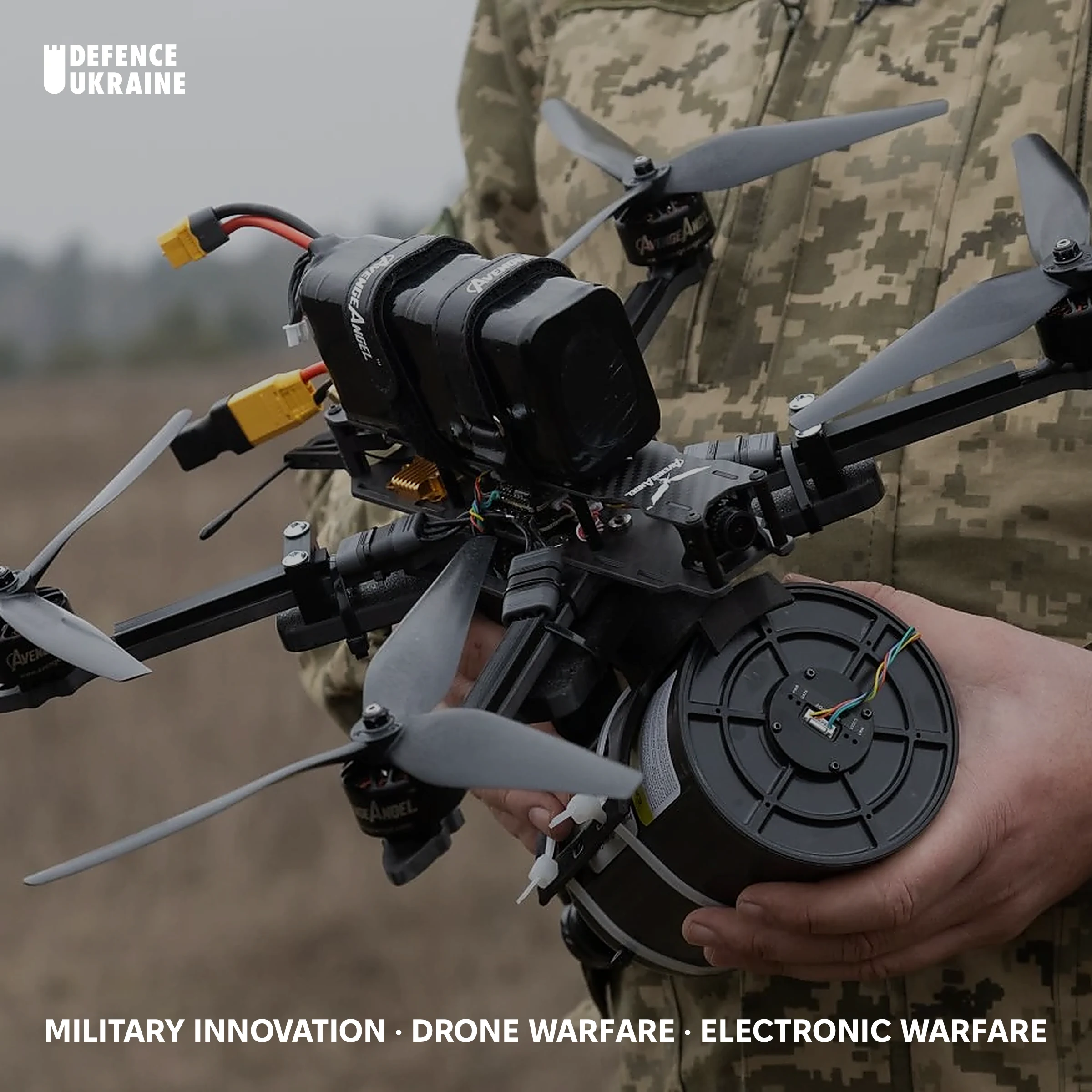
Russian integrated air defence in Ukraine is the densest and most electronically pressurised in modern military history. The Royal United Services Institute's *Meatgrinder* report, by Jack Watling and Nick Reynolds, and its 2024 to 2025 follow-ups, documented one major Russian electronic warfare system roughly every ten kilometres of the front. Platforms such as the RB-301B Borisoglebsk-2, Shipovnik-Aero, and Krasukha-2/4 degrade GPS navigation, sever the Ku-band datalinks essential for MALE command and control, and blind the synthetic aperture radars Western drones depend on. The same EW pressure that has driven Ukrainian operators to fibre-optic control on FPV strike systems, covered in Defence Ukraine's analysis of Ukraine's counter-drone and electronic warfare innovation, would render an MQ-9 Reaper non-operable across most of the contact line.
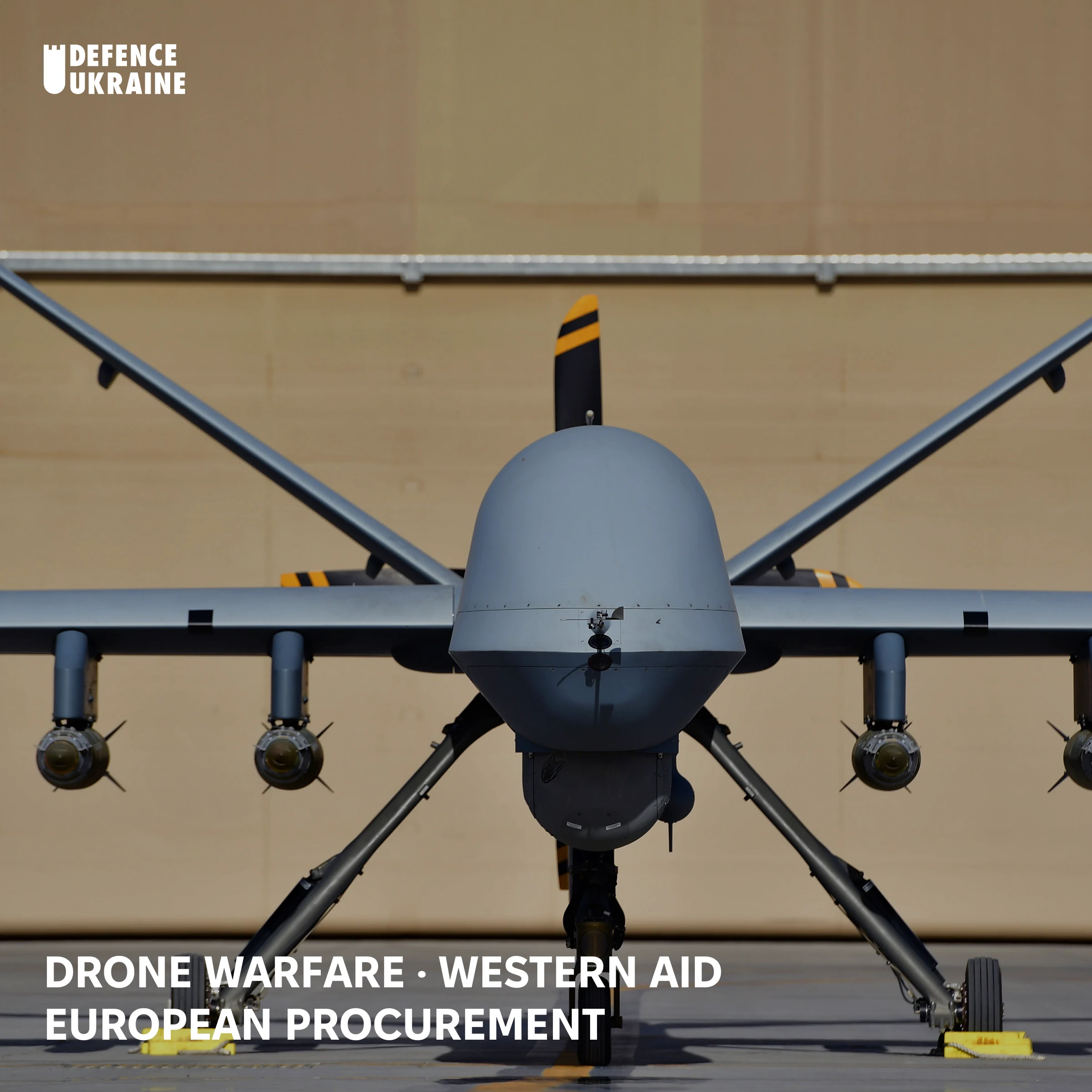
Above the EW environment sits the strategic surface-to-air missile threat. The S-400 Triumf engages targets out to 400 kilometres and up to 30 kilometres in altitude. The Reaper cruises at around 240 knots true airspeed and operates optimally between 25,000 and 50,000 feet, which places it directly inside the unimpeded kill zones of S-300 and S-400 batteries positioned safely deep within Russian-held territory. Descending below 10,000 feet to evade strategic SAMs places the platform inside the engagement envelopes of mobile point defences (Tor-M2, Buk-M3, Pantsir-S1) and degrades wide-area ISR capability simultaneously. The vulnerability of MALE to crewed Russian aviation was demonstrated in March 2023 when a Russian Su-27 collided with a US MQ-9 over the Black Sea.
The pattern has been validated outside Ukraine. During early-2026 US and Israeli strikes against Iran, MALE platforms operating against Iran's Russian-supplied air defences took heavy losses, with multiple Reapers and Hermes 900s reported shot down by surface-to-air missiles. The CSIS *Empty Bins* analysis, which framed the move toward attritable mass before the Iran strikes, has now been empirically reinforced.
Indigenous Strike and the Persistent ISR Gap
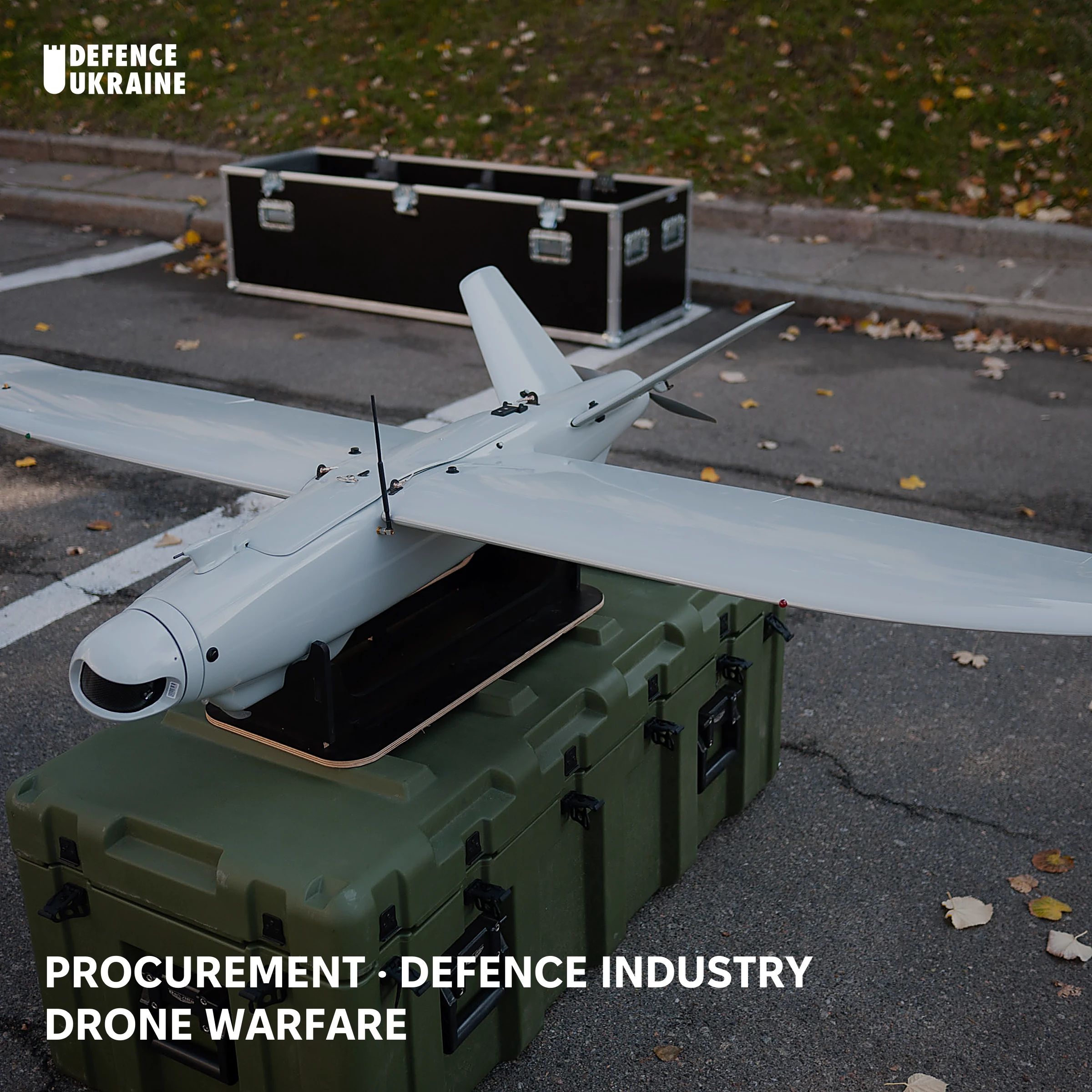
Denied access to Western MALE for the deep-strike role, Ukraine has substituted indigenous one-way attack drones at industrial scale. The Antonov-built Liutyi (AN-196) carries a 50 to 75 kilogram warhead between 1,000 and 2,000 kilometres; in February 2026, Liutyi drones struck the Lukoil refinery in Ukhta, Komi Republic, 1,700 kilometres from the Ukrainian border. The FirePoint FP-1 Flamingo, built primarily of plywood at roughly fifty thousand dollars per unit, carries a 105-kilogram warhead to 1,000 kilometres; FirePoint claims a production rate of two hundred units per day. The canard-layout Bober fields at the same scale. The turbojet Palianytsia missile-drone, unveiled in August 2024, has a range of 650 to 1,200 kilometres. Across this fleet, the Ukrainian Ministry of Defence is targeting more than seven million uncrewed systems of all classes for 2026. Germany has now contracted directly to finance the production of more than five hundred AN-196 Liutyi drones inside Ukraine, a move structurally closer to the European industrial subcontracting model laid out in Defence Ukraine's analysis of the EU's €60 billion Ukraine Support Loan than to legacy Western platform donation.
What this fleet does not do is substitute for the Reaper's persistent ISR role. A Liutyi is a blind kamikaze. It cannot loiter for twenty-four hours over a sector, perform battle damage assessment, lase dynamic targets for follow-on aircraft, or stream real-time full-motion video to a ground commander. The strike gap is filled by indigenous mass; the persistent, wide-area surveillance gap remains acute.
Ukraine has built a decentralised substitute. Commercial satellite providers, including Maxar, Planet Labs, BlackSky, and ICEYE, supply imagery at scale. In January 2026, Ukraine's Ministry of Defence expanded its partnership with ICEYE to receive 16-centimetre-resolution synthetic aperture radar imagery, which penetrates cloud cover, smoke, and night conditions and provides near-real-time tactical intelligence regardless of weather. Tactical and operational gaps are filled by domestically produced platforms (Leleka-100, Furia, Vector, Shark) that provide artillery correction and target designation, a model adjacent to the interceptor drone development covered in earlier Defence Ukraine analysis. Layered over both is Project Maven, the US Department of Defense computer-vision and signals-fusion system designated a Program of Record in March 2026, which compresses the kill chain by classifying military vehicles, tracking patterns of life, and recommending targeting solutions to human operators.
The mosaic is highly resilient: it cannot be decapitated by a single S-400 missile. It accepts higher latency and higher attrition of small platforms as the cost of operating in a contested environment. That is the architectural choice Ukraine has made.
NATO ISR from Outside the War
NATO contributes to the same picture from outside Ukrainian airspace. The US Air Force flies high-altitude RQ-4B Global Hawks (frequently under the FORTE 10 callsign) from Sigonella over the Black Sea, providing deep-look synthetic aperture radar mapping of Russian naval movements and Crimean troop concentrations. The NATO Intelligence, Surveillance and Reconnaissance Force operates a fleet of five RQ-4D Phoenix drones from the same base for autonomous reconnaissance flights along the Alliance's eastern flank. RC-135W Rivet Joint signals intelligence flights and E-3A Sentry early-warning sorties run alongside. Intelligence is fused at Sigonella and fed to Ukrainian targeting cells, including the Mykolaiv intelligence cell.
The geographic constraint is real. NATO sensors flying over the Black Sea or Romanian airspace can peer hundreds of kilometres into Russian-occupied territory but cannot see deep into the Donbas without crossing into Ukraine, which they do not. The NATO ISR contribution is best understood as a substantial intelligence subsidy, not a substitute for organic Ukrainian persistent surveillance over the line of contact. Defence Ukraine's analysis of NATO's planned Eastern Flank Drone Wall examined how the Alliance is now investing in extending that intelligence picture forward, and the same arguments about MALE survivability are reshaping that programme's design.
The European Reckoning
The European MALE programme of record, Eurodrone, was conceived as a route to strategic autonomy from US platforms. Industrially led by Airbus, Dassault, and Leonardo on behalf of Germany, France, Italy, and Spain, the programme has been plagued by cost overruns and schedule slippage. Budget has ballooned past €7 billion, initial operating capability has slipped to 2030 or 2031, and the eleven-to-thirteen-tonne, twin-engined design was specified for a permissive operating environment that Ukraine has now demonstrated does not exist on Europe's eastern flank.
On 8 April 2026, the French government formally withdrew from Eurodrone in its updated 2026 to 2030 Military Planning Law. The French Air and Space Force chief of staff publicly described the platform as "yesterday's drone that we can get tomorrow". French Minister of the Armed Forces Catherine Vautrin explicitly cited the Ukraine experience, noting that Eurodrone had been "designed to operate in Europe in a rather permissive environment" and was "clearly out of step with what the MALE drone market can offer". France redirected its €3.4 billion budget allocation toward the Rafale F5 standard, stealthy collaborative combat drones, supersonic suppression-of-enemy-air-defences cruise missiles, and mass procurement of cheap tactical drones and loitering munitions. Germany, Italy, and Spain now face a €730 million funding shortfall and the industrial work of redistributing Dassault's flight control development to Airbus.
Other European procurement has not yet caught up. Poland signed a $310 million contract for three MQ-9 Reapers in late 2024. The United Kingdom continues to induct the MQ-9B Protector. Defenders of these acquisitions argue they are necessary for peacetime border surveillance and operations in semi-permissive environments. Critics within the defence community describe the procurements as institutional inertia.
Strategic Implications for Ukraine
- The MALE absence is a deliberate doctrinal choice, not a transfer failure. Ukrainian operators, Ukrainian industry, and Ukrainian doctrine have all priced in the assumption that exquisite, runway-dependent, slow-moving platforms cannot survive over the line of contact. The political failure to transfer Reapers and Gray Eagles has been overtaken by the operational judgement that they would not have been useful if delivered. This is the most important framing for Western audiences whose intuition still defaults to "send the best platforms".
- The persistent ISR gap is the analytically open question. Ukraine fills it with mosaic resilience: SAR satellites, small tactical drones, AI fusion, and NATO ISR feeds from outside Ukrainian airspace. That mosaic accepts higher latency, higher attrition, and a degree of geographic compromise that an organic Reaper fleet would have closed. Whether that is the optimal long-term architecture, or merely the architecture forced by survivability constraints, is the question European force planners are now opening. The same logic applies to the Alliance's eastern flank, where any future MALE acquisition needs to be measured against the attritable alternatives Ukraine has demonstrated at industrial cadence.
- The European procurement reckoning is real but uneven. France's Eurodrone withdrawal is the clearest signal that Ukraine doctrine is reshaping European acquisition; it is also exceptional. Most European MALE procurement, including Polish Reaper acquisition and the British Protector programme, has not yet been re-baselined against Ukraine's lessons. The next two procurement cycles, particularly under the European Defence Industrial Programme and the EU Support Loan, will reveal whether European primes follow France or Poland. The Ukrainian industrial base has built indigenous deep-strike capability that European primes have not yet matched, which positions it as a credible subcontracting partner for whichever path Europe chooses.
Conclusion
Western Medium-Altitude Long-Endurance UAVs were the headline platforms of 2010s air operations. They have not arrived in Ukraine in significant numbers, they are unlikely to, and the absence reflects an honest tactical judgement rather than political failure. Ukraine has substituted attritable strike at industrial scale and a decentralised ISR mosaic for the platforms denied to it. NATO has filled part of the surveillance gap from outside Ukrainian airspace. Europe's procurement debate is now starting to reflect the same constraints, with France leading and other capitals trailing. The question for the next decade is not whether to send Reapers to Ukraine. It is whether European armed forces, looking at the lessons of the eastern front, can move past their own institutional preference for exquisite platforms before the next high-intensity contingency forces the question.
Defence Ukraine's tracker of SAFE Phase 1 and Ukraine Support Loan implementation covers the first procurement cycle that will answer that question.