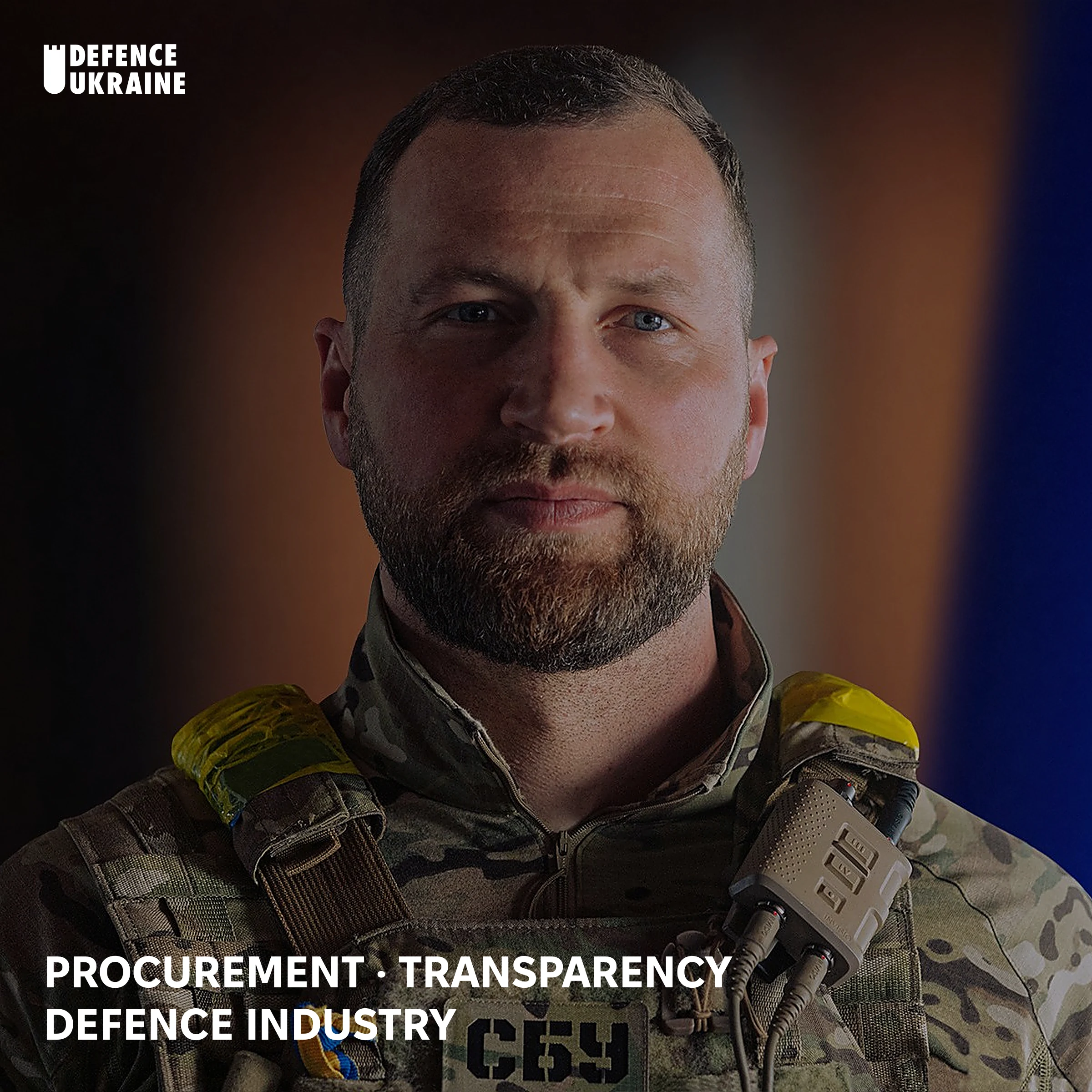
On 3 August 2026, Ukraine's Ministry of Defence signed a memorandum with YouControl, a Kyiv business-intelligence company, that makes digital vetting a precondition for every prospective defence supplier before a state contract can be signed. It was the first concrete instrument of the new acting Defence Minister, Yevhenii Khmara, a career Security Service officer who took the portfolio on 20 July. The document reads like administrative housekeeping. It is also a statement of intent about how Ukraine plans to buy weapons for the rest of the war.
The vetting layer does not sit on empty ground. It sits on top of the open digital marketplace that Khmara's predecessor spent eighteen months building, and the open question is whether a security officer's instinct to screen everyone will protect that marketplace from fraud or slow it down.
The Vetting Gate Before the Contract
The memorandum is a cooperation framework, not a commercial purchase. It plugs YouControl's corporate database into the Ministry's internal vetting workflow. Deputy Minister of Defence Mstyslav Banik signed for the Ministry; Danylo Hloba, YouControl's deputy director for legal affairs, signed for the company.
The mechanics are simple. When a company wants to bid, an MoD registrar runs it through YouControl's Trust Index from a single account, rather than searching dozens of state registers by hand. The system checks the bidder against open sources and official state data in real time and raises what the Ministry calls "red flags": the company or its beneficial owners on national or international sanctions lists, ownership chains that trace back through shell structures, hidden ties to Russia or Belarus, outstanding tax debts, active criminal proceedings, and broader security risks. The Ministry has said it intends to extend the same scrutiny to non-resident foreign companies later.
One boundary matters more than the rest. The Trust Index is advisory. It cannot approve or reject a supplier on its own. When the platform raises a flag, the registrar is required to confirm it against the official state registers before any procurement decision follows. The search is automated; the judgement stays with a person. YouControl is also contracted to train Ministry staff in counterparty analysis and open-source verification so registrars can read the intelligence rather than defer to it.
The rationale the two signatories gave was operational, not political. Banik framed unidentified risk as a supply problem: a counterparty that is not screened in time can mean late deliveries or defective equipment reaching troops, so the screening has to be fast as well as thorough. Hloba described the precondition in plainer commercial terms, saying a bidder must show, before it is allowed to bid, that it can actually deliver the goods at the price and on the terms the armed forces have agreed. Neither claim is controversial. The controversy is in what a mandatory gate does to the system behind it.
From Fedorov's Open Marketplace to Khmara's Filter
Mykhailo Fedorov ran the Ministry as a market designer. Over his tenure he built the rails that now carry most of Ukraine's fast procurement: the Brave1 Marketplace, the e-Points allocation system, and the DOT-Chain Defence backend. That architecture, examined in Defence Ukraine's account of Fedorov's six months at the Ministry, was designed to pull barriers down. DOT-Chain, operated by the State Rear Operator, now serves 186 combat brigades and has cut the average time from order to delivery to about nine days, with advance payments of up to 70 per cent to keep manufacturers producing. The Brave1 catalogue lists close to 800 items from more than 200 Ukrainian manufacturers. In the first quarter of 2026 alone the Ministry routed 12 billion hryvnias of orders through DOT-Chain.
Khmara comes from the opposite instinct. A former head of the Security Service's Alpha special-operations unit and, until July, its acting chief, he treats a supplier as a counterparty to be checked rather than an innovator to be onboarded. Defence Ukraine's analysis of his appointment read the move as a security-services pivot in search of an instrument. The YouControl memorandum is that instrument.
The contrast runs clean across the axes that matter. Fedorov optimised for market expansion and the speed of acquisition, and pushed purchasing authority outward to open marketplaces and brigade-level buyers. Khmara optimises for supply-chain security and fraud prevention, and pulls a checkpoint back in front of the contract. Where the technocratic model saw entry barriers as inefficiencies to remove, the security-discipline model sees them as filters worth keeping.
The vetting sits in front of the marketplace, not inside it. A company trying to become a verified supplier, a process Defence Ukraine has mapped in its guide to Ukraine's defence procurement system, now clears the Trust Index before it reaches DOT-Chain or a Defence Procurement Agency contract. Established manufacturers with legal departments will clear it easily. The concern inside the defence-tech sector is narrower and sharper: that a minor data discrepancy, or an opaque risk score, could keep an agile newcomer out of the marketplace that made Ukraine's drone base what it is.
There is a specific wrinkle here. A 2025 Cabinet order lets defence companies restrict public access to their registry data for physical security, so Russian targeting cannot follow a supplier home. Hloba himself has acknowledged that open-source screening often reads the deletion of public data as a red flag, which means a company hiding from a missile strike can look, to the algorithm, like a company hiding something else. Nothing in the memorandum suggests Khmara wants to dismantle DOT-Chain or Brave1. The Ministry frames the vetting as a shield for those platforms. Whether it works as a shield or a chokepoint depends on staffing the manual verification behind it.
What the Vetting Catches, and What It Misses
The gate is a direct response to a documented record. Ukrainian defence procurement has produced a run of scandals since 2022, and each one exposed a different structural gap. The 2023 food-procurement affair, where ration prices were inflated, cost Defence Minister Oleksii Reznikov his job and led to the creation of the State Rear Operator. The 2024 Lviv Arsenal case saw roughly $40 million routed to intermediary companies for artillery shells that were never delivered. In 2025, officials at the state special-communications service were suspected of embezzling more than 90 million hryvnias earmarked for drones, and the Energoatom investigation known as Operation Midas exposed a kickback scheme charging state contractors up to 15 per cent. The aggregate picture the Prosecutor General has since reported is 3.9 billion hryvnias in documented losses across the defence sector and 488 suspects. Most of these cases remain in prosecution.
The Trust Index is well matched to some of these. It catches newly registered companies with no financial history, the mechanism behind the Lviv Arsenal ammunition fraud, and it flags owners under investigation or linked to sanctioned Russian entities. What it cannot catch is the rest of the list. It does not detect collusive pricing among established, "clean" vendors, the pattern in the 2023 food scandal, where legitimate firms simply inflated the invoice. It does not see a compromised official steering a tender from the inside. It does nothing about quality fraud on goods already delivered. The system is a due-diligence filter at the door, not an auditor of the contract.
Two structural risks sit underneath the reform. The first is dependence: the Ministry has made a single commercial platform a mandatory gate for the entire supplier base, which means an outage, a cyberattack, or a poisoned dataset at YouControl becomes a Ministry-wide screening failure, and a proprietary risk score becomes a thing the state cannot fully audit. The second is duplication. The Defence Procurement Agency, the State Rear Operator, and the Prozorro system already run sanctions and debarment checks. YouControl consolidates those queries into one automated profile, which saves registrar hours, but the memorandum still requires a human to verify every flag by hand. In a war where an FPV drone's useful life is measured in days, a verification step without the staff to clear it quickly is how a gate becomes a queue.
The Baker Tilly Confusion
Part of the reform's public framing rests on a conflation worth untangling. On 4 August the Kyiv Post ran the headline "New Defense Minister Hires Ukraine's Top Audit Firm for Due Diligence on Army Contractors." The article beneath it described the YouControl memorandum. The headline named a different organisation entirely: Baker Tilly Ukraine, the accounting firm.
The Baker Tilly engagement is real and separate. The Defence Procurement Agency contracted the firm to audit the agency's own 2025 financial statements, a job worth 1.79 million hryvnias with deliverables due around 30 September 2026. The contract was awarded on 23 June 2026, nearly a month before Khmara took office. It is an inherited accountability measure, not a new policy of his.
The award also drew a contested allegation. On 1 July 2026 the investigative outlet ANTIKOR claimed the Defence Procurement Agency had passed over bidders offering roughly half the price to award the audit to Baker Tilly. The claim rests on that outlet's reporting. As of 11 August no finding from the State Audit Service, and no rebuttal from the agency or the firm, had addressed it, and the dispute remains open. The point for Ukraine's procurement optics is not the merit of the allegation, which is unresolved, but the speed with which a pricing dispute predating Khmara attached itself to his integrity agenda. Perception in this arena moves faster than proof.
The Donor Calculus
The reform has an audience abroad, and it is a paying one. Ukraine's state budget covers roughly $10 billion of weapons purchases against a domestic defence-industrial capacity assessed at $35 billion to $40 billion. Allied financing fills the gap, and it now arrives through mechanisms that come with fiduciary strings.
Two of those mechanisms carry most of the weight. The Danish Model, which wires allied capital straight to Ukrainian manufacturers, moved on the order of $1.3 billion into Ukrainian production lines in the 2025 to 2026 cycle, and it comes with pre-contract inspections and due-diligence audits as a condition of the money. The European Union's €90 billion Support Loan, tracked in Defence Ukraine's assessment of SAFE and the loan one year on, ring-fences €60 billion for military procurement across 2026 and 2027, with its first €3.9 billion tranche allocated for drones. The loan was frozen by a Hungarian veto and unblocked only in late April 2026, and its disbursement tranches are tied to anti-corruption and rule-of-law benchmarks. Stronger vetting is not a side benefit for Kyiv here. It is part of what releases the next tranche.
The credential is domestic as well as foreign. Khmara is still only acting minister. His confirmation runs into Ukraine's National Security Law No. 2469-VIII of 2018, which requires the defence minister to be a civilian and which exists to hold the Ministry to NATO norms of civilian oversight. Khmara holds the active rank of major general. To take the job permanently he must either move to the reserve or have parliament suspend the civilian requirement for the duration of martial law, and some lawmakers have called changing that law to fit a serving general a bad precedent. Rolling out a visible anti-corruption instrument in the weeks before a confirmation vote is, among other things, a way to answer them.
Strategic Implications for Ukraine
The vetting memorandum will be judged less by its intent than by its throughput. Three tests will decide whether it reads as reform or as friction by the end of 2026.
- Tempo is the real metric. Fedorov's architecture earned donor and battlefield trust by compressing order-to-delivery to about nine days. A pre-contract screen adds a step, and the memorandum keeps a human in the loop for every flag it raises. If the Ministry staffs that verification well, the gate costs a bidder little. If it does not, the same gate becomes a bottleneck that delays interceptors and drones the front needs now. The reform's success is an operations question before it is a policy one.
- The startup base is the thing at risk. Ukraine's edge in cheap, iterated drones came from newcomers who could enter the marketplace fast. Legacy manufacturers will clear compliance without effort. The danger is that opaque scoring or a data discrepancy filters out a small firm with a good product, and the 2025 rule letting companies hide their registry data for physical safety makes false flags more likely, not less. Keeping the door open to clean newcomers, while closing it to shell firms, is the hardest balance the reform has to strike.
- Donor absorption runs through this gate. With EU tranches and Danish Model capital conditioned on anti-corruption benchmarks, a credible vetting system is part of the machinery that turns pledges into cash. A gate that demonstrably screens out fraud lowers the perceived risk of wiring money straight into Ukrainian accounts. A gate that stalls procurement, or that is seen to favour incumbents, does the opposite and hands sceptical capitals a reason to slow disbursement.
The Test Ahead
Khmara has inherited a working system and added a filter to its front. He has not, on the evidence so far, moved to replace the rails Fedorov built, and the Ministry insists the vetting is there to protect them. The design is defensible. The execution is unproven, and it depends on a variable the memorandum does not control: whether the Ministry can verify the flags it raises fast enough to keep the marketplace moving.
The near-term test is the confirmation vote and the civilian-mandate question that hangs over it. The longer test is quieter and more telling. If, by the end of 2026, the time it takes a clean new supplier to clear vetting and reach a first contract holds close to Fedorov's nine-day benchmark, the gate will have done its job. If that number stretches, the security-discipline doctrine will have bought integrity at the cost of the speed that made Ukrainian procurement worth defending.