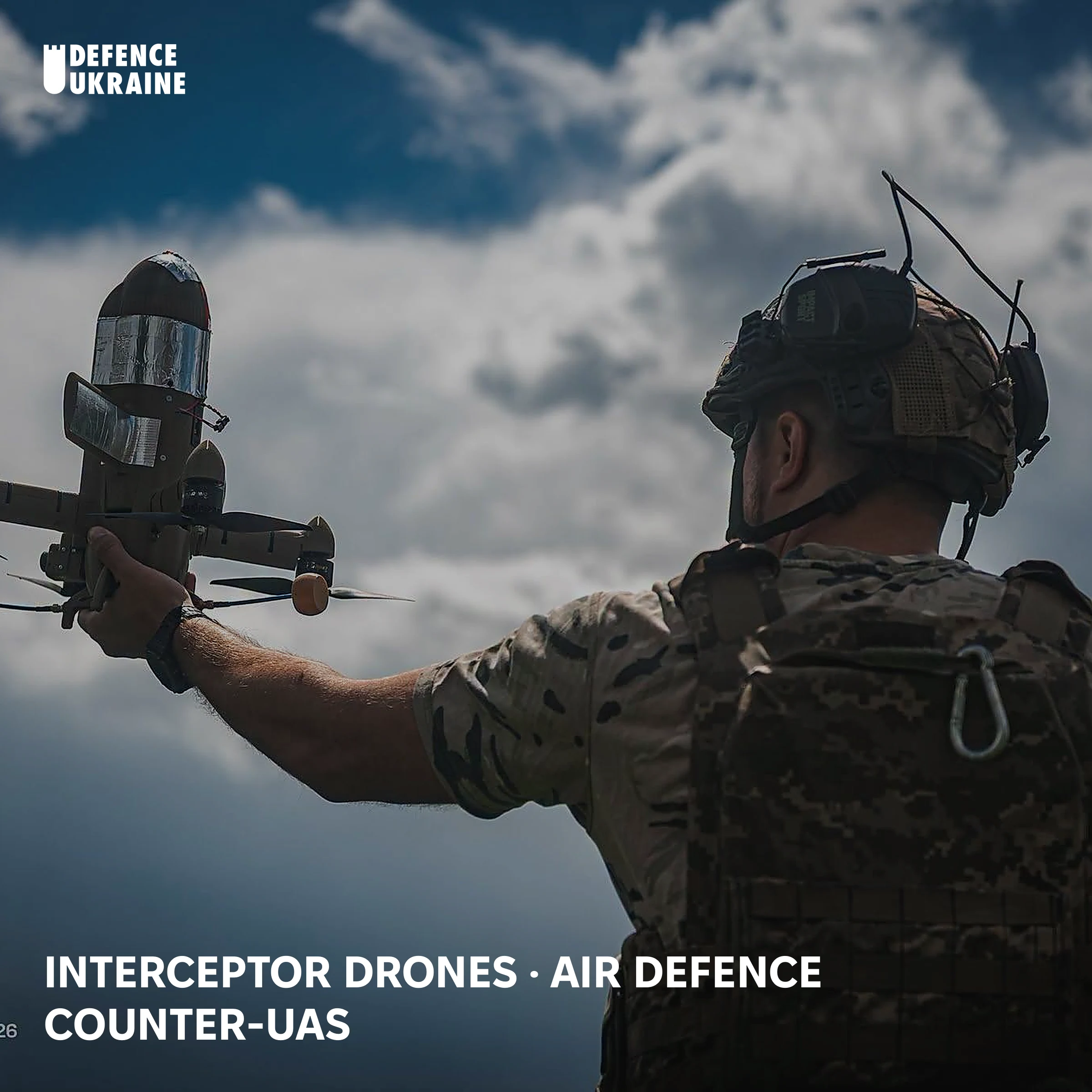
On 3 May 2026, personnel from Ukraine's 1020th Anti-Aircraft Missile Regiment shot down a Russian strike drone with a Sting interceptor. The kill was routine. The target was not. It was a Geran-4, the jet-powered version of the Shahed-136, and it had been cruising at close to twice the speed of the propeller-driven drones Ukrainian interceptor crews had spent two years learning to catch. The interception worked because the geometry happened to favour it. The larger question, the one that now shapes Ukraine's counter-drone planning, is whether the cheap-interceptor model survives the moment Russia's attack drones start flying faster than the drones sent up to stop them.
A Faster Shahed
The Geran-4 is built to defeat the thing that beat the Shahed-136: the interceptor drone. Where the baseline Geran-2 uses a pusher-propeller piston engine and cruises at roughly 185 km/h, the Geran-4 carries a Chinese-supplied Telefly turbojet, more recent airframes using the roughly 200 kgf TF-TJ2000A also fitted to the larger Geran-5. Ukrainian Air Force tracking and manufacturer specifications put its cruise speed between 350 and 500 km/h. The airframe has been reinforced for high-speed manoeuvring, maximum takeoff weight has risen from 350 to 450 kg to carry the heavier engine and its fuel, and the platform keeps a 50 kg warhead out to around 850 km at altitudes from 100 to 5,000 metres.
Speed is not the only change. Ukrainian Defence Intelligence analysis of wreckage recovered in July 2026 shows a redesigned nose housing an electro-optical seeker, which lets the drone acquire and strike a target visually even when its satellite navigation is fully jammed. That matters because it closes the door on the cheapest countermeasure. A drone that no longer needs a radio link or a working GPS signal cannot be talked down by electronic warfare.
Production sits at the Alabuga Special Economic Zone in Yelabuga, Tatarstan, where Ukrainian intelligence estimates combined Geran-4 and Geran-5 output at around 3,000 units a month. Russia has stopped building the transitional Geran-3 to concentrate on the two. In early June 2026 Ukraine's Commander-in-Chief, General Oleksandr Syrsky, said Russia intended to raise the jet-powered share of its drone raids toward half. The volume trend already points that way: Russian forces launched roughly 1,400 jet-powered UAVs between January and mid-June 2026, against about 180 in the whole of 2025. Stockpiled in quantity, these drones feed the saturation salvos of several hundred munitions in a single night that stress Ukrainian defensive magazines and reward any effector that is fast, cheap, and hard to jam.
Ukraine's Interceptor Fleet Grows Up
Ukraine's answer has matured from improvised FPV quadcopters into a fielded fleet of purpose-built interceptors. The dedicated drone-hunter layer that emerged through 2025 is now a standing part of the air-defence system, and the Ukrainian Ministry of Defence and Unmanned Systems Forces say interceptor drones account for one in every three Russian aerial targets destroyed over Ukraine.
The Sting, made by Wild Hornets, is the numerical backbone. Its maker reports the quadcopter had destroyed more than 9,000 Shahed-class drones and Gerberas by June 2026, and it recorded the first confirmed kill of a jet-powered Geran-4 in early May. On 5 August 2026 the defence outlet Militarnyi reported a second platform joining that club: ZIRKA, built by NOCTIS with backing from Vyriy Industries and developed alongside the Darknode anti-Shahed battalion of the 412th Nemesis Unmanned Systems Brigade. NOCTIS puts ZIRKA's range at 30 km, endurance at up to 20 minutes, top speed at up to 340 km/h, and unit cost at around US$2,000, and says the onboard automation detects, acquires, and tracks the target on its own, leaving the operator to manage only the closing speed. A ZIRKA 2.0 with more automated navigation has been announced.
Others fill out the fleet. The Octopus-100, developed with British involvement and offered on the Brave1 marketplace by several state-contracted makers, claims a top speed of 300 to 305 km/h, a 3,500-metre ceiling, and a 1.2 kg warhead, with LiDAR for proximity detonation and computer vision for the terminal run. Across the fleet the direction of travel is the same: away from a pilot flying every intercept by hand, toward radar cueing a drone into an intercept box where onboard sensors and vision models finish the engagement. That autonomy is not a luxury. At jet closing speeds, a human in the loop for the final second is a liability.
The Speed Race No One Has Won Yet
Here the arithmetic turns against the defender. ZIRKA tops out around 340 km/h. A Geran-4 can cruise at 500. In a tail-chase, an interceptor slower than its target never closes the gap; a 340 km/h drone chasing a 500 km/h one watches it pull away at 160 km/h. Every current electric interceptor, ZIRKA, Sting, Octopus-100, is therefore locked into favourable geometry: head-on or high-angle flanking shots, set up ahead of the threat vector. If a jet-Geran slips past the launch point, the crew has no way to run it down. The altitude ceiling compounds the problem, because the Geran-4's 5,000-metre profile sits above where many FPV-derived interceptors keep useful lift and battery life.
The fix Ukrainian industry is reaching for is jet propulsion of its own. At the Farnborough International Airshow in July 2026, the manufacturer SkyFall showed the P1-SUN JetKiller, which it says reaches 370 km/h, up from 310 on its earlier models, with the stated aim of passing 400 and eventually 500 to draw level with the Geran-4. Company representatives acknowledged the design was not settled, and that the firm was still weighing electric against a small turbojet.
That choice is where the economics bite. A propeller interceptor at around US$2,000 is what makes the whole model work: cheap effectors against cheap threats. Tomasz Wozniak, a partner at the defence investment firm Grenadyr, has put the price of a jet-powered interceptor at under US$10,000, several times the cost of the electric drones it would replace. A jet interceptor at that price is still a bargain against a jet-Shahed. It is not a bargain against the volume Russia is building, and every euro added to the unit cost narrows the margin the strategy depends on.
Preserving the Patriots
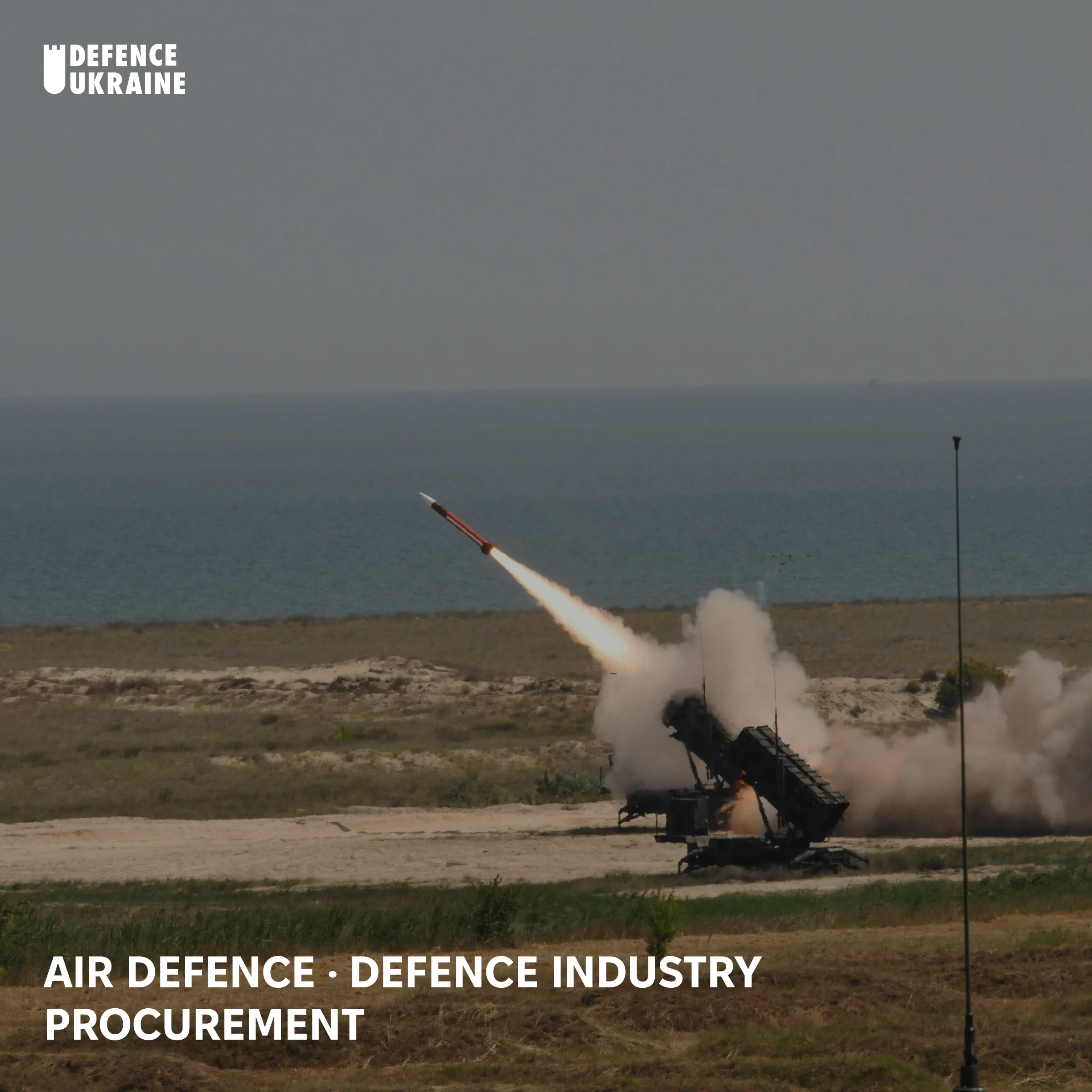
The interceptor drone earns its place less by what it shoots down than by what it lets Ukraine hold in reserve. The layer exists to keep scarce high-end missiles for the threats only they can meet. Ukrainian defence ministry figures for July 2026 make the split concrete: Ukraine intercepted 29 of 195 Russian ballistic missiles that month, against 5,142 of 8,653 attack drones. Sending a Patriot PAC-3, at roughly US$3.8 million, against a $50,000 Shahed inverts the cost exchange catastrophically. Pushing the drone problem down onto interceptor UAVs and automated guns is what keeps the Patriot and IRIS-T rounds Ukraine can no longer easily replace available for Iskanders and Zircons.
Electronic warfare is meant to be the cheapest layer of all, and against radio-linked drones it still works. Ukrainian firms keep fielding new systems, including wide-band jammers built to cover the expanding frequencies Russian drones use. But the structural limits of jamming against a hardened deep-strike drone are now plain. The Geran-4 leans on inertial navigation and a multi-channel satellite antenna, and once its optical seeker takes over the terminal dive there is no link left to break. The same logic runs the other way on the tactical front, where fibre-optic-tethered FPV drones pass their signals down a glass thread and ignore jamming entirely. Soft-kill has a ceiling, and both sides have found it.
This division of labour is now the organising principle of Ukrainian air defence, and the leadership change of mid-2026 has hardened it. President Zelensky dismissed Defence Minister Mykhailo Fedorov, an architect of the drone-procurement push, on 15 July 2026, and Major General Yevhenii Khmara, a career SBU officer, took over the ministry days later. "We can't go punch for punch. We have to be asymmetric," Khmara told The Straits Times in an interview published on 29 July 2026. Under his caretaker administration the ministry has kept the rule simple: drones hunt drones, and Patriots are held for ballistic missiles.
Financing the Volume
Matching 3,000 Russian jet-Shaheds a month is a manufacturing problem before it is a technical one, and Ukraine cannot self-fund it. Its defence industrial base can build an estimated $55 billion of output a year, while the state weapons budget sits near $10 billion. European allies have moved to close that roughly $45 billion gap through the government-to-government financing framework known as the Danish Model, under which donor states pay Ukrainian manufacturers directly for certified capacity. Denmark's defence procurement agency audits the supplier's facilities, ownership, and delivery record before signing on the funder's behalf. Through 2026 the mechanism grew from a €590 million experiment into a €1.3 billion pillar channelling an estimated $6 billion into Ukrainian lines, with contracts carrying 50 to 70 per cent pre-payment and delivery to the front in weeks.
The interceptor is also becoming an export. In November 2025 Ukraine licensed the Octopus-100 to the UK Ministry of Defence for serial production in Britain, the first Ukrainian combat drone mass-produced inside a NATO country, with an initial tranche of 8,000 units earmarked for Ukrainian forces. The direction of the technology transfer is worth noting: for once it runs out of Ukraine, not into it.
Strategic Implications for Ukraine
The jet-Shahed does not break the interceptor-drone model, but it does raise its price and tighten its timeline. Three consequences will decide how well the model holds through the winter of 2026 and into 2027.
- The cost-exchange advantage is eroding, not gone. A $2,000 electric interceptor against a 185 km/h Shahed-136 was a rout for the defender. A sub-$10,000 jet interceptor against a 500 km/h Geran-4 is still favourable, but the margin is thinner and every additional feature, seeker, jet engine, autonomy stack, narrows it further. Ukraine can afford to lose the price war slowly. It cannot afford to lose it fast, which means holding jet-interceptor unit costs down is now a first-order defence-industrial goal, not an engineering footnote.
- Volume, not capability, is the binding constraint. Ukrainian interceptors have already downed the jet-Shahed; the open question is how many can be built. Russia's Alabuga complex is a known, centralised, roughly 3,000-a-month target. Ukraine's dispersed manufacturing base has to match that output while shifting part of its line from cheap electric drones to costlier jet ones. The Danish Model's pre-payment structure is the mechanism most likely to fund that transition at the speed required, which makes allied disbursement schedules a live operational variable, not a budgetary abstraction.
- Autonomy is now the contested edge. Both the Geran-4's optical seeker and Ukraine's automated terminal guidance move the fight beyond human reaction time and beyond electronic warfare. The next round will be fought over target discrimination, decoy rejection, and intercept algorithms rather than over airframe speed alone. The side that automates the final second more reliably, and does so at a unit cost the volume can bear, holds the advantage.
Whether Ukraine closes the gap depends less on any single interceptor than on how fast its industrial base, and the allied money behind it, can turn a proven kill into a manufactured one at scale. The Geran-4 has already been shot down. The harder task is shooting down three thousand of them a month, every month, without spending a Patriot to do it.