At the 34th MSPO defence exhibition in Kielce on 10 September 2026, Fire Point chief executive Iryna Terekh said the FP-7 ballistic missile had cleared two of its three testing stages and was entering military testing. New Voice of Ukraine reported her setting the horizon for combat use at weeks rather than months.
Reuters carried that same projection on 4 August, when Terekh said certification was two to four weeks away and pointed to first combat use in early autumn. Defense News repeated the timeline on 25 August, running a headline saying the missile was weeks away from combat. Thirty-seven days divide the first forecast from the third. Across that span, no Ukrainian state body has publicly confirmed that the FP-7 has cleared any administrative rung at all.
Three Forecasts and the Rung That Did Not Shift
The sequence tells more than any single claim within it.
Fire Point unveiled the FP-7 and the longer-range FP-9 in September 2025, with Interfax-Ukraine reporting a range of roughly 200 km and a maximum speed of 1,500 m/s. Footage of a first launch surfaced publicly in late February 2026. On 4 August, Terekh told Reuters the company had conducted around fifteen test launches and looked for certification within a month. On 25 August, Defense News reported projections of combat readiness by the end of September. By 10 September, the company described itself as entering the third of three test stages, a step Terekh characterised as one Fire Point still had to work through.
Read forward, that suggests momentum. Read against the administrative ladder, it looks different. A certification window that stood two to four weeks wide on 4 August had not closed by 10 September, and the 10 September remarks describe a stage opening rather than a stage completed. The publicity milestone and the procedural milestone are not the same thing, and only the first of them has moved.
Two labels given to the FP-7 in September coverage also require narrowing. The first calls it Ukraine's first domestic ballistic missile. Ukraine's state Sapsan programme, also designated Hrim-2, appears in public reporting linked to both trials and claimed combat use, so any claim of primacy for a privately developed system must be argued against the state programme rather than asserted around it. The second label is certification. Fire Point has described military testing as the step that finishes codification with the Ministry of Defence. That remains a manufacturer's framing of a state process, and the ministry has published nothing naming the FP-7.
What Codification Actually Settles
Ukraine's Ministry of Defence has laid out its own vocabulary with unusual clarity, and the distinctions it draws do not match how news reports cover the FP-7.
Codification registers an item in the state catalogue of supply items and makes it eligible for state procurement. It creates an administrative record of what an item is, checked against a testing programme, test protocols verifying the declared characteristics, technical specifications and design documents, with a specialised commission recommending approval once the weapon clears those hurdles. The ministry treats it as distinct from authorisation for operational use, which is the wartime instrument, and from adoption into service, which is the peacetime one. Defence Ukraine examined how that gate works in practice in its analysis of Ukraine's codification pipeline and its missing rejection figures.
In March 2026 the ministry reordered that sequence. Codification can now take place before military buyers establish a procurement need, meaning the order runs codification, then requirement, then contract. The reform makes the distinction sharper rather than softer: being catalogued no longer even implies that anyone plans to buy the item.
The ministry reported 1,526 weapons and equipment models codified and authorised for supply during the first eight months of 2026, almost 91 per cent of them Ukrainian-made. The published category breakdown nowhere mentions the FP-7. An aggregate figure cannot be used to place a specific missile inside it.
So the ladder spans nine rungs, and the public record reaches only the fourth. Announcement, ground and laboratory testing, flight testing, military evaluation. Then codification, a state requirement, a contract, serial production and combat use. As of 14 September 2026 there is no public Ministry of Defence file naming the FP-7 as codified, no identified state contract, no declaration of realised serial production, and no verified combat use. Artem Romaniukov has led the Defence Procurement Agency in an acting capacity since 1 September, after Arsen Zhumadilov's departure from the agency, and the agency has announced no FP-7 contract. Defence Minister Yevhenii Khmara, confirmed in post on 19 August, has said nothing publicly about the missile.
None of that proves a contract does not exist. Ukraine has good reasons to keep an active weapons programme off the public record. It does mean nobody can describe a contract as established, which is a separate claim and the only one the evidence supports.
The Specification Record Clashes With Itself
Every published performance figure for the FP-7 comes straight from Fire Point.
The September 2025 announcement listed roughly 200 km of range, a 150 kg warhead and 1,500 m/s. Defense News cited up to 300 km in August 2026, again attributed to company representatives, again carrying a warhead up to 150 kg. Nobody has explained the discrepancy. It may reflect a lighter payload configuration, a design that improved, or a claim that grew. An honest assessment prints both figures with their dates and leaves the question open.
One apparent corroboration is basic arithmetic. The 1,500 m/s figure and the 5,400 km/h figure that circulated in September coverage represent the same number: 1,500 multiplied by 3.6 is 5,400. Two outlets reporting the two units do not offer two observations. The same caution applies to every other parameter in circulation, because ten articles repeating a company data sheet remain one manufacturer claim wearing ten datelines.
That discipline is not unique to Fire Point, but Fire Point has offered more reasons to apply it than most. The same pattern ran through the FP-5 Flamingo, where production targets shifted between 30 and 200 missiles a month depending on the date and the spokesperson, as Defence Ukraine found when examining the engine bottleneck behind the Flamingo ramp.
Derived From the 48N6 Does Not Mean Converted From One
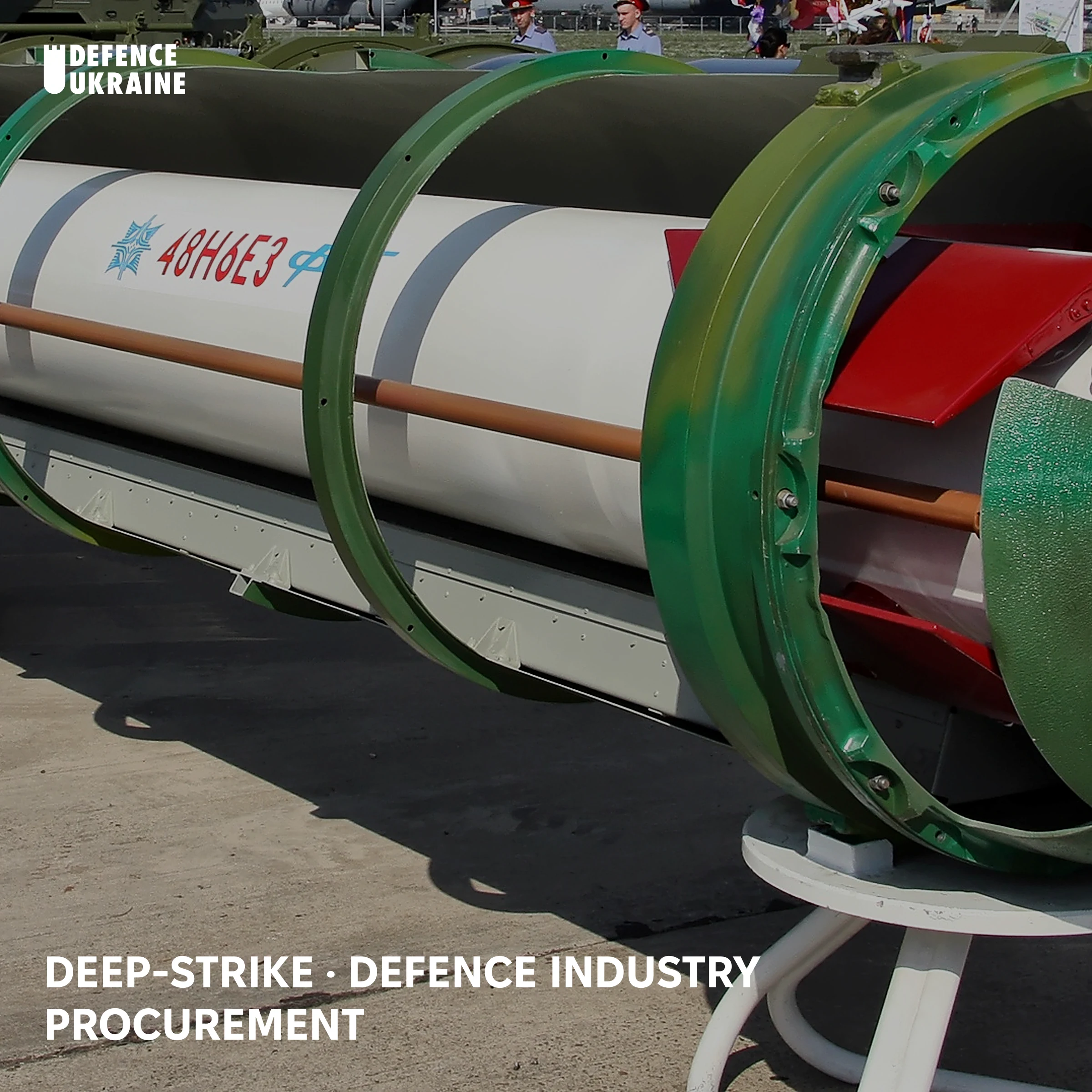
The FP-7's reported link to the Soviet 48N6 interceptor, the round fired by the S-300 and S-400 families, has been flattened in media coverage into the claim that Ukraine is launching repurposed surface-to-air missiles at ground targets. The available evidence lends no support to that compression.
Terekh told Reuters in August that the FP-7's architecture drew on Soviet S-300 and S-400 interceptor design, and that the missile now retained roughly 20 per cent similarity to it. Other company-linked accounts describe borrowing the external aerodynamic layout rather than reusing complete legacy rounds. Derived from a 48N6 design is defensible on that record. Converted from a 48N6 round is not.
The gap between those two phrases settles the industrial question. Converting an existing stockpile produces a weapon bounded by how many rounds exist and cannot be scaled past that stockpile. Building new airframes to an inherited geometry yields a weapon bounded by tooling, propellant and money, which are problems engineers can work. Coverage that treats the two as interchangeable strips out the only detail that would tell a reader which kind of programme this is. No independent technical confirmation of what was inherited has been published.
The Sixty Per Cent Claim Lacks a Denominator
Terekh told CBS on 8 September that Fire Point weapons accounted for about 60 per cent of Ukrainian strikes on Russian territory in 2026, and that Ukraine had launched twice as many long-range strikes against Russia this year as Russia had conducted against Ukraine.
Nobody can verify that figure, and the reason is structural rather than a matter of effort. Sixty per cent of what remains undefined: launches, attack events, munitions expended, targets struck, or assessed effects. Independent strike-tracking projects exist, but they use different definitions of a strike, different geographic boundaries, different treatment of multi-weapon raids and different verification thresholds. Two datasets built on incompatible definitions cannot validate one another, and a figure from the General Staff showing one Fire Point product outperforming several drone types would still not establish a 60 per cent share of everything.
Inability to verify remains the finding. It makes a weaker statement than confirmation and a much stronger one than repetition, and it applies to a claim about the campaign Defence Ukraine analysed in its work on Ukraine's deep-strike pressure on Russian refining and state revenue.
One Company, Three Programme Tracks
Fire Point now occupies three roles at once. It builds the FP-5 Flamingo, Ukraine's most-cited deep-strike cruise missile. It is developing the FP-7. And its FP-7.X is the interceptor candidate inside FREYJA, the Ukrainian-led anti-ballistic coalition that Reuters reported in August as having thirteen industrial partners.
FREYJA's maturity should be weighed against one test. Reuters reported that Fire Point was aiming for a first successful ballistic interception by mid-2027. A missile that flies is not an interception, and by the company's own timetable the decisive demonstration has not happened. European Commissioner for Defence and Space Andrius Kubilius said on 11 September that the European Union was considering how FREYJA might be supported, which Euractiv reported as interest rather than an award. The Commission separately approved a €6.1 billion package for Ukrainian air and missile defence and related procurement on the same day. Those two developments have been merged in some coverage into an EU allocation to FREYJA. No instrument joining them has been published.
That concentration itself poses a verification problem before it is anything else. Three programme lines running through a single private firm means that a large share of what the public knows about Ukraine's cruise-missile, ballistic-missile and interceptor efforts arrives through one commercial source with a direct interest in how news lands. The scrutiny record around Fire Point sharpens that problem rather than resolving it. Reporting since 2025 has raised questions about the company's ownership and contracting, the company has denied wrongdoing, prosecutors have filed no suspicion notices against its leadership, and in May 2026 Danish authorities publicly contradicted a Fire Point co-owner's account that cooperation on the company's Danish project had been frozen. Defence Ukraine set out that chronology alongside the broader Ukrainian missile industrial base. Allegation is not finding, and absence of charge is not clearance. The relevant point here is narrower: a company whose own statements have been publicly contradicted by a partner government is a company whose programme-status claims need state corroboration before anyone reports them as status.
Strategic Implications for Ukraine
The FP-7 may well be what Fire Point claims it is. Four consequences follow from the fact that, on 14 September 2026, the public record cannot yet say so.
- The certification gate holds the real answer, and it is checkable. A product-specific codification entry naming the FP-7 would clear a rung in a way no interview can match. The ministry publishes codification totals quarterly and has shown it will name individual systems when it chooses to, as it did with the Dovbush T40 in August. Until an entry appears, the strongest defensible claim remains that Fire Point says the missile is in military testing. That is not a hedge. It is the claim the evidence carries.
- Two hundred kilometres makes this a theatre weapon whatever label anyone gives it. The published range puts the FP-7 far below the Flamingo's reported reach and below the FP-9 concept. Its argued value lies in speed, responsiveness against air defences built for slower targets, and an indigenous source of supply rather than depth. Those are real properties. They are also tactical ones, and describing the system as a strategic capability before a single corroborated effect exists imports a conclusion the range figure does not support.
- Repeating a near-term forecast without clearing a rung carries a cost. Three combat-readiness forecasts in thirty-seven days, none of them followed by a state confirmation, teaches partners and analysts to discount the fourth. For a company seeking European funding and a state seeking allied procurement money, that discount is expensive. The fix is not quieter marketing but state-side confirmation, which is the only currency that settles a status question.
- Codification would still leave the central question unanswered. Under the March 2026 sequence, a codified FP-7 would be a catalogued item eligible for state purchase. It would not prove a requirement had been logged, a contract signed, a line running or a round fired. Ukraine has a documented pattern of systems clearing the catalogue and waiting, and anyone reading a future codification announcement as a fielding announcement will make the same error twice.
The watch-list is short and each item is testable. A Ministry of Defence record naming the FP-7. A Defence Procurement Agency contract with a quantity attached. A declaration of realised serial production rather than a target. A dated, located and independently corroborated combat firing. A FREYJA ballistic interception. None of the five had occurred by 14 September 2026, and any one of them would tell a reader more about the FP-7 than every interview given since August.