Ukraine's Ministry of Defence recorded 8,766 guided aerial bombs employed against Ukrainian positions in August 2026, 283 a day and the highest monthly total of the war. The series behind that figure climbs almost without interruption: at least 10,378 in 2023, roughly 40,000 in 2024, nearly 44,000 across the first eleven months of 2025, then 7,987 in March 2026 and 8,266 in June before August set the record.
Read as a scoreboard, the series says Ukrainian countermeasures have failed. That reading is wrong, and the error is in the denominator.
A Bolt-On Kit and a Seventy-Decibel Problem
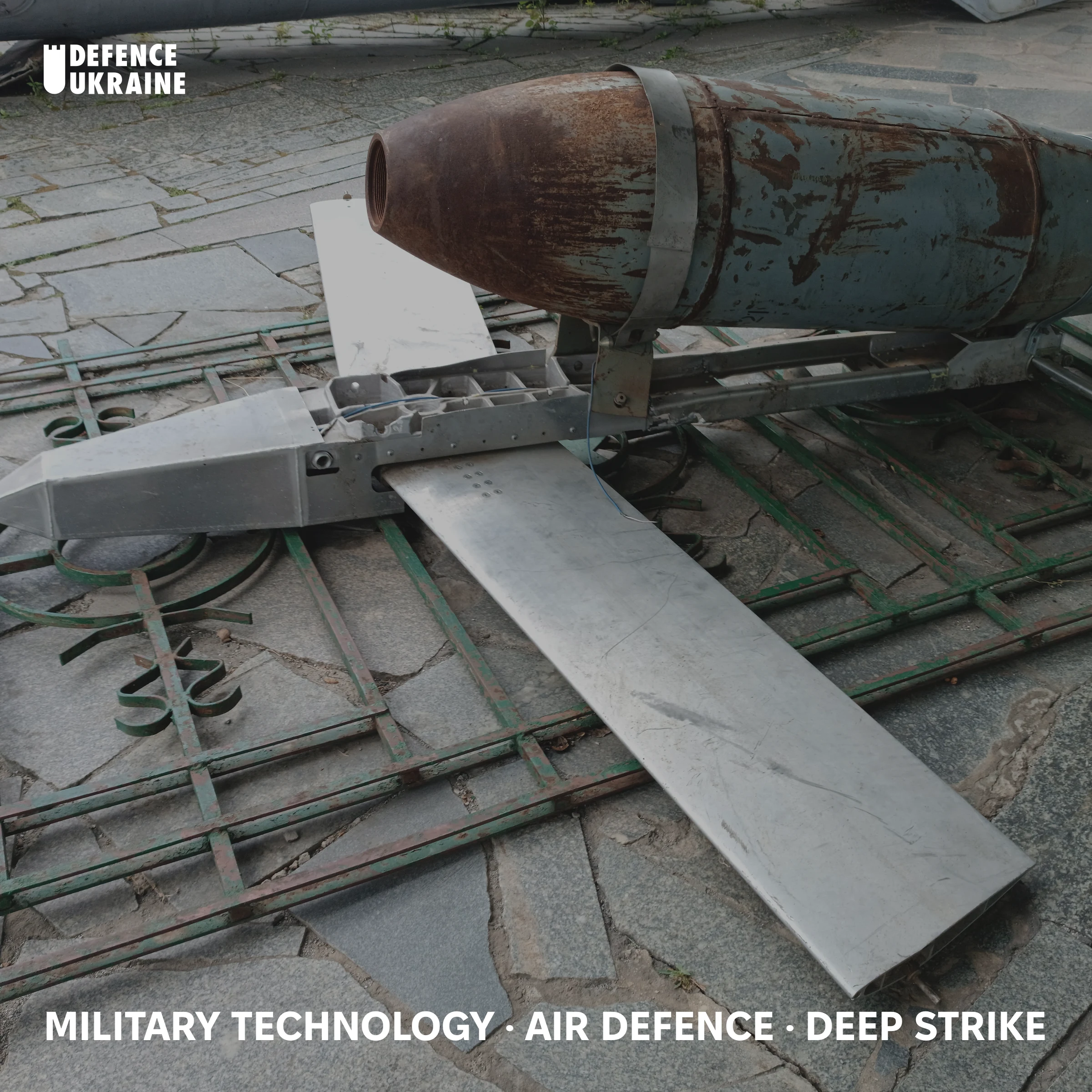
The Universal Gliding and Correction Module is not a precision weapon in any sense a Western air force would recognise. It is a strap-on assembly of folding wings, small tail surfaces and a guidance box, clamped with iron hoops around a Soviet-era FAB bomb that was never designed to be guided. On a Russian FAB the tail cannot be removed and replaced with a guidance unit the way a Joint Direct Attack Munition kit converts an American Mk 84, so the module rides on the outside. That single engineering compromise produced the property that matters: the kit can be fitted at the airfield by the operating unit, not at a depot.
Guidance is inertial, with a satellite receiver periodically resetting the accumulated drift. Electronic attack works on the correction half of that loop, and the arithmetic is heavily one-sided. Satellite navigation signals arrive at roughly minus 127 dBm. A Russian R-330Zh Zhitel jammer still delivers minus 53 to minus 56 dBm at the 30-kilometre edge of its stated range, some seventy decibels above the signal it is drowning, on RUSI's own worked calculation. The same physics runs in Ukraine's favour against the incoming bomb, which is why the Kometa controlled-reception-pattern antenna exists: it steers a null toward the interfering source rather than filtering it, and Russian iterations of that antenna have tracked Ukrainian jamming improvements closely enough that the wider Russian electronic-warfare architecture shows the same adaptation cycle running from the other direction.
One widely repeated account of that cycle is wrong in an instructive way. The antenna is usually described as escalating through a single sequence, four elements to eight to twelve to sixteen. Ukraine's Defence Intelligence stated in February 2026 that the standard kit still carries four to eight elements, while the extended-range variant fielded since 2024 carries a twelve-element unit. The hardware bifurcated rather than escalating. Two lines run in parallel, and the more consequential Russian answer to jamming was never antenna engineering at all.
Counting the Wrong Thing
Jamming a satellite-guided bomb does not usually destroy it. It degrades the correction, the inertial unit accumulates error over the glide, and the bomb lands somewhere other than where it was aimed. The operational consequence is that more bombs are required per destroyed target.
Fighterbomber, the unofficial Russian air force channel, put that figure at up to sixteen bombs for one reliable hit. The independent measurement points the same way. Clément Molin, who has geolocated roughly 40 to 50 per cent of monthly reported airstrikes since March 2026, finds approximately one guided bomb in two now falling in open terrain, and estimates that around 5 per cent of all launched glide bombs strike a genuine military position. Both figures are single-source and unreplicated, and neither should carry an argument alone. Together they describe the same mechanism.
That mechanism inverts the meaning of the monthly series. If a countermeasure works by raising the number of rounds needed per hit, then rising expenditure is partly a measure of the countermeasure working. A launch total cannot distinguish between a Russian air force striking more targets and a Russian air force striking the same targets less efficiently. Counting launches answers a question nobody asked.
What is absent is not a single estimate but a series: a measurement of targets destroyed per hundred bombs released, tracked over time. The published record contains no such measurement demonstrating a sustained reduction attributable to any Ukrainian countermeasure since December 2023, when ISW assessed a drop in glide-bomb activity across southern Ukraine after Ukrainian forces downed three Su-34s on 21 and 22 December and a further Su-34 and a Su-30 three days later. Absence of a published measurement is not absence of effect. It does mean the most cited number in this subject is the one least able to settle it.
What the Production Figures Cannot Support
The employment series is institutionally attributed, monthly and cross-verified. The production figures are none of those things, and the gap between them is routinely missed.
Every circulating output estimate rests on material that cannot be checked. RUSI's figures of 40,000 kits for 2024 and a 70,000 target for 2025 sit in its own footnote to a State Defence Order document that RUSI describes as not publicly available. Ukraine's Defence Intelligence gave Reuters a 2025 target of up to 120,000, and Reuters stated in the same article that it could not verify the figure, that the official did not say how he obtained it, and that the total included both newly built munitions and existing bombs converted to glide. There is no well-evidenced production figure anywhere in the open record.
One number in wide circulation is not a disputed estimate but a copying error. The 75,000 kits frequently attributed to RUSI appears in neither RUSI primary document, both of which say 70,000. It entered circulation through aggregators relaying a British assessment and has been reproduced since under RUSI's name.
The best-anchored figure in the subject arrived by an unglamorous route. Ukraine's Ministry of Defence gave at least 10,378 UMPKs employed during 2023 in a written reply to the anti-corruption organisation NAKO, letter 646/165/3/1047/окп/пс of 11 December 2024. A document reference number and a named recipient outrank a headline.
The Supply Chain Is Active, and Sanctions Have Not Reached It
NAKO, working from more than 600,000 customs shipment records alongside components identified by Ukrainian teardown teams, found that 71 per cent of the microelectronics in a UMPK kit originate with Western-aligned manufacturers. The Kometa antenna is built substantially from Western parts: an Irish ceramic patch antenna, an Altera field-programmable gate array, a Swiss satellite receiver, American converters.
Component date marks settle a question that stockpile arguments leave open. Ukraine's Defence Intelligence recorded an Analog Devices converter marked to the first week of January 2024 and a Linear Technology module marked to June 2024, inside assemblies fielded through 2026. Parts manufactured in late 2023 and mid-2024 reaching the front two years later describe a supply chain still running, not a pre-war inventory being drawn down.
Enforcement has not kept pace, and in one case has been overtaken entirely. NAKO mapped 26 Russian enterprises in the production cycle and found that as of January 2025 the United Kingdom had sanctioned two of them, 7 per cent. Kurganpribor, which performs final assembly of the UMPK-250 and UMPK-500 modules, carried no Western designation at all twenty months after being named publicly. The sharper lesson comes from the node that was designated. VNIIR-Progress, which makes the Kometa antenna, was sanctioned by the United States in November 2023, the United Kingdom in June 2024 and the European Union in December 2024, and its Cheboksary site has been struck kinetically four times. Production continued through all of it. Designation percentages are a weak proxy for disruption once a node is both listed and structurally embedded.
The Range Trend Changes the Problem
The strongest Russian answer to Ukrainian jamming was not a better antenna. It was moving the release point.
The progression is dated and mostly observed rather than claimed. Standoff ran 30 to 50 kilometres through 2024. Debris analysis from strikes near Tomarivka on 31 May 2025 showed an extended-range kit with heavier mounts and enlarged wings reaching 95 kilometres, released at 9,000 metres and 700 to 800 kilometres per hour. By October 2025 Kharkiv prosecutors assessed a weapon that had covered approximately 130 kilometres to reach Lozova, with a commercially purchasable Chinese Swiwin turbojet identified in the debris. Defence Intelligence has stated that a 400-kilometre variant is in development, a claim with no observation behind it.
A jammer defends a volume. As the release point moves beyond that volume, the jammer loses purchase without getting worse, because the geometry has changed rather than the electronics. The control case makes the mechanism plain: the air-dropped GBU-39 Small Diameter Bomb has been reported resilient to Russian jamming in Ukrainian service, while the same warhead and the same guidance on a ground-launched rocket motor was withdrawn after jamming degraded it, returning only after nineteen validating test-fires. Identical seeker, opposite outcome. The discriminator is time spent inside the jammed volume, not the quality of the electronics.
That trajectory converts the problem. Countering glide bombs at 60 kilometres is an air-defence question at the line of contact. Countering them at 130 kilometres and beyond is a deep-strike question about airfields, aircraft and the industry behind them, and the long-range strike campaign against Russian infrastructure is the only counter whose economics improve as Russian range extends rather than degrading.
Strategic Implications for Ukraine
The exchange arithmetic is the part of this subject that survives the collapse of the production figures, because it is a per-round ratio and does not depend on annual output. Four consequences follow for Ukrainian and European planners.
- Interception cannot be the primary counter, and the reason is arithmetic rather than capability. Against published Western interceptor prices, roughly $900,000 to $1.1 million for a NASAMS or IRIS-T round and $4.2 to $5 million for a PAC-3 MSE, a glide-bomb kit estimated at $30,000 to $50,000 yields an exchange ratio of roughly 18:1 to 37:1 for the cheaper interceptors and far worse for Patriot. NATO's Joint Air Power Competence Centre reaches the same conclusion independently: advanced systems could engage glide bombs, but continuous use is unsustainable on cost and war-reserve grounds. The frequently quoted 350:1 figure pairs the least verified number on each side and should be retired.
- Degraded Russian accuracy improves the exchange ratio for Russia, not for Ukraine. If heavier and longer-range variants need two or three bombs per target, the effective cost per destroyed target rises to $90,000 to $150,000 and the ratio compresses to roughly 6:1 against the cheaper interceptors. The asymmetry survives; its magnitude does not. Any procurement argument resting on the widest version of this ratio is resting on the weakest version.
- The absence of an effects metric is a measurable gap that Ukraine's partners could close. Ukrainian institutions publish monthly launch counts, which cannot show whether a countermeasure works. They do not publish targets destroyed per hundred bombs released. That series would need to sit with partner governments rather than in public, because an open figure would tell Russian planners what their own damage assessment cannot. Without it in some form, every claim about jamming effectiveness reduces to a vendor assertion or a Russian milblogger's complaint, and the recurring headline that Ukrainian jamming has rendered glide bombs ineffective has now appeared in March 2025, June 2025 and April 2026 without a durable result behind it.
- Sanctions enforcement should be judged by node, not by coverage percentage. The Kometa supply chain shows a fully designated, repeatedly struck manufacturer continuing production, alongside an undesignated final-assembly plant. Coverage statistics conflate those two situations. The useful question for the next designation round is which specific node, if removed, would interrupt assembly, and the honest answer from the public record is that nobody outside Russian industry currently knows.
Russia has not built a good weapon. It built a mediocre one it already owned most of, and then iterated it faster than the counter could be fielded: enlarged wings, a twelve-element antenna, an elongated airframe and a hobby-grade turbojet, each arriving within months of the countermeasure that provoked it. Defence Ukraine's analysis of the 1-2 June saturation salvo traced the same cost-exchange logic in the air-defence tier, and reached the same place by a different route.
The next measurement worth having is not the September bomb count. It is the first published figure for how many of those bombs hit anything, and which institution is willing to put its name to it.