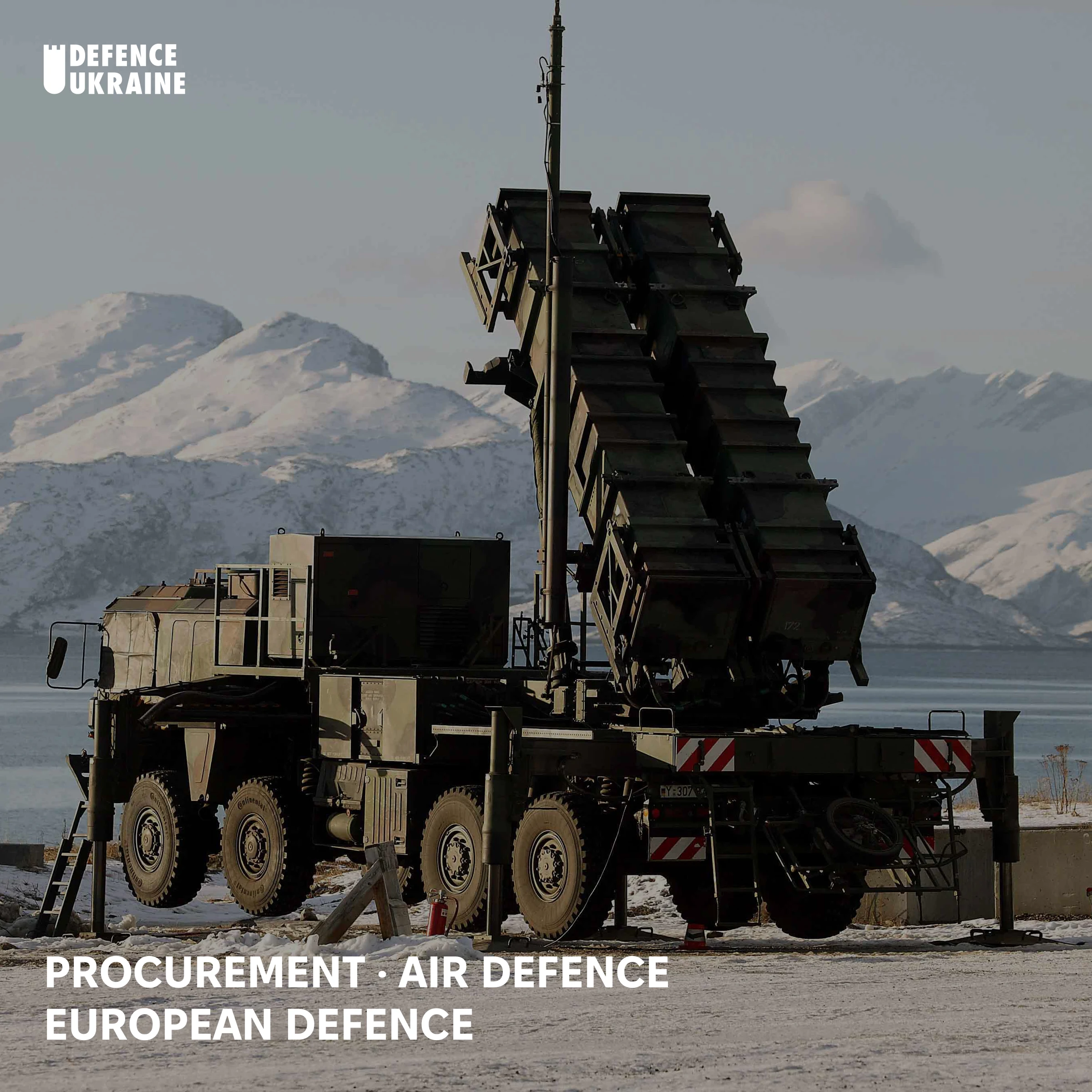
Envoys from member states meet on Monday 7 September to decide whether Ukraine can put roughly €2 billion of the European Union's €90 billion Ukraine Support Loan into American PAC-3 interceptors. Kyiv can already draw down the money. The only dispute before ministers is where Ukraine can spend it.
A procurement rule drives that argument. Weapons bought with loan funds cannot source more than 35 per cent of their value from outside the EU and the European Economic Area, though Ukrainian production counts on equal footing with European manufacture. A PAC-3 Missile Segment Enhancement round, built by Lockheed Martin, misses that threshold entirely. Buying it demands an official derogation, turning what seemed like a procedural vote in Brussels into the most consequential air-defence decision of Ukraine's autumn.
On 25 August, Euronews reported that France was pushing to attach expiry dates to those specific derogations. Paris does not propose an outright ban on non-European hardware. It wants each waiver to expire on a set schedule, ensuring European factories eventually take over orders that American and Chinese suppliers fill today. Ukraine has requested two such exemptions so far: one for Chinese drone components, and one for the Patriot interceptors it needs before winter.
What the Origin Rule Demands in Practice
The 35 per cent cap is not an allowance Ukraine can draw down at will. It operates as a ceiling over an item-by-item waiver process, leaving the burden of proof entirely on the borrower.
Kyiv must submit an individual application for every derogation, which the European Commission weighs against four benchmarks: whether an EU-made equivalent answers the urgent frontline requirement, whether European producers can deliver the necessary volume, whether manufacturing lead times are short enough, and whether the price tag is acceptable. Passing a single test settles nothing. The Commission must verify that European manufacturers cannot deliver the weapon system, at the scale needed, in the time remaining.
The renewal process gives the regulation its teeth. Each waiver ties to a specific purchasing timeline and requires fresh paperwork whenever Ukraine submits another payment request. No blanket carve-out exists. A derogation issued for one delivery batch of PAC-3 rounds provides zero clearance for the next, so the clash France started in August will restart whenever Kyiv asks for more cash.
Ukraine stands inside this wall as well as behind it. Because Ukrainian manufacturing counts as EU-origin, the rule restricting Kyiv's overseas orders simultaneously protects domestic builders from non-European rivals. Defence Ukraine's examination of the €60 billion military allocation within the loan laid out the structure this rule guards: a funding mechanism built to weave Ukrainian suppliers directly into European defence orders rather than simply pay for finished goods. The Auterion-Airlogix partnership shows this clearly. On 3 September, factory floors began turning out more than 5,000 medium and long-range strike drones under a €300 million German contract, with the Ukrainian partner building the airframes and Auterion providing the software navigation stack, built at plants near Munich and in eastern Germany. Ukrainian engineering, European assembly, origin standard met.
That setup scales for expendable airframes. It cannot scale, on any timetable relevant to this winter, for hit-to-kill anti-ballistic interceptors.
The French Argument and Its Missing Bridge
The French argument makes sense, and carries far more weight than dismissive claims of simple protectionism imply. Bonds issued jointly across European capital markets and backstopped by the EU budget serve, in Paris's view, as an engine to rebuild European defence industrial capability. If €60 billion of that pot heads to American prime contractors, Europe ends the decade tied to the same foreign dependencies, after paying billions for the loan.
Paris also commands the industrial commitments to support its case. France pledged eight Franco-Italian SAMP/T NG systems to Ukraine under the November 2025 Macron-Zelensky bilateral agreement, a transfer worth roughly €3 billion. Denmark reinforced that buying pattern on 21 April 2026 with a €1.47 billion contract for four SAMP/T NG batteries, turning down the Patriot over delivery schedules. The 14 July 2026 France-Ukraine joint declaration broadened those ties, covering 16 Rafale aircraft, SAMP/T NG systems, and licensed Ukrainian production of Aster 30, SCALP and AASM munitions. A waiver framework that allows Ukraine to keep buying American rounds without end weakens every one of those deals.
The flaw in the French case is not its logic. It is the lack of a bridge.
Paris has offered no sped-up shipments, no stopgap handovers from French military stocks, and no surge pledge to carry Ukraine through the gap while European factories spin up. Crews deployed the eight SAMP/T NG systems to Ukraine for combat qualification, meaning the hardware has not yet proven under fire what the French stance takes for granted. Eurosam ran successful firings of the Aster 30 Block 1NT in October 2024, July 2025 and December 2025, entirely under test range conditions. Against live manoeuvring ballistic targets inside contested electronic warfare, crews are writing that record right now in Ukrainian airspace, and the verdict is not in. Defence Ukraine's breakdown of Ukraine's air-defence pivot treated that combat evaluation as the single most consequential procurement choice in European air defence this decade. Demanding that Kyiv wager its winter on the result, before anyone knows the outcome, is what French officials are asking in practice.
Nine Ministers and the Patriot Supply Chain
In July, the defence ministers of Sweden, the Netherlands, Germany, Denmark, Estonia, Poland, Latvia, Finland and Lithuania sent a letter to Kaja Kallas and Andrius Kubilius arguing the opposing view. "We continue to stress that the swift approval of product schedules is crucial, including through the pragmatic use of the derogation for the purchase of materiel produced by third countries," the letter said. No minister has backed away from that statement since.
Viewed through threat perception, the nine appear as a Nordic-Baltic frontline coalition backed by two large powers. Viewed through manufacturing interests, they look very different. Germany and Poland do not buy Patriot hardware as detached observers. Germany's Ministry of Defence bankrolled the $3.7 billion RTX contract for GEM-T interceptors delivered to Ukraine in April 2026, while MBDA Deutschland forms one half of COMLOG, the joint venture setting up Patriot production at Schrobenhausen. Poland's state armaments group integrates Patriot batteries into the Wisła programme alongside CAMM-ER effectors. Both states have capital and factory lines depending on the Patriot network remaining eligible for EU loans.
That shifts the debate. This is not simply Europe versus America. It is a French European-content case clashing with a German and Polish European-content case, where the second faction places its European workshare inside an American weapon.
Schrobenhausen Produces the Wrong Missile
The plain escape hatch is definitional. If workers build enough of a Patriot missile in Europe, the weapon ceases to count as non-EU materiel, wiping out the need for a derogation. Several officials have floated that solution. Manufacturing realities do not bear it out.
COMLOG, established in 1987 by MBDA Deutschland and Raytheon, is putting up a roughly 6,000 square metre plant at Schrobenhausen as Europe's first Patriot assembly line. Workers expect to finish the site in September 2026, opening production late this year and making initial handovers in early 2027. Orders covering up to 1,000 rounds for Germany, the Netherlands, Romania, Spain and Sweden are already locked down. Initial serial handovers on those European purchase orders are slated for 2028.
The plant produces the PAC-2 Guidance Enhanced Missile-Tactical. The GEM-T relies on blast fragmentation: it destroys aircraft, cruise missiles and older tactical ballistic threats, but was never built for terminal hit-to-kill collisions that knock down an Iskander-M or a KN-23. That task requires the PAC-3 MSE, which Lockheed Martin manufactures in the United States and which no European plant builds or plans to build.
So the legal exit shuts twice over. The European Patriot site will not ship at volume before 2028, and once deliveries begin, it will hand over the wrong weapon for the ballistic threats that triggered the derogation request. A Schrobenhausen-assembled GEM-T is fully European. It is also not what Kyiv requested.
Chinese Components European Industry Cannot Replace
The second live derogation draws less attention and proves harder to defend on principle. Ukraine secured an exemption for the loan's initial defence tranche, valued at €5.9 billion and dedicated entirely to drones, to buy Chinese components that European manufacturers cannot supply at the needed scale or cost.
The items are mundane: electric motors, flight controllers, electronic speed controllers, batteries, optics. European and Ukrainian companies build strong systems at the high end, where automated flight and resilience against electronic warfare generate value. Nobody in Europe can match Shenzhen in the cheap component tier that FPV and one-way-attack airframes burn through by the hundred thousand. An EU framework designed to build European industrial autonomy ends up paying Chinese suppliers, because the only alternative is fielding fewer drones.
The strategic price is real and cuts both ways. Beijing can restrict exports whenever it likes, and that commercial pipeline supplies the Russian military as well: the Geran-4 that Ukraine must now shoot down runs on a Chinese-supplied Telefly turbojet, as Defence Ukraine's investigation into the jet-powered Shahed threat documented. Ukraine buys parts from the exact industrial ecosystem that supplies the drones targeting its cities. European ministers understand this. They approved the derogation anyway, because frontline drone losses do not pause for industrial strategy.
Why the Derogation Is Not the Main Bottleneck
Assume Monday's ballot breaks Kyiv's way, as appears likely. France cannot block the decision single-handedly: operational steps under the loan pass by qualified majority voting among participating member states, and with Germany and Poland aligned against Paris, assembling a French blocking minority is numerically difficult. Ursula von der Leyen said on 2 September that member governments were examining the bid and "it's going in the right direction."
Approval does not build interceptors.
The first bottleneck is American. Exporting PAC-3 rounds still demands US government authorisation, and Washington holds the reins no matter who pays the bill. Defence Ukraine's report on the Patriot licence announced and swiftly pulled mapped how quickly political promises on Patriot systems can flip in Washington. EU money clears a European barrier. It leaves the American barrier standing.
The second barrier is arithmetic. At US Army price points of $4 million to $5 million a missile, $2.3 billion purchases between 460 and 580 interceptors. At the $6.61 million per missile Germany paid in late 2024, it purchases about 315. At the $12.3 million rate approved for Saudi Arabia in January 2026, it covers about 190. Lockheed Martin turns out roughly 600 PAC-3 rounds each year against an objective of 2,000 by 2030, while Ukrainian crews fire 60 to 70 interceptors in an average month. President Volodymyr Zelensky disclosed on 21 August that yearly receipts plunged 61 per cent, from 675 rounds in 2023 to an estimated 264 in 2026, against a stated winter requirement of 300.
The third constraint is contractual. Releasing loan cash requires signed purchase deals, not approved procurement timetables. Ukraine's Defence Procurement Agency must turn Monday's political pact into signed contracts with an American prime holding a jammed order book, and Defence Ukraine's review of the 35 per cent origin rule across its opening year found that payout pipelines run consistently slower than the political bodies that authorise them. Officials have actually released roughly €8.5 billion of the loan since June.
Strategic Implications for Ukraine
The origin rule dictates what Ukraine can buy, but it marks only one of three gates separating an invoice from an interceptor on the tarmac. Four key implications emerge for Ukrainian defence planners through the end of 2026.
- The exemption battle repeats on every tranche. Because derogations terminate when their underlying procurement schedules lapse, Kyiv runs into this barrier at the next funding draw-down, and on every subsequent one. The French plan would codify that grind with binding expiry deadlines. Ukraine's Ministry of Defence and its procurement agency need an enduring file of evidence, not a single plea: recorded European lead times, recorded production shortfalls, recorded unit costs. That requires building institutional capacity, which matters far more than carrying any single vote.
- European origin works for drones but fails for interceptors. The Auterion-Airlogix joint venture shows how Ukrainian industry satisfies the origin threshold by running assembly inside the EU, a route available across the consumable-drone fleet. That avenue remains barred for anti-ballistic air defence until European factories field a viable hit-to-kill missile. Ukrainian planners must manage these two sectors under separate rules, because operational realities demand nothing less.
- Winning a derogation puts no missiles on the launcher. The hard ceilings on PAC-3 deliveries remain Lockheed Martin's factory output and US export authorisation, neither of which Brussels commands. Kyiv can secure an approved delivery schedule and signed EU financing yet gain zero new interceptors if Washington delays export approvals or order books stay packed. Entering the winter on the gamble that Monday's vote fixes the missile deficit would be a grave miscalculation.
- SAMP/T NG performance will settle the fight France cannot win politically. Ukrainian crews are running combat trials on eight systems right now. If those batteries shoot down incoming Iskander-M and Kinzhal salvos, the French position transforms from an industrial lobbying pitch into proven combat performance, tightening the derogation rules automatically. If they do not, EU authorities will continue stretching the origin rule over a capability gap European industry has failed to close.
The clash that broke out in Brussels in late August is real, and France rightly argues that spending European loans on American missiles expands American manufacturing capacity. Yet Paris offers no answer to what Ukrainian air-defence crews must fire in the meantime. The Schrobenhausen facility begins assembly only at the close of this year, and its first European serial deliveries arrive in 2028. Russian missile strikes will not respect that timetable.
Monday's vote picks the budget line that funds the interceptors. It does not bring them into existence.