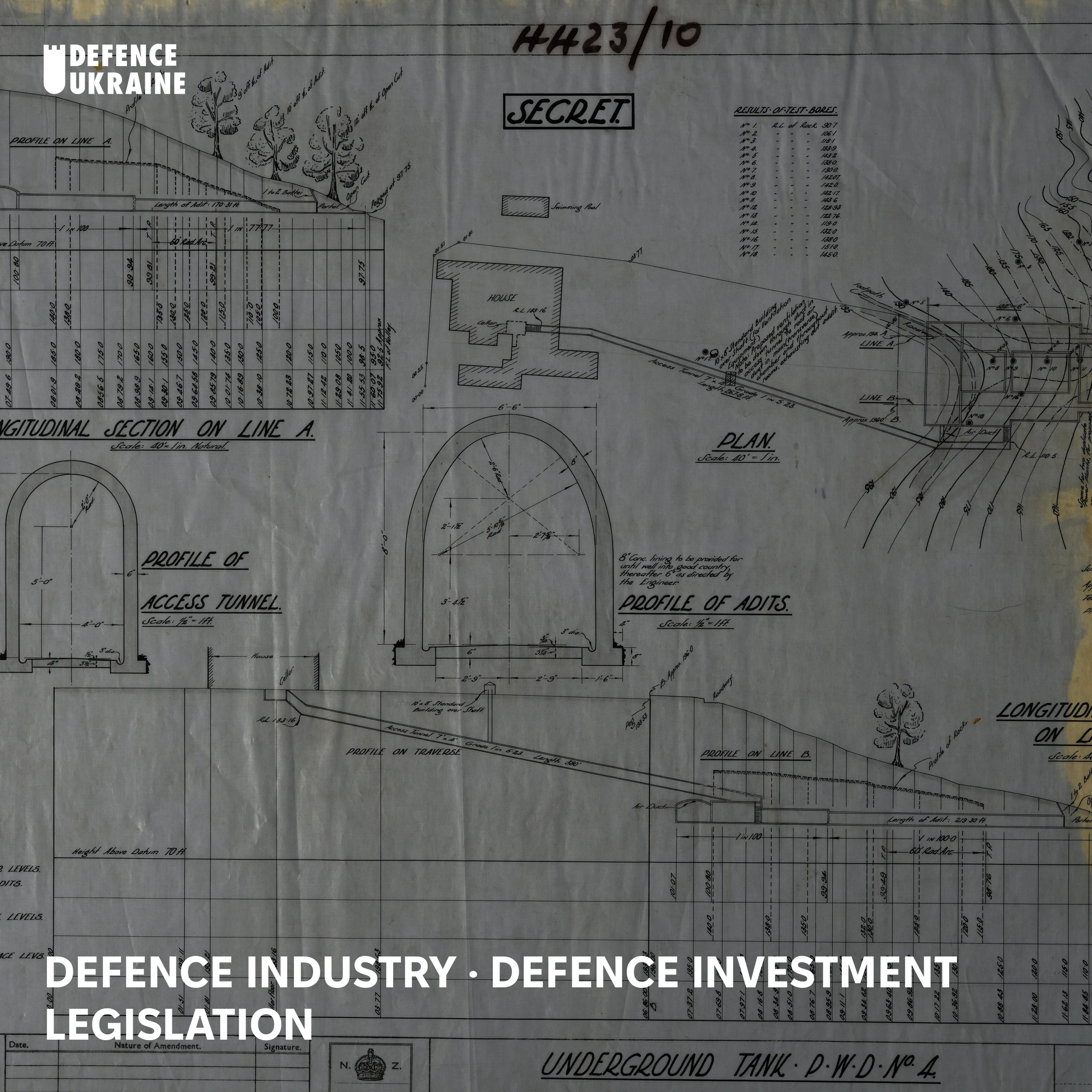
On 9 September 2026, one day after returning to the post of Deputy Minister of Defence, Hanna Hvozdiar announced that her ministry had drawn up rules for a new category of defence plant. "We have developed comprehensive amendments to Cabinet of Ministers Resolution No. 1494 to create the legal conditions for building protected underground production infrastructure," she said, according to LB.ua. Private developers and commercial investors would build the sites "using their own or raised funds, and then transfer them to defence-industry enterprises for ownership, use or lease."
That statement describes a draft. It does not establish a rule. Subsequent reporting has largely blurred that distinction, and the difference matters because the plan separates four functions that a state arsenal normally keeps together: who buys the concrete, who holds the title, who runs the machines inside, and who carries the loss when a missile strikes. The draft settles the first three problems. On the fourth, the public record says nothing.
A Draft Rooted in an Experiment
Resolution No. 1494 is not new, and the government did not draft it for underground works. The Cabinet of Ministers approved it on 19 November 2025 as an experimental project covering new construction, reconstruction and capital repair of production buildings in the defence-industrial complex. In its original form it applied to a single state enterprise.
On 24 April 2026, Resolution No. 525 expanded the experiment. The amended text opened access to Defence City residents, to enterprises the Ministry of Defence classes as critical, and to a specified roster of state and private producers in an appendix. It also widened the permitted capital sources: participants could pay for projects out of their own resources, charitable donations, or funds from international financial institutions.
The September proposal marks the third step. It would permit an entity outside the defence sector entirely, a developer or an investor, to build the facility and hand it over. Reporting on 11 September, Interfax-Ukraine described the amendments as developed, matching the status the ministry itself has claimed. The government has published no text. No Cabinet vote has been reported through 18 September 2026. Militarnyi's English-language report used the identical phrasing: the amendments "have been prepared".
Hvozdiar put the stakes in less procedural terms. Building underground, she said in remarks reported by Interfax-Ukraine, is a new reality that Ukraine will have to live with for as long as Russia exists.
The same announcement contained two smaller financing proposals whose costs are simpler to calculate. Concessional lending to defence producers had cleared UAH 10 billion, according to Interfax-Ukraine's account, and the ministry wants to lift the ceiling on working-capital loans from UAH 100 million to UAH 500 million. Like the underground amendments, that increase remains a proposal.
Four Roles and a Missing Guarantor
The draft's own phrasing shows the logic of the model. The state does not pay for excavation. A private investor shoulders the capital cost, holds title until transfer, and recovers the outlay through sale, a use arrangement, or rent. The defence company runs the line. The draft's own description accounts for each of those three parties.
Nobody can name the fourth. A facility built to survive attack is, by definition, an asset the adversary intends to destroy. Commercial lenders calculate that danger before they price anything else. As described publicly, the draft contains no war-risk guarantee.
The closest policy tool is broad. At the YES-2026 meeting on 12 September, Prime Minister Serhii Koretskyi said the government planned a separate budget line for war-risk insurance, preliminarily set at $1 billion, to build a reserve covering 40 to 50 per cent of losses from attacks. "We expect international partners to multiply this amount," he said, according to the Cabinet of Ministers. The fund targets business in general. No government statement has linked it to protected defence production, and it remains an intended budget item, not an adopted one. It is also a partial shield by design: relying on the Prime Minister's numbers, an investor in a destroyed facility would still carry half or more of the loss.
Commentators sometimes cite another bill alongside the underground plan, but it does not belong there. Bill No. 14117, which the Verkhovna Rada passed at first reading on 19 August 2026 by 274 votes, allows regional military administrations to impose one-year easements on private agricultural land for fortifications and military engineering structures. Compensation is set at 12 per cent of the land's normative valuation and must be paid within two years of the end of martial law. It is a trench-and-obstacle statute for farmland. It does nothing for a commercial investor building a factory.
Defence City: The Tax Half of the Framework
The underground draft does not stand alone. It leans on a tax regime that is already on the statute books and operating.
Defence City rests on two statutes signed in 2025: Law No. 4577-IX, amending the Tax Code, which entered into force on 5 October 2025, and Law No. 4578-IX, amending the Customs Code, in force from 24 October 2025. Cabinet implementing regulations followed at the close of 2025, and the Ministry of Defence opened the register in January 2026. The regime runs until 1 January 2036 or until Ukraine joins the European Union, whichever comes first.
Residents must generate at least 75 per cent of their revenue from defence activity, or 50 per cent in the case of aircraft manufacturers. In return they pay zero corporate income tax, subject to two rules: they pay no dividends except to the state, and they reinvest the untaxed profits in defence production, technology or research by 31 December of the following year, according to a September 2025 review by Deloitte Ukraine. Unused sums become taxable. Residents also gain exemptions from land tax, environmental tax, and property levies on production buildings they do not rent out, alongside streamlined customs and export-control procedures.
That reinvestment requirement forms the bridge between both halves of the policy. A tax break that companies can spend only on manufacturing capacity amounts to a state contribution to capital works that never shows up as budget expenditure. A resident that builds or leases a protected facility spends revenue the state chose not to collect. The underground draft brings private outside money into that pool. It does not replace it.
The accession clause is the policy's most unusual provision. Selective tax privileges of this type run directly counter to EU state-aid rules, and Kyiv wrote that tension into the statute rather than leaving it to diplomats. For an investor, the practical result is a fixed horizon. A project funded in 2027 on the premise that its tenant pays no corporate income tax may see that premise collapse when the accession treaty enters into force.
Fifty-One Residents and a Flat Revenue Trend
The Ministry of Defence publishes the register's size as new companies enrol, and the official data reveals a much more specific story than the headline numbers.
On 29 May 2026, the ministry reported 31 residents with combined qualifying revenue of UAH 89.7 billion. By 24 July, according to ministry data cited by Mezha, the register held 45 residents and qualifying income exceeded UAH 93.5 billion. On 9 September, Hvozdiar put the total at 51 companies and the income at more than UAH 93 billion.
Twenty companies entered between late May and early September. Over that span, combined qualifying income rose by roughly UAH 4 billion, or about 4 per cent. The arithmetic implies that the industrial heavyweights joined first and that latecomers are small. The regime's overall economic weight, about $2.2 billion in qualifying income, has barely shifted since spring.
That fact matters for the underground plan. A protected factory is a large, capital-heavy undertaking, and the pool of residents able to sign up for long leases has not expanded at the pace the raw headcount suggests.
The fiscal cost is unknown. Neither the Ministry of Finance nor the Accounting Chamber has published an estimate of revenue forgone under Defence City, and the structure of the regime makes an independent estimate difficult.
Deliberate Opacity
Defence City residents do not have to publish annual or consolidated financial statements until three months after martial law ends. That deferral represents one layer of a broader system of rules that pulls Ukrainian defence manufacturers out of public view.
Cabinet Resolution No. 1257 of 3 October 2025 lets defence manufacturers designate which electronic databases must restrict access to their records. More than 250 companies had asked the Ministry of Defence to restrict access to their profiles on YouControl, the Kyiv business-intelligence platform, according to a May 2026 report published by Defender Media on YouControl's research. Since 18 November 2025, under Law No. 4576-IX, the State Register of Property Rights has concealed cadastral numbers and property addresses below settlement level, making an exception only for banks operating under service agreements.
The security justification is obvious: a listed address gives the enemy a target coordinate. The downsides are just as clear. YouControl's analysts argue that shutting off data makes counterparty asset checks impossible, multiplying corruption risks and the threat of covert asset seizures, while corporate "invisibility" leads foreign banks to reject partnerships or block currency transactions under know-your-customer and anti-money-laundering regulations. YouControl sells the very information these measures conceal, so its warnings are not disinterested. But the compliance hurdle it describes remains real for any foreign investor asked to back a facility whose tenant it cannot fully vet.
The ministry stands on both sides of that line. In August it made YouControl screening mandatory for every prospective defence contractor, even while hundreds of arms makers used a Cabinet resolution to pull their records from that platform's public view. The state can still see what it needs. A private financier in Frankfurt or Toronto cannot, unless Ukraine builds a controlled disclosure mechanism for them. Kyiv has announced none.
The Order Book Underneath the Concrete
A protected plant pays for itself only if it has orders to run. In February 2026, Hvozdiar, then serving as an adviser to the Minister of Defence, said Ukrainian manufacturing capacity had grown fiftyfold during the full-scale war, reaching up to $50 billion. A higher figure of $55 billion for 2026 circulates widely in secondary reporting, but Defence Ukraine could not trace its primary source. The gap between factory capacity and funded procurement orders is the older and better-documented problem. A year prior, Herman Smetanin, then Minister of Strategic Industries, put 2025 capacity at $35 billion and said Ukraine could contract only about a third of it.
Kyiv has shrinking room to close that gap. On 14 September, Koretskyi said Ukraine's public finances were nearing a critical situation and warned that delays in parliamentary votes could forfeit a substantial share of $29.5 billion in international funding, according to Ukrainska Pravda. The government has moved its deadline for 42 reform decisions forward to 15 October. That sits on top of the $27 billion defence funding request and the five channels meant to carry it.
The partner money that does arrive buys finished output. Resolution No. 525 already allows international financial institution funding inside the construction experiment, but no foreign government or institution has publicly pledged capital to a protected production facility in Ukraine as of 18 September 2026. Hvozdiar's appearance at a National Defence Canada business event in Calgary on 17 September, according to the Ministry of Defence, focused on joint manufacturing, supply chains and investment in broad terms; the ministry's readout makes no mention of underground construction or Defence City.
Protection by distance is the rival strategy, and it taps the same thin pool of capital and engineers. Licensed production of Western systems shifts certain production lines out of strike range entirely, or leaves final assembly in Ukraine while partners build the costliest components abroad. The underground draft represents the domestic answer: sovereign production lines that remain in the country and go beneath the surface. Kyiv has released no study comparing the two approaches on cost or timetable, and the Ukrainian government has put no estimate on record for the construction premium of protected underground plants.
Strategic Implications for Ukraine
The policy has two finished pieces and one unfinished one, and that unfinished piece carries most of the risk.
- Formal approval is the first test, and the published text is the second. Until the Cabinet adopts the Resolution No. 1494 amendments and puts them in print, no investor can calculate project costs, because the rules governing title, asset transfers, and remedies for attack damage remain unknown. A published regulation with a clear transfer process would turn an announcement into a workable financial tool. A long delay between this announcement and Cabinet approval will signal that the Ministry of Finance or ministers harbour doubts the Ministry of Defence has not acknowledged in public.
- The war-risk question decides whether private money shows up at all. The $1 billion insurance reserve outlined by the Prime Minister covers 40 to 50 per cent of losses and targets ordinary commercial business. A private backer of a protected plant would bear the remaining loss alone. Either protected defence factories secure a ring-fenced guarantee from the Ukrainian state budget, an allied government, or an institution like the EBRD, or this underground strategy will rely almost exclusively on Defence City residents ploughing their own untaxed earnings back into concrete, which current law already permits.
- Roster expansion no longer translates into industrial growth. Twenty new residents lifted combined qualifying income by only about 4 per cent. The Ministry of Defence's next data release will show whether major manufacturers still sit outside the system or whether Defence City has hit its natural ceiling. If the roster has peaked, the tax-shielded revenue pool available to fund self-financed underground projects cannot grow much further.
- Opacity requires a controlled exit for foreign capital. The current register rules shield factories from missile targeting while cutting foreign compliance departments off from the data their regulations demand. A secure, vetted disclosure mechanism for qualified financiers and their lenders, run directly by the Ministry of Defence rather than through open public portals, would allow the state to protect site coordinates without forcing every foreign transaction through an ad hoc compliance bypass. The 2027 budget debate represents the earliest chance to fund that channel and give it legal standing.