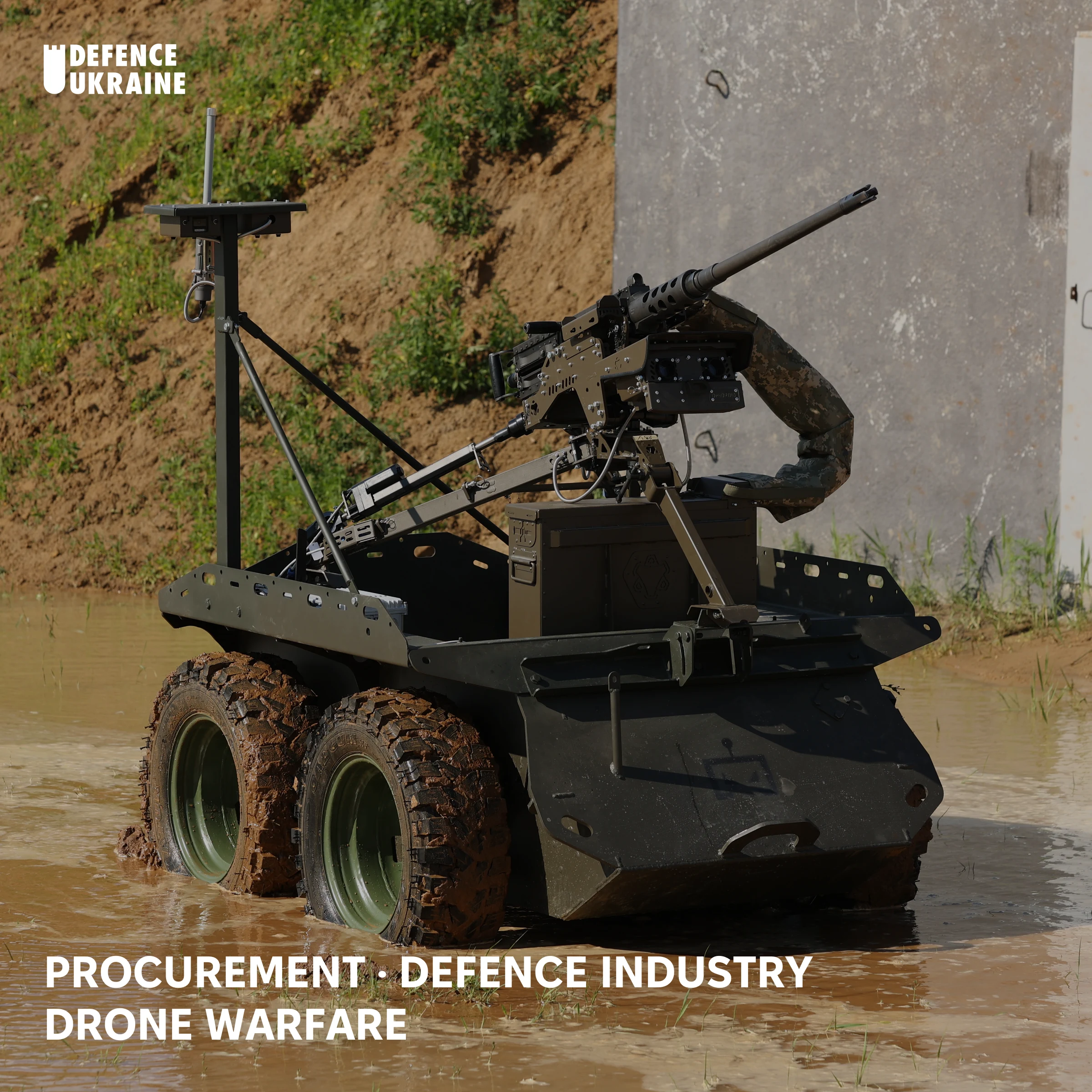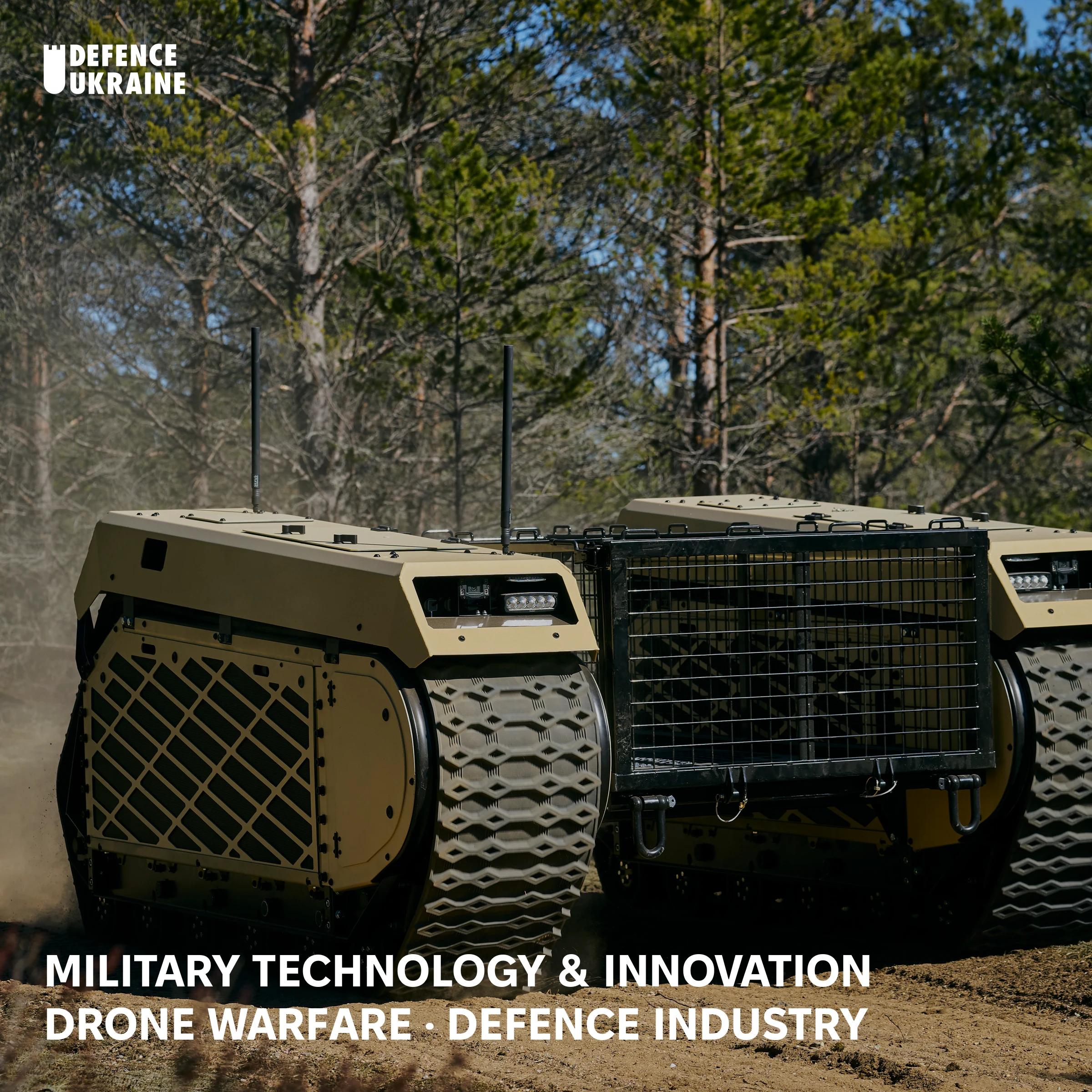
The Ukrainian Ministry of Defence logged nearly 24,500 unmanned ground vehicle missions in the first three months of 2026, with more than 9,000 in March alone. The number of Ukrainian units operating UGVs rose from 67 in November 2025 to 167 by March 2026. Between 2022 and early 2026, ground robots moved from a niche battalion experiment into a distributed support layer embedded inside brigade operations: resupply, casualty evacuation, mine-laying and mine-clearing, engineer work, and selective assault. The transition is the clearest evidence yet that Ukraine's defence industrial base has built a category of weapon the rest of NATO has studied in theory but not yet fielded at scale.
The central doctrinal innovation is not robot autonomy. It is combined human-machine assault, where aerial reconnaissance, FPV strike teams, and armed or cargo-carrying UGVs act inside a single planning and mission-management layer, while infantry still secure and hold the ground.
From Niche to Routine
The tempo data from DELTA, Ukraine's battlefield management system, show how fast the integration has happened. The Ministry of Defence's top five UGV-using formations in March 2026 were the 3rd Separate Assault Brigade, the 1st Separate Medical Battalion, the UGV company of the 92nd Assault Brigade, the 95th Air Assault Brigade, and the Spartan brigade of the National Guard. The mix is telling: an elite mechanised assault formation, a medical battalion, an air assault unit, and a National Guard brigade are all counted in the same tempo report. UGVs have stopped being specialised kit and started being standard brigade equipment.
On 13 April 2026, President Volodymyr Zelensky told Ukrainian arms makers that ground robotic systems had carried out more than 22,000 missions in the preceding three months. The divergence from the MoD's 24,500 figure reflects different counting methods and reporting windows rather than contradiction, but both numbers tell the same story: a distributed, brigade-level capability operating at industrial cadence. Azov publicly demonstrated its Zmiy robotic complex extinguishing a fire after a Russian strike near Kramatorsk in April 2026, a non-assault task that nonetheless shows UGVs absorbing the dangerous post-strike engineering work that would otherwise kill sappers. The 35th Marine Brigade used ground robots for food and ammunition resupply and for evacuating wounded personnel from zones where humans could no longer go.
The Ukrainian Industrial Base
The industrial base that feeds these missions has broadened from a few volunteer workshops in 2022 into a recognisable ecosystem. Brave1, the state-backed defence-tech cluster, had awarded 329 grants totalling roughly $5 million by September 2024. By the end of 2025, Brave1 reported that more than 50 Ukrainian defence-tech startups had raised over $105 million from private investors that year. A €3.3 million EU-backed grant line, EU4UA Defence Tech, launched in December 2025 with individual awards of up to €150,000. In April 2026, Deputy Prime Minister Mykhailo Fedorov said the Defence Procurement Agency had already signed 19 UGV contracts worth UAH 11 billion and planned to contract 25,000 unmanned ground systems in the first half of 2026, roughly twice the 2025 volume.
The clean-sheet Ukrainian producers are the most visible part of this base. Ratel Robotics, which pivoted to military robotics from professional street lighting after the full-scale invasion, said in August 2025 it had increased UGV production almost fivefold year-on-year and was serially producing three variants: the Ratel S loitering or mining robot, the Ratel M logistics platform, and the Ratel H casualty-evacuation platform. Founder Taras Ostapchuk has said the Ratel S costs from $25,000 per unit. In January 2026 he disclosed a move to Ukrainian-made engines to phase out Chinese components, the clearest public sign of powertrain localisation in the sector.
Roboneers, whose origins trace back to 2014 volunteer development of the ShaBlya remote weapon turret, fields the Ironclad combat UGV and a growing family of armed platforms. DevDroid has taken a modular approach, publishing the Droid TW 12.7 armed UGV, the NW 40 grenade-launcher carrier, the Wolly 7.62 combat module, and the Droid Box universal control system, with the value proposition sitting as much in the fire-control stack as in the chassis. Ukrainian Unmanned Technologies, whose work traces back to 2016 ATO-zone volunteer development, produces the Lyut combat UGV and the Ravlyk logistics platform.
Frontline Robotics is a different kind of case: an integrator rather than a mass chassis producer. Its flagship land contribution is BURIA, a codified remote weapon station that can be fitted to multiple mobility bases, including Milrem's THeMIS chassis. In April 2025, Frontline closed a seed round led by the German drone manufacturer Quantum Systems, which took a 10 per cent stake, and later became part of the Quantum Frontline Industries expansion in Germany. That arrangement is the clearest public example of the model likely to shape the sector: Ukrainian battlefield IP combined with European manufacturing finance and export pathways. Defence Ukraine's analysis of Europe's defence investment boom traced the emergence of this pattern at the fund level; Frontline shows it operating at the company level.
Beneath those named firms sits a broader tier whose corporate details are thinner but whose platforms are real. Zelensky's April 2026 arms-makers address named Ratel, TerMIT, Ardal, Rys, Zmiy, Protector, and Volia as ground robotic systems already completing tens of thousands of missions. Publicly, the sector is strongest in chassis fabrication, welded metalwork, board integration, remote weapon modules, and in-field repair. Motors, battery cells, and certain electrical subcomponents have been heavily import-dependent, which is why the Ratel engine localisation matters beyond any single platform.
Combined Human-Machine Assault
The most important operational innovation is not any single platform. It is the doctrinal sequence that ties aerial, ground, and human elements into one mission.
The December 2024 Khartiia brigade operation near Hlyboke and Lyptsi in Kharkiv Oblast set the template. Reuters reported it as a "machine-only ground assault" combining assault, mine-laying, and mine-clearing vehicles guided by drones overhead. A June 2025 United States Army Training and Doctrine Command analysis then characterised the Khartiia attack as a first-of-its-kind uncrewed combined-arms assault involving more than 50 systems. Planning began in July 2024 and focused on three areas: maintenance and training, electronic warfare and terrain analysis, and AI integration for enhanced targeting. Larger multirotors conducted mine-laying, surveillance, and communications relay. Smaller FPV drones identified targets and cued the ground vehicles. Armed or explosive UGVs conducted the dangerous approach. Two ground systems were lost in the operation, both to mud rather than enemy fire, a detail that says more about current doctrine limits than the weapons debate does.
The 3rd Separate Assault Brigade took the model further. In July 2025, the brigade's NC13 unit, part of the DEUS EX MACHINA unmanned-systems company of the 2nd Assault Battalion, attacked a Russian position in the Kharkiv sector using only FPV drones and ground robots, compelled Russian soldiers to surrender, and took them prisoner without exposing infantry during the assault itself. The brigade later established a standing UGV school to train operators and absorb manufacturer feedback directly into tactics and maintenance, converting ad hoc crews into a repeatable formation. The same brigade's integration of micro-UAVs and ground systems into squad-level operations was covered in Defence Ukraine's analysis of the Black Hornet and Ukrainian urban combat.
DELTA sits across this picture as a common management layer. Units plan logistics and evacuation missions inside the system, mission completion is verified and scored, and the Ministry of Defence uses the resulting data to award combat points that units can exchange for more technology through Brave1 Market. The design is not accidental. It is a procurement doctrine that rewards units for using robots well, then lets the successful users pull more kit faster. The battlefield selects, not the committee.
Demining at Scale
Ground robotics in Ukrainian mine action divide into two categories that overlap in hardware but differ in rules and reporting. Military engineer work is about route opening, breaching, and risk transfer under threat of artillery and drones on or near the contact line. Humanitarian mechanical clearance is about scale, IMAS-standard release of land, and survey-verify-clear sequencing in liberated territory.
The best-documented heavy military-engineer platform is the Danish-donated Hydrema MCV 910. The Ministry of Defence said in July 2025 that Hydremas had cleared more than 560 hectares in the Kharkiv region since 2024. On the humanitarian side, the Swiss-built Global Clearance Solutions GCS-200 is the dominant family: 62 machines were operating across Ukraine by March 2025, with 26 more due that year, and GCS produced its 100th GCS-200 in April 2026. The Croatian DOK-ING MV-10 line is also in Ukrainian service, with 17 machines reported by the government in June 2024 and partial local assembly. Five more Slovak Bozena systems were transferred under an October 2025 agreement, adding to the Bozena 4+ and 5+ vehicles already in humanitarian use.
Indigenous mechanical demining is now moving past pilot scale. The Rover Tech Zmiy passed certification testing in September 2024. In February 2026, the domestic UDM Vormela was certified, with armoured steel construction and a claimed clearance rate of up to 2,500 square metres per hour. The armed forces' mechanised demining fleet also includes domestically produced MR-3101 machines alongside foreign types.
The absolute numbers remain tilted toward manual and hybrid clearance. The State Emergency Service said in April 2026 it had cleared nearly 200,000 hectares and neutralised about 600,000 explosive items since the start of the full-scale war. The Ministry of Defence said its mine-clearance units cleared 66,267 hectares in 2025. FSD reported in November 2025 that SESU's 98 mechanical demining vehicles had cleared "more than 2,700 hectares," a small slice of the aggregate. Mechanical UGVs are not replacing sappers; they are letting sappers work in sequence, with first-pass mechanical clearance followed by manual verification. The scale of the broader demining challenge, and why mechanical clearance matters inside it, is covered in Defence Ukraine's analysis of Ukraine's demining effort.
The Russian Response and the EW Problem
Russian forces have not matched Ukraine's UGV tempo. Legacy demonstrator systems such as the Kalashnikov Concern Uran-9 and the Marker test programme remain in Russian media coverage, and discussion of Sturm- and Kurier-type concepts continues, but battlefield reporting points to narrower roles for Russian ground robots: logistics, resupply, ad hoc mine-laying, localised experimentation. Ukrainian frontline reporting in early 2026 described Ukrainian border troops destroying Russian robotic mine-layers on the southern axis.
The more effective Russian response to Ukrainian UGVs uses the same tools Russia already fields against UAVs: FPV interception, dense minefields, artillery, and electronic warfare pressure on datalinks and navigation. Highly publicised Ukrainian "hero robots" have been destroyed by fibre-optic FPV drones after successful missions. Robotic assault and robotic logistics do reduce human exposure. They do not eliminate attrition. They shift it into machines and maintenance pipelines.
EW is the durable constraint. Ground robots operating close to terrain and often on short, relay-supported links face a different EW exposure profile from aerial drones, but wide-area GNSS jammers like Pole-21 and communication-disruption systems like Zhitel are serious problems for any unmanned platform. The design response has been predictable and effective: simpler interfaces, more resilient communications, fibre-optic control where the tactical situation allows it. Ratel's newer Nurse TB variant can be controlled over fibre optics out to 20 kilometres, a direct answer to radio jamming. The broader Ukrainian answer to Russian EW pressure, including the domestic fibre-optic drone industry that emerged alongside these ground systems, is covered in Defence Ukraine's analysis of Ukraine's counter-drone and EW innovation.
Western Transfers and the Feedback Loop
The best-verified Western UGV transfers are the THeMIS and Rheinmetall's Hermelin or Ermine family. Milrem delivered an initial 14 THeMIS systems through Germany and Krauss-Maffei Wegmann in 2022. A Dutch-led initiative announced in October 2025 will provide more than 150 additional THeMIS vehicles, with significant final assembly by VDL Defentec, a hybrid model that combines an Estonian base platform, Ukrainian tactical integration, and Dutch-financed manufacturing. In June 2025, Rheinmetall announced that 20 Hermelin vehicles had been contracted by the Dutch Ministry of Defence for Ukrainian casualty evacuation. France committed six ROCUS unmanned demining systems in 2025.
The feedback loop from Ukraine into Western design is unusually well documented. Milrem's leadership has publicly credited Ukrainian operators with forcing design changes that emphasise simplicity, communications resilience, and resistance to jamming and spoofing. BURIA live-fire trials in Ukraine validated the Frontline weapon station on the THeMIS chassis, with accurate target engagement out to 1,100 metres. European mobility bases are now being adapted to Ukrainian weapon modules and Ukrainian operational conditions, not just handed over as finished products. For Western industry, Ukraine is the most demanding field laboratory in the world for contested-environment ground robotics, and the design decisions that survive the eastern front will shape the next generation of NATO ground-robot programmes.
NATO has built institutions to capture these lessons. The Joint Analysis, Training and Education Centre in Bydgoszcz, Poland, was set up specifically to absorb lessons from the war and improve interoperability between allied and Ukrainian forces. In January 2025, NATO's Admiral Pierre Vandier explicitly linked JATEC to "new space, robotics and AI." The US Army's June 2025 TRADOC analysis translated the Khartiia operation into concrete recommendations for large-scale combat operations: team UGVs with UAVs, do detailed terrain and EW analysis, and equip engineer formations with robotic breaching tools.
Strategic Implications for Ukraine
The UGV story carries three implications that reach beyond the immediate tactical advantage.
- The Ukrainian defence industrial base now produces a category of weapon NATO has studied but not fielded. Twenty-five thousand UGV contracts planned for the first half of 2026, alongside a credible domestic ecosystem of platforms, remote weapon modules, and operational doctrine, constitutes a defence-industrial position that most NATO armies cannot yet match. The Ukrainian export question is no longer hypothetical. As European procurement under the €60 billion military component of the EU's Ukraine Support Loan begins to move, the Ukrainian UGV sector is a plausible subcontracting base for European primes, not just a recipient of donated platforms. Whether that opening converts into signed contracts will depend on AQAP certification, export-control alignment, and working-capital support, the same structural barriers that apply to every other Ukrainian defence-tech segment.
- The doctrinal centre of gravity is combined human-machine assault, not robotic autonomy. The public record is consistent across Khartiia, the 3rd Assault Brigade's July 2025 operation, and the DELTA tempo data. UGVs work when they sit inside a layered mission with aerial reconnaissance, FPV strike, a resilient communications stack, and human infantry holding the ground after. Allied doctrine writers, including the US Army TRADOC and the Atlantic Council, have reached the same conclusion. The implication for NATO force structure is unglamorous but consequential: distributed robotic support at squad and platoon level, tied into a common data layer, iterated at wartime speed. Not autonomous conquest.
- The procurement mechanism is a selection mechanism. Ukraine's combined DELTA-plus-Brave1 Market system rewards units for actual mission tempo and lets them pull more technology into their formations based on verified use. That is a procurement doctrine, not just incentive design. It favours maintainable, useful systems over unproven prototypes and lets combat feedback reach manufacturers through a structured channel rather than by chance. For allied procurement agencies still running on multi-year acquisition cycles, the Ukrainian mechanism is the real lesson. The weapons will continue to evolve. The institutional speed with which those weapons are selected, procured, and improved is the structural advantage that matters.
Conclusion
Ukraine did not reach 24,500 UGV missions in a quarter by accident. It reached them through a compounding loop of frontline feedback, brigade-level training pipelines, a grant-and-market system that rewards actual use, and a manufacturing base that has scaled in the middle of a war. The next tests are procurement: whether the Defence Procurement Agency can honour its 25,000-unit 2026 plan; whether Ukrainian producers can convert the Ratel and BURIA precedents into European procurement subcontracts under the EU Support Loan; and whether NATO armies translate the Khartiia doctrine into their own brigades before the next crisis forces the question. The weapons are evidently ready. The procurement question is open.