What It Is
The Ukraine Support Loan (USL) is a €90 billion multi-year facility nested inside the €150 billion Security Action for Europe (SAFE) programme, unblocked by the Council of the EU on 23 April 2026. Of the total envelope, €60 billion is ring-fenced for military procurement and €30 billion for general budget support to Ukraine. The €28.3 billion 2026 operational tranche of the military allocation began flowing in the second quarter of 2026.
The USL builds on the 2024 G7 Extraordinary Revenue Acceleration (ERA) Loan, under which G7 leaders committed approximately USD 50 billion (about €45 billion) to Ukraine, to be serviced by future windfall proceeds on immobilised Russian sovereign assets. The EU tranche of the ERA package was authorised by the Council on 23 October 2024 for up to €35 billion in macro-financial assistance. The European Commission disbursed the first €3 billion in January 2025.
The USL scales that architecture into a dedicated defence-procurement envelope. It gives European capital a direct route into Ukrainian and EU-established defence contractors, backed by a servicing stream built on Russian assets rather than European taxpayer receipts. This is the load-bearing financial engine for the 2026-2027 European procurement cycle in and around Ukraine.
How It Works
The mechanism has three moving parts: borrowing, servicing, and disbursement.
On the borrowing side, the European Commission raises capital on markets under the SAFE regulation, adopted by the Council on 27 May 2025. The SAFE framework mobilises EU-borrowed capital across a 2025 to 2030 window and issues loans to member states and to Ukraine at rates well below what most sovereigns could raise individually.
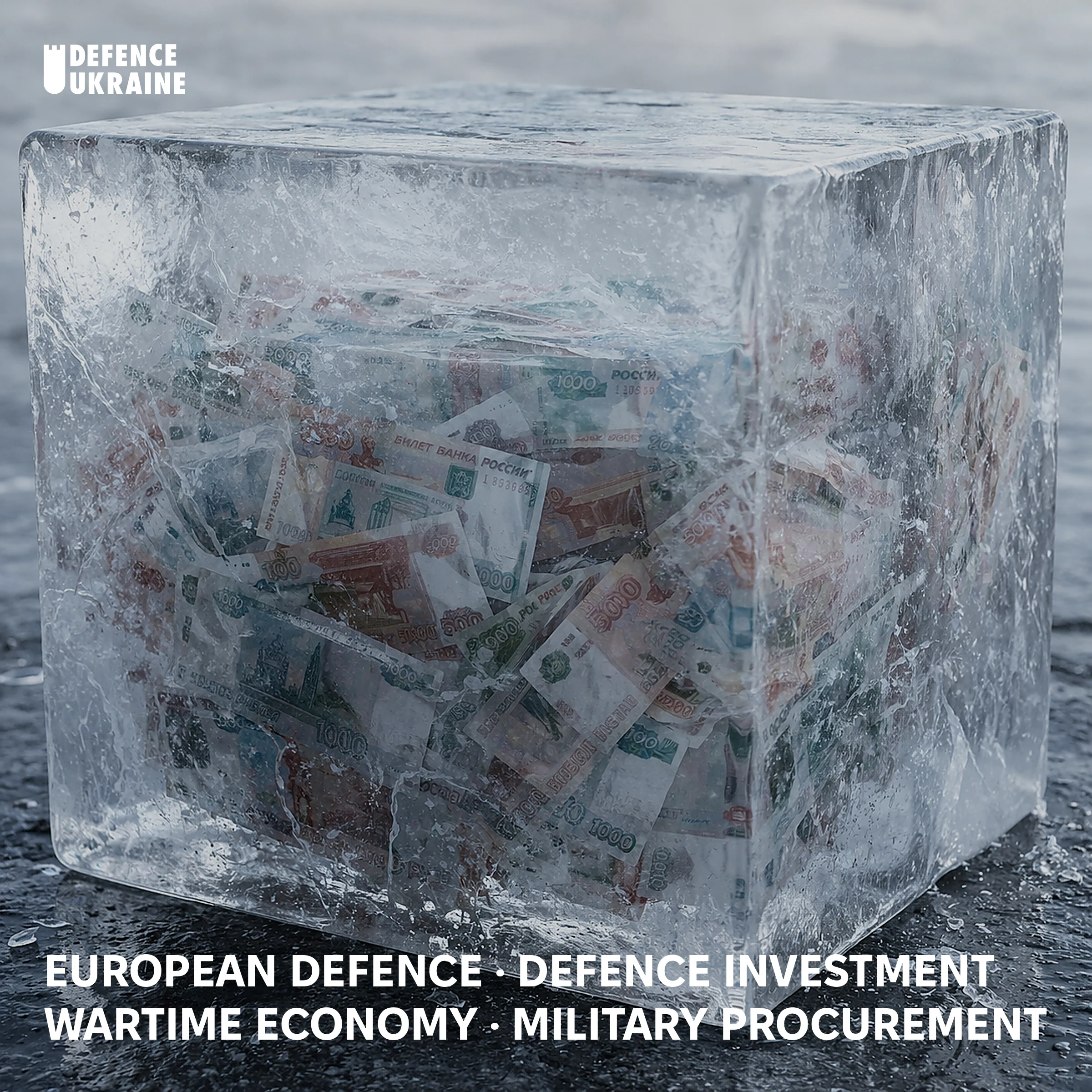
On the servicing side, the Ukraine Loan Cooperation Mechanism (ULCM) captures 95 per cent of future windfall proceeds on immobilised Russian sovereign assets held in EU Central Securities Depositories. The underlying windfall regime rests on Council Decision (CFSP) 2024/577, Council Decision (CFSP) 2024/1470, and Regulation (EU) 2024/1469, which together authorise appropriation of up to 99.7 per cent of net windfall profits. Approximately €210 billion in Russian central-bank assets held inside the EU sit behind the yield stream that services the loan.
Disbursement runs through two channels. Budget-support tranches flow via standard macro-financial assistance mechanisms into the Ukrainian state treasury. Military tranches flow via pre-audited bilateral conduits, principally the Danish Model, into segregated U24 accounts and onward to certified domestic manufacturers. This split lets the USL clear procurement compliance without routing every euro through Brussels tendering.
SAFE imposes a strict geographic-origin rule: primary contractors and subcontractors must be legally established in the EU, the European Economic Area, the European Free Trade Association, or Ukraine. Non-eligible-zone content of an end product cannot exceed 35 per cent of estimated total cost. The €60 billion military portion enforces an even stricter rule: third-country procurement is permitted only as a last resort when the required product is genuinely unavailable within the eligible zone.
The origin rule is what makes the pre-audited bilateral conduit valuable. A donor state contracting a Ukrainian manufacturer through the Danish Model clears the SAFE eligibility test automatically, because the primary contractor is legally established in Ukraine. Attempts to run the same disbursement through a Western prime contractor with a Ukrainian subcontractor face 12 to 24 months of compliance work on top of the underlying production timeline. This is the practical reason bilateral channels absorb a growing share of USL military disbursement.
Governance And Financing
The European Commission executes the loan. The Council of the EU authorises it. The European Parliament reviews and approves disbursements above defined thresholds. The Court of Auditors and OLAF retain audit and anti-fraud oversight.
The USL was unblocked on 23 April 2026 via enhanced cooperation under Articles 20 TEU and 332 TFEU, bypassing Hungarian and Slovakian veto threats that had stalled the file through the first quarter of 2026. This procedural workaround remains politically contested by Budapest, though as of August 2026 no reversal has been recorded.
The programme complements, rather than replaces, several other EU instruments. The European Peace Facility (EPF) continues to reimburse member states for donations from national reserves, absorbing 90 per cent of the windfall proceeds still being routed under the pre-USL regime. The Ukraine Facility, under Regulation (EU) 2024/792, captures the remaining 10 per cent of that stream. The European Defence Industry Programme (EDIP), adopted 30 March 2026, layers a further €1.5 billion of grants across 2026 and 2027, including a €260 million Ukraine Support Instrument carve-out for drones, counter-drone systems, missiles, and electronic components.
The BraveTech EU initiative, in Phase 2 since 29 April 2026, formally requires the European Defence Agency to assess proposed solutions against operational scenarios drawn from the Ukrainian theatre. This shifts the standard against which EU-financed procurement is measured, making combat validation a compliance criterion rather than a marketing point.
Disbursements And Deliveries
The USL and its parent SAFE facility began moving capital at scale in the first half of 2026. The European Commission adopted its first disbursement proposals worth €38 billion across eight member states on 15 January 2026. The first physical pre-financing transfer of €6.56 billion cleared to Poland on 29 May 2026, confirming that the operational plumbing works.
Within the Ukraine-specific tranches, the 15 July 2026 EU-Ukraine Defence Industrial Partnership signed in Kyiv unlocked an immediate €1 billion drone-capability tranche from the USL. The agreement legally commits the signatories to expanding the partnership into joint anti-ballistic missile production by 2028, formalising joint ventures between European primes and Ukrainian defence entities.
On 13 July 2026 the UK and EU signed a bilateral defence deal permitting British defence companies to bid for USL-funded procurement contracts. That reopened a channel that had closed in November 2025 when the original SAFE negotiations with the UK broke down over origin-cap disputes.
Sector-specific carve-outs sit alongside the headline envelope. The €260 million EDIP Ukraine Support Instrument runs its own call cycle inside the same regulatory perimeter: the first call, focused on energetic components such as propellant powder and explosives, closed on 16 June 2026 with 83 proposals and an anticipated allocation of €165 million. These smaller instruments front-load the sub-tier supply base that USL-funded prime contracts depend on, so their pace is a leading indicator for whether the headline €60 billion can be spent as intended.
Contested Points And Open Questions
The Hungary-Slovakia veto workaround under Articles 20 TEU and 332 TFEU is legally contested. Budapest has publicly reserved the right to challenge the enhanced-cooperation mechanism, and an adverse ruling from the Court of Justice would reopen the entire file. As of August 2026 no such challenge has been formally lodged.
Windfall-stream durability is the loan’s second load-bearing dependency. The ULCM assumes predictable yields on immobilised Russian assets. The 21st EU sanctions package, adopted on 23 July 2026, paused the automatic adjustment of the Russian oil-price cap until 15 July 2027 in an explicit attempt to stabilise the yield against shadow-fleet circumvention. That decision reflects institutional anxiety about whether the servicing stream can hold through the loan’s medium term.
Outright confiscation of Russian sovereign principal remains legally contested inside the EU and beyond. The USL is calibrated deliberately to leverage yield only, not principal, but any future confiscation move would change the loan’s risk profile.
Absorption capacity is a practical constraint. The Ukrainian state weapons-procurement budget runs at roughly USD 10 billion a year, while the Ministry of Strategic Industries assesses total Ukrainian Defence-Industrial Base capacity at USD 55 billion. The €60 billion USL military allocation implies a rate of contracting the Ukrainian and European supplier base has not previously sustained. Bottlenecks at certification, prime-contractor selection, and physical delivery are the practical brake on how fast the loan can translate into capability.
UK access sits inside a similar structural question. The 13 July 2026 UK-EU defence deal restored British eligibility, but the origin-cap disputes that killed the November 2025 attempt reflect an unresolved political question about how open the EU intends its financing to be to non-EU allies.
What To Watch
Whether the January 2027 disbursement pace matches Council forecasts will be the first serious measure of the loan’s implementation. Slippage against the schedule would compress the 2027 procurement window at the moment Ukrainian air-defence stocks are expected to be most stretched.
Whether Hungary or Slovakia mount a fresh Common Foreign and Security Policy challenge in 2026 or 2027 will decide whether the enhanced-cooperation workaround becomes settled EU practice or a one-off manoeuvre.
Whether the ULCM windfall stream holds under lower Russian energy revenues will determine whether the loan can amortise as scheduled through 2028. The 21st sanctions package extension is a leading indicator here.
Whether the 2028 anti-ballistic co-production commitment attached to the 15 July 2026 partnership translates into physical missile deliveries, or remains a paper commitment, will be the largest single test of what the USL actually buys Ukraine.
Whether €60 billion of military-earmarked capital reaches Ukrainian primes at the scale the envelope implies, rather than being absorbed by Western-EU contractors under permissive origin rules, will decide whether the USL delivers on the industrial-sovereignty framing under which it was sold politically.
Whether the loan’s legal architecture holds after the war’s eventual end is the largest strategic question in the file. The ULCM windfall stream depends on continued immobilisation of Russian sovereign assets. Any settlement that unfreezes those assets, or that redirects them into a reparations mechanism outside the ULCM, forces a rewrite of the servicing arrangement. Neither Brussels nor the G7 has published a plan for that scenario, and the absence of one is itself part of what the loan is doing politically: fixing the current regime of asset immobilisation in place for the medium term by making European debt service depend on it.