On 18 September 2026 the US State Department approved a possible $2.68 billion Foreign Military Sale to Ukraine, and a single sentence in the paperwork matters far more than the hardware list. "The FMF will be counted as a U.S. capital contribution to the Ukraine Reconstruction Investment Fund via a 1:1 reimbursement," the release says. US grant aid for Ukrainian air defence goes onto the books as an American equity share in the vehicle set up under the 2025 minerals agreement. European cash sits in the same case, and the notice never explains what that money buys the contributing governments.
What the Notice Actually Spells Out
Transmittal 26-90, a Defense Security Cooperation Agency notification titled "Air Defense Development Upgrade", covers a package put before Congress and nothing else. No official has signed a Letter of Offer and Acceptance, let a contract, or handed over any kit. The $2.68 billion figure is an estimated ceiling for congressional review, not an obligation of funds.
The wording on financing is explicit: "Ukraine would finance it using a combination of European contributions and U.S. Foreign Military Financing appropriated during the prior Administration." Two funding streams, one case. The announcement names none of the participating European governments and omits the size of their contribution, nor does it specify the appropriation act funding the Foreign Military Financing (FMF).
Lawmakers have a statutory 30 days to review the package under Section 36(b) of the Arms Export Control Act, a window expiring around 18 October 2026. As of 21 September, no hold or objection had been reported.
A Shopping List With No Supplier
The hardware list reads like a development programme. The notification sets out "S-300 Clone missiles; GAM-67 missiles; Range-Extended Air Defense Laser Guided Rocket missile systems; Improvised Transporter Erector Launcher 1.5; mobile launching system modification kits; RPS 202 counter-Unmanned Aircraft System radars", alongside erectable mast trailers, spare parts, software, and engineering support from the US Government and private contractors. The document designates every item as "non-major defense equipment".
Virtually none of these designations carries an open technical specification. In its 20 September review of the package, Turkish Defence News drew on reporting from Defense Express to explain that the S-300 Clone is a fresh design tailored to S-300 batteries already serving in Ukraine, using an altered guidance method instead of copying the Soviet 5V55 interceptor. That same analysis tracked GAM 67 across US federal procurement databases to three 2025 awards totalling roughly $116.3 million, won by Defense Systems and Solutions for development work run by the US Army's Aviation and Missile Center on behalf of the US Air Force and the Office of the Secretary of Defense for Policy. Retired US Army Colonel Robert Hamilton told PBS NewsHour that a joint US-Ukrainian modernisation push could start producing weapons late in 2026, delivering between 100 and a couple of hundred missiles a year. The US Government has verified none of the technical characteristics, build numbers, or manufacturers.
The procurement clause bears out that reality: "The principal contractor(s) will be selected through competitive procurements conducted by the U.S. Government in accordance with the Federal Acquisition Regulation." DSCA notices for established weapons name a prime contractor. The August 2025 notice covering up to 3,350 Extended Range Attack Munitions identified Zone 5 Technologies and CoAspire. Transmittal 26-90 lists no firm, because the US Department of War will run the tenders after the case is signed. A package with no selected supplier cannot arrive this winter.
The Blend Is Familiar. The Accounting Is New.
European funds flowing into an American FMS case break no new ground. The $825 million ERAM notification from August 2025 noted that Ukraine would pay for the buy using cash from Denmark, the Netherlands, and Norway alongside US FMF. Transmittal 26-90 copies that exact template.
The shift lies in the accounting. The ERAM notification made no mention of the minerals fund. The September 2026 filing turns the American portion of the money into a capital contribution to it.
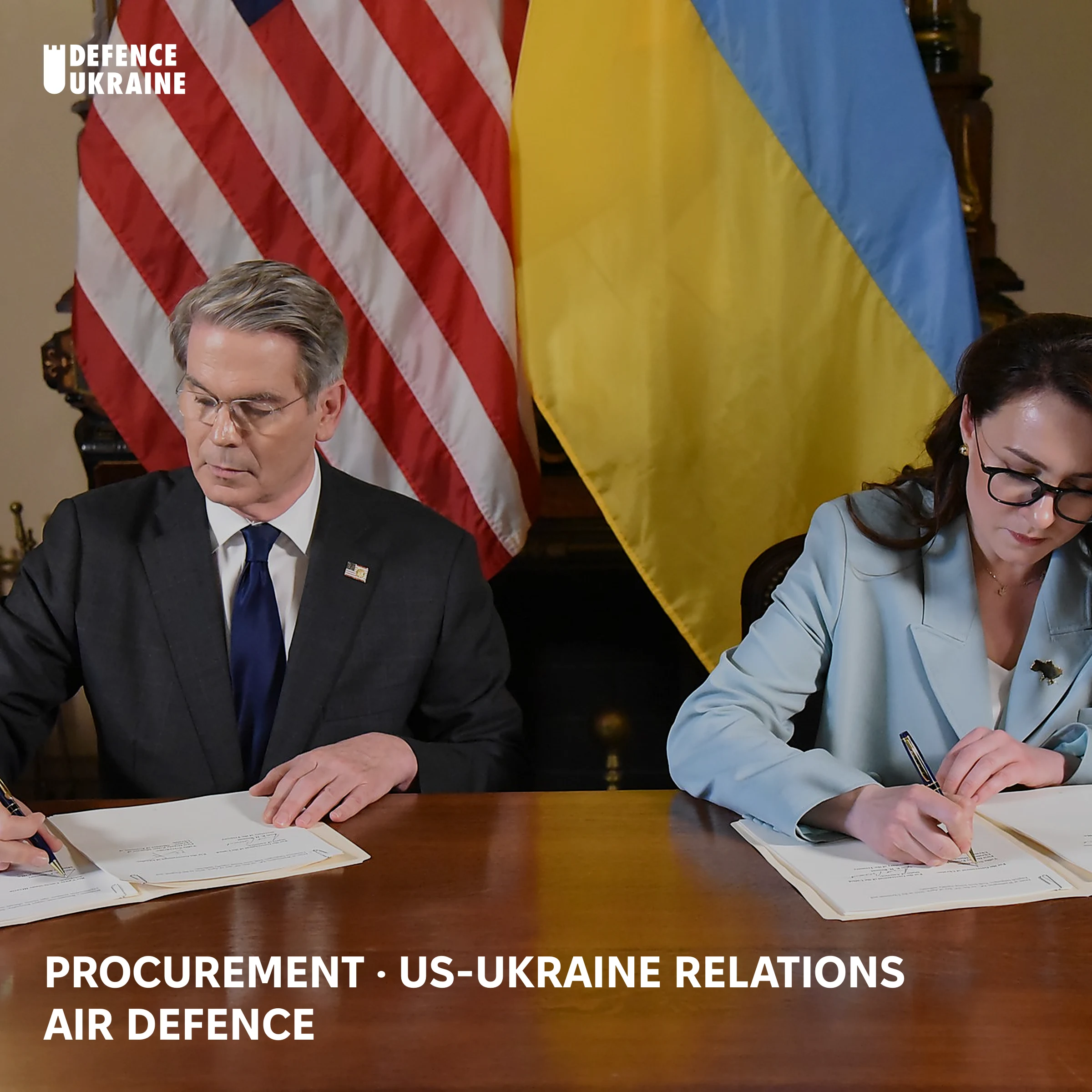
That conversion rests on clear documentation. Treasury Secretary Scott Bessent and then First Deputy Prime Minister Yulia Svyrydenko created the United States-Ukraine Reconstruction Investment Fund by signing an agreement in Washington on 30 April 2025, before it formally opened on 23 May 2025. Ukraine injects 50 per cent of state revenues from new natural-resource licences. The United States contributes direct capital or provides what Ukraine's Ministry of Economy called "new military assistance". The US International Development Finance Corporation (DFC) chairs the fund's board, which convened for the first time on 3 September 2025. On 17 September 2025 the DFC announced a $75 million equity commitment, matched by Ukraine for $150 million combined, and said the board had "discussed valuation protocols that will facilitate the crediting of preferred shares in the fund to the United States for new military assistance it delivers to Ukraine."
That credit arrives as preferred shares. Delivered weapons turn into senior equity claims on a fund drawing its income from Ukrainian lithium, titanium, and hydrocarbon licences.
Two core questions remain open. The first is timing. Prime Minister Denys Shmyhal said on 27 April 2025 that prior US aid would not count towards the fund. Congress appropriated this FMF under the Biden administration, yet the transaction is new and deliveries remain years away. The notification makes the delivery date decisive rather than the appropriation date, expanding the pool of American funding eligible for crediting. The second turns on the phrase "via a 1:1 reimbursement". Neither the State Department, the DFC, nor Ukraine's Ministry of Economy has disclosed what gets reimbursed, by whom, or into which account. The valuation protocols the board discussed in 2025 remain unreleased.
What European Cash Actually Buys
Here the package shifts from an American accounting exercise into a European problem. European partners bankroll a share of an FMS case where Ukraine sits as the official buyer. Ukraine signs the Letter of Offer and Acceptance and receives the case reporting. The US Government manages the contracting and selects the suppliers. The American share of that same transaction secures preferred shares in the minerals fund.
No released document grants the European contribution any comparable status. It yields no equity in the fund and no claim against its revenues. No public instrument gives European donors standing over delivery timetables, repricing, or cancellation proceeds. By 21 September 2026 no European government had acknowledged on the record that its money sits inside Transmittal 26-90, and none had explained to its national parliament how officials would book the outlay. That disparity may simply reflect confidential side letters rather than substantive neglect. Yet the public record contains no answer, and that silence is the finding.
This accountability dispute has surfaced before. On 23 March 2026, according to two US officials quoted by The Washington Post, the Pentagon informed Congress of plans to divert roughly $750 million in NATO allies' Prioritised Ukraine Requirements List (PURL) cash to restock American arsenals. The Post noted it was unclear whether contributing capitals understood where their money went. In September, Defence Ukraine's review of Ukraine's five financing channels spelt out the structural problem: PURL and its FMS counterpart JUMPSTART both end in a decision taken in Washington that European cash cannot steer. Transmittal 26-90 sharpens that dilemma. Under PURL, European governments worried about fungibility. Under this arrangement, European and American taxpayer money buys the same kit, but only American dollars appreciate.
The contrast with Ukraine's own channels is stark. Under the €1.3 billion funding cycle of the Danish Model, an allied government pays Ukrainian factories directly through the Defence Procurement Agency. That money builds Ukrainian industrial capacity, and the donor's return is the finished weapon. Under Transmittal 26-90, European money builds American industrial capacity for development programmes, while the equity accrues to Washington alone.
Strategic Implications for Ukraine
The notification establishes a precedent long before it establishes a shipping timetable, and Kyiv has four clear reasons to watch the precedent far more closely.
- Every future American weapon now carries a claim on mineral income. If sales backed by FMF count as capital contributions, each new US-funded delivery enlarges Washington's preferred claim on the Reconstruction Investment Fund. The US stake in the fund expands with the war rather than with private capital investment. Ukrainian negotiators need to demand the release of those valuation protocols before signing any Letter of Offer and Acceptance, because the formula translating a delivered interceptor into equity shares is a financial condition that belongs at the bargaining table.
- European donors will seek equal terms, or pull their money. When finance ministries in Oslo or The Hague discover that American cash in a joint case earns equity while their own funds do not, they have two options: demand parity or redirect their budgets. Parity would dilute Ukraine's own half of the fund. Diverting the funds would channel money towards mechanisms where donors control contracting, which in practice means Danish Model procurement through Ukrainian manufacturers. Either path shifts the arithmetic of Ukraine's air-defence funding far more than the $2.68 billion figure does.
- Development funding moves slowly. Without a named prime contractor, the contracts must go through competitive bidding under the Federal Acquisition Regulation after officials sign the Letter of Offer and Acceptance. Across the public record, not a single hardware item in this package represents a 2026 delivery. Military planners in Kyiv must treat Transmittal 26-90 as long-term industrial investment in US-run S-300-compatible and counter-UAS lines, keeping urgent requests inside mechanisms that pull from ready stocks.
- The October calendar provides the test. The congressional review window shuts around 18 October. The Ukraine Defence Contact Group meets in early October, while the European Council gathers later that month with Ukraine financing on its agenda. Any of the three settings gives participating governments a stage to clarify what their funding secures in this transaction. If no allied government comes forward by the end of October, that silence will be an answer in itself.
The first document that would resolve the ownership question is the Letter of Offer and Acceptance, and the second is the fund board's valuation protocol. Neither is public. Until one appears, the United States remains the only party to Transmittal 26-90 with a defined return on its money.