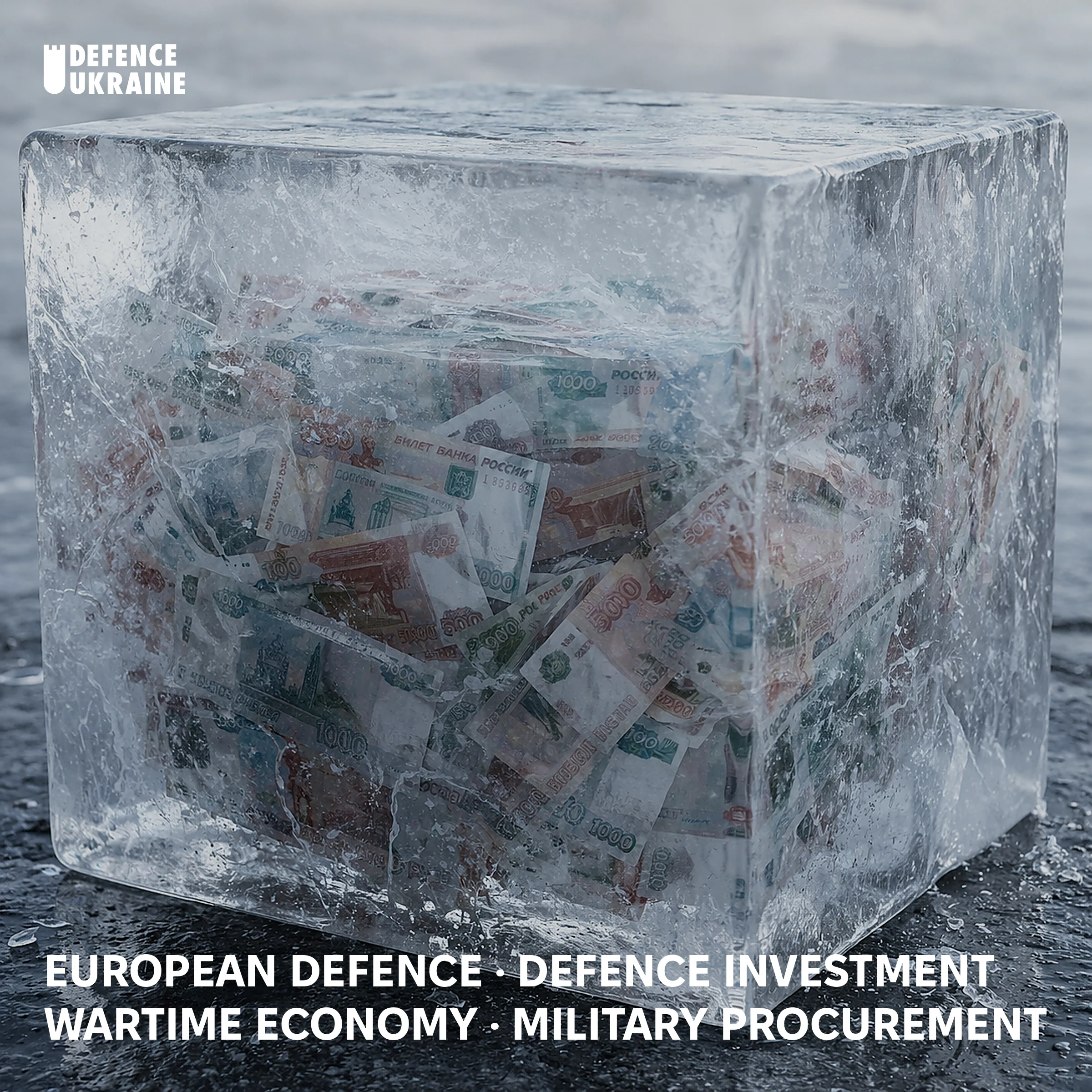
When Western governments immobilised approximately $300 billion in Russian central bank reserves in February 2022, the action was meant as punishment. By the spring of 2026, those frozen reserves have become something the original architects did not plan: the collateral underpinning the largest single tranche of European defence assistance to Ukraine since the war began. €60 billion of the European Union's new Ukraine Support Loan is earmarked for military procurement, backed by the windfall profits generated as the immobilised reserves throw off interest in European securities depositories. The EU raises the capital itself by borrowing against its budget headroom; the frozen-asset profits service and guarantee the debt.
That €60 billion is two-thirds of a €90 billion package the European Commission proposed for the 2026–2027 period, structured to cover Ukrainian state survival through the end of 2027. The remaining €30 billion goes to general budget support: civil servant salaries, healthcare, education, the basic functioning of the Ukrainian state. The military component breaks new ground. No previous European financial commitment to Ukraine has carried this much explicit weight on lethal aid, defence-industrial integration, and procurement contracts.
Where the Money Comes From
The architecture is deliberately indirect. The European Union does not propose to seize the €209 billion of Russian sovereign reserves immobilised in European jurisdictions, nearly all of it parked at the Belgian central securities depository Euroclear. Instead, the loan is collateralised against the windfall profits those reserves generate as Euroclear rolls the maturing securities into European money markets. In 2024 alone, those windfalls amounted to roughly $7 billion in interest at Euroclear. Belgium taxes them at 25 percent and channels its share to Ukraine. The remainder flows through the European Council's Ukraine Loan Cooperation Mechanism, which directs the proceeds to service the EU's bilateral Ukraine loans.
For Ukraine, the loan is non-recourse. Kyiv does not owe the principal back to Brussels unless and until it receives war reparations from the Russian Federation. The arrangement satisfies the IMF's debt sustainability requirements, which would otherwise have made Ukraine's projected debt-to-GDP ratio impossible to model as sustainable, and unlocks consecutive tranches of the IMF's $15.6 billion Extended Fund Facility for Ukraine. The European Union, meanwhile, raises the upfront capital by borrowing against the headroom of its own multiannual budget. Defence Ukraine's earlier analysis of Europe's defence investment surge covered the broader pattern that this loan now formalises at scale: European public and private capital reorganising itself around the assumption that defence funding is a permanent fixture, not an emergency line.
What the €60 Billion Buys
The European Commission's framing of the military component names four categories explicitly. Air defence systems, the most urgent and the most expensive line, will continue funding the layered shield around Ukrainian cities and critical infrastructure. Anti-drone technologies, both kinetic interceptors and electronic-warfare systems, address the saturation problem that has dominated the air war since 2024. Large-calibre ammunition, especially 155mm artillery shells, remains the single most consumed item on the Ukrainian front and the one European production has struggled hardest to scale. And the fourth category, the deepest in its implications for the next decade, is the integration of Ukraine's defence industrial base into the broader European defence sector.
Each of these categories sits inside an existing European procurement architecture. Air defence runs through the Patriot, NASAMS, IRIS-T, and SAMP/T programmes, with Kongsberg, Raytheon, Diehl Defence, Eurosam, and MBDA among the European primes already engaged. Anti-drone falls across a more fragmented set of vendors, with European primes only now consolidating their offers. Ammunition procurement runs through the European Defence Agency's joint procurement framework and through national stockpile contracts that the EU has been pushing to align since 2023. The fourth category, defence-industrial integration, is the one without an obvious institutional home: it is the part of the loan that asks European procurement to make space for Ukrainian companies as suppliers, not just as recipients.
The model is not new. The Norway-Ukraine NASAMS co-production agreement signed in mid-2025 is the most concrete existing example. Norway's defence ministry agreed to finance the production of a cheaper interceptor missile inside Ukraine, with Kongsberg holding the design IP and a Ukrainian co-producer responsible for assembly. What that arrangement transferred was not licensed manufacturing rights alone but the supply-chain knowledge that comes with them. The €60 billion is structured to enable many more such arrangements.
The Veto and the Workaround
The package nearly did not happen. The Ukraine Support Loan required a formal amendment to the EU's 2021–2027 Multiannual Financial Framework to authorise the use of budget headroom as the guarantee. That amendment required absolute unanimity in the European Council, and Hungary used its veto. Prime Minister Viktor Orbán tied the veto explicitly to two demands. The first was the resumption of Russian oil deliveries via the Druzhba pipeline, which had been disrupted by Russian strikes in early 2026. The second was a softer overall European posture toward Moscow ahead of his April 2026 domestic election against opposition leader Péter Magyar.
The deadlock threatened to bankrupt the Ukrainian state mid-fiscal-year. On 29 January 2026, the European Council authorised an Enhanced Cooperation mechanism under Article 20 of the Treaty on European Union, a provision that allows a subset of member states to pursue deeper integration when the union as a whole cannot reach consensus. The €90 billion loan now proceeds through 24 member states, with Hungary, Slovakia, and Czechia explicitly excluded. Because those three states abstained from the mechanism, they bear no financial obligation under the resulting EU budget guarantee.
The procedural workaround preserved the funding line, but it set a controversial precedent. For the first time, a major European foreign-policy and macro-financial commitment is being routed around the unanimity requirement that has defined EU external action since Maastricht. Whether this becomes a pattern or a one-off depends on how the next few EU votes on Ukraine assistance go, and on whether other unanimity-blocking states decide they prefer the deal-making leverage of the veto to the financial obligations of full participation.
What This Means for Ukrainian Industrial Access
The €60 billion is the largest single procurement opening Ukrainian defence companies have ever faced. It is also one of the hardest to access. European defence procurement is not a free market that rewards the lowest bidder. It is a network of national champions, prime contractor relationships, NATO standardisation requirements, security clearance regimes, and political guarantees. Ukrainian companies that want to win subcontracting work inside the €60 billion will need to satisfy each of those gates.
The most accessible path runs through the kind of co-production agreement Norway pioneered with Kongsberg. A European prime holds the design and the security clearances; a Ukrainian company holds the production capacity and the operational knowledge from manufacturing under wartime conditions. The two companies sign a manufacturing partnership, the donor government finances the local production of items the donor would otherwise have shipped from its own stockpile, and the resulting weapons go directly into Ukrainian inventory. The model satisfies both the European procurement framework and the Ukrainian capability requirement, and it transfers durable industrial knowledge along the way.
For this model to scale, Ukrainian companies need to clear three structural barriers. The first is certification: NATO procurement requires quality-management standards from the AQAP series, and many Ukrainian defence firms have not yet been audited against them. The second is export controls and end-user verification: European primes are only as willing to share IP as their domestic export-control authorities allow, which depends on the destination, the product category, and the political weather of the moment. The third is financial guarantees: contract advances and milestone payments depend on the Ukrainian counterparty being able to absorb working-capital risk, which is harder under wartime banking constraints. Ukraine's practical guide to its defence procurement system covers the procurement-side mechanics in detail; the structural gaps for accessing donor-funded EU procurement specifically remain. Defence Ukraine's Market Access programme exists to help companies navigate exactly these gates.
Strategic Implications for Ukraine
The €60 billion is not the only consequence of the architecture above. Four secondary effects matter as much for Ukrainian planners as the headline number.
- The shift from aid to industrial partnership. The €60 billion is not a transfer. It is a procurement budget. The distinction matters because procurement budgets create durable customer relationships, supplier bases, and follow-on contracts in a way that emergency aid does not. Every Ukrainian company that wins a subcontract under the €60 billion gains a European customer relationship that survives the end of the current acute phase of the war. That is the real long-term shift: Ukraine moving from an aid recipient to a defence-industrial supplier inside the European market.
- The political fragility of the funding line. The Enhanced Cooperation workaround proved that the €90 billion could be preserved against a single veto. It also proved that the underlying mechanism is contested. Sanctions against the Russian central bank, which keep the immobilised assets immobilised, must be unanimously renewed every six months under Article 24 of the Treaty on European Union. A future Hungarian or Slovak government less willing to play along, or a different vote outcome in another member state, could collapse the collateral that makes the loan possible. Ukrainian planners and European primes building procurement pipelines around the €60 billion are taking on a real political risk that the funding survives the full 2026–2027 horizon.
- The IMF unlock. Without the non-recourse loan structure, Ukraine's projected public debt would have crossed thresholds that legally bar further IMF Extended Fund Facility disbursements. The €90 billion solves that problem. It allows the IMF to continue modelling Ukrainian debt as sustainable, which unlocks roughly $5.3 billion in further EFF tranches over 2026–2027. That secondary effect, the IMF unlock, may matter more for Ukraine's long-term macro-financial stability than the headline €60 billion itself, because IMF support is the catalyst for almost every other bilateral lender's continued engagement.
- The precedent for treaty workarounds. Enhanced Cooperation has now been used for a major macro-financial commitment, not just for technical or regulatory matters. Whether this becomes the routine path for Ukraine support, or a one-time emergency manoeuvre, will shape how the EU handles every future Ukraine financing question through the end of the war.
Conclusion
The next eighteen months will determine whether the €60 billion becomes Ukrainian defence-industrial capacity or a European procurement story with Ukraine as the marketing line. The signs to watch are concrete. By the end of 2026, the European Commission will publish disbursement data showing which European primes have signed the first procurement contracts under the loan. By mid-2027, the first co-production agreements modelled on the Kongsberg arrangement should be operational. And the next semi-annual sanctions renewal vote, due in autumn 2026, will be the first real test of the political durability of the underlying immobilisation under the Enhanced Cooperation framework.
If the disbursement data shows contracts flowing to Ukrainian production lines, not just to Western European factories that promise to involve Ukrainian partners later, the loan will have done what its designers claimed it would. If not, it will be a substantial transfer to the European defence industry with Ukraine on the invoice line. The difference will be visible in the contract awards, not in the press releases.