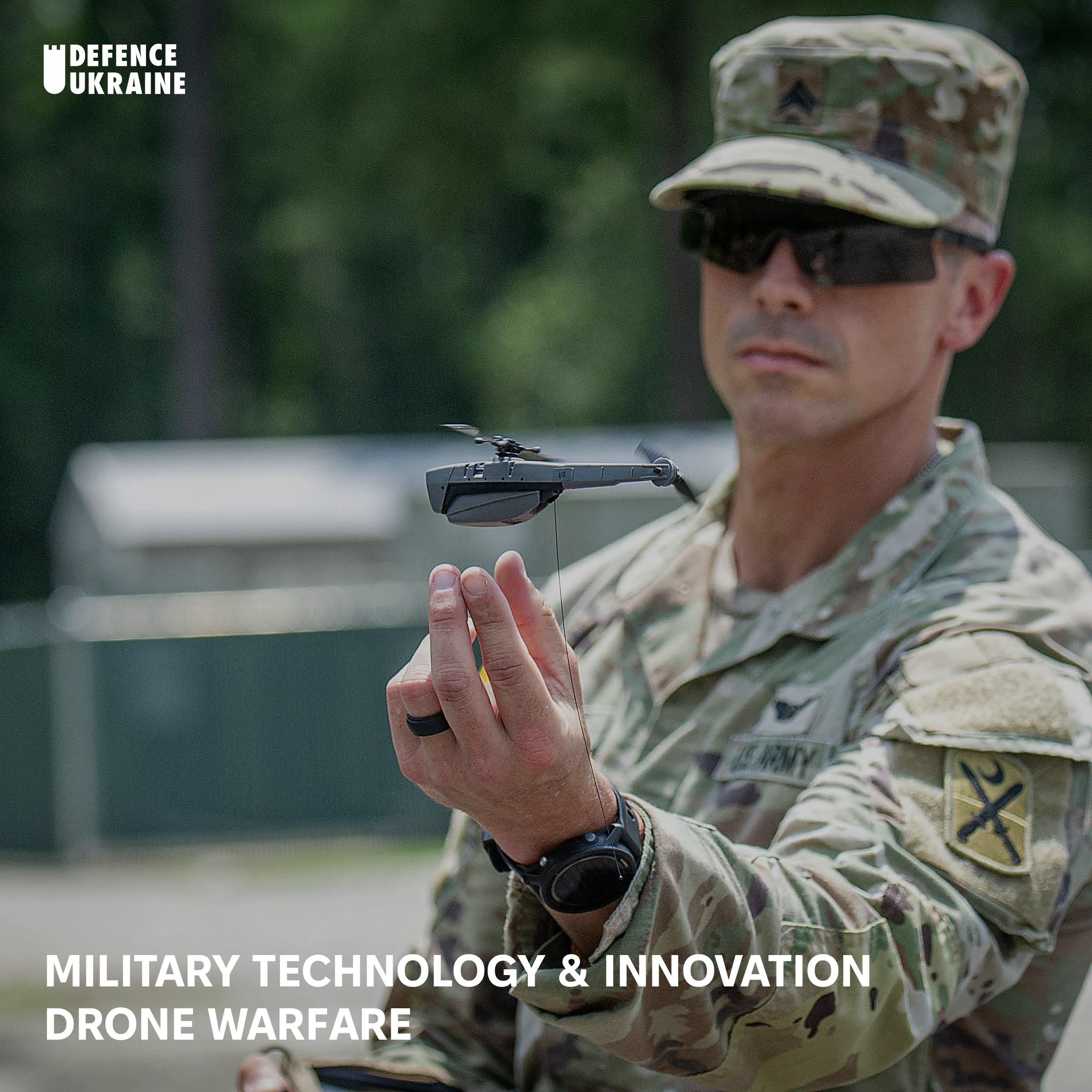
Norway delivered approximately 1,300 Black Hornet nano-drones to Ukraine between August 2022 and the end of 2023. At 33 grams and 168 millimetres, the Teledyne FLIR Black Hornet is smaller than a sparrow and nearly silent in flight. In the rubble of Bakhmut and Avdiivka, that silence has proved to be a survival advantage that no other capability in the Ukrainian infantry's arsenal can replicate.
The Black Hornet is a Personal Reconnaissance System (PRS): an unarmed, encrypted, pocket-sized helicopter that gives a single dismounted soldier a bird's-eye view of whatever is around the next corner, over the next wall, or inside the next building. It carries no weapons. Its value is informational, and in the contested urban sectors of the eastern front, information is what keeps infantry squads alive.
From Special Operations Novelty to Frontline Necessity
The Black Hornet was originally a niche tool. Prox Dynamics, a Norwegian firm acquired by the American conglomerate Teledyne FLIR in 2016 for roughly $134 million, designed it for counter-insurgency operations in Afghanistan and Iraq. Small numbers went to British and Norwegian special forces. The idea that it would one day be mass-issued to conventional infantry fighting a near-peer adversary in European cities was not part of the original design brief.
The war changed that. In August 2022, Norway and the United Kingdom announced a joint procurement through the International Fund for Ukraine (IFU). Norway contributed an initial 400 million NOK, with up to 90 million NOK allocated specifically for the Black Hornet package. That first tranche delivered approximately 300 systems, including spare parts, logistics, and an operator training pipeline. By July 2023, the Norwegian Ministry of Defence had ordered a further 1,000 units directly from Teledyne FLIR, bringing the total known delivery to roughly 1,300 systems.
At early, low-volume procurement prices, a complete Black Hornet system (base station, control tablet, and two nano-helicopters) cost between $160,000 and $195,000. Scaled production has since brought the unit cost down to an estimated $40,000 to $60,000. That is still 20 to 70 times the price of a commercial DJI Mavic 3. The cost argument only makes sense when measured against what the Black Hornet protects: a trained special operations soldier whose replacement cost, in years of training and operational experience, is incalculable.
What the Black Hornet Does in Urban Combat
Verified combat footage from Avdiivka shows Ukrainian personnel deploying the nano-drone directly from the shattered windows of contested residential buildings. The drone flies over rubble mounds, through breached corridors, and around compound walls. It maps room layouts, identifies booby traps, locates hostile fighters, and returns thermal and electro-optical imagery to the operator's tablet in real time. No soldier needs to cross the threshold first.
The operational footprint is concentrated among Ukraine's most capable formations. The SSO (Special Operations Forces), including the UA REG TEAM documented using the system during the 2024 Kursk Oblast incursion, are the primary operators. The 3rd Separate Assault Brigade, an elite mechanised formation with roots in the Azov regiment, has integrated the Black Hornet into combined human-machine assault preparation alongside unmanned ground vehicles. The 411th Unmanned Systems Regiment, established as a battalion in 2022 and expanded to regimental strength in 2024, operates across Kherson, Bakhmut, Chasiv Yar, and Robotyne, and coordinates reconnaissance drones with FPV strike teams in a tightly integrated kill chain.
The reconnaissance-strike loop is where the Black Hornet's value multiplies. The operator identifies a position with the nano-drone, relays coordinates through the Delta battlefield management system, and an adjacent FPV team strikes the target within minutes. The Black Hornet then provides real-time battle damage assessment without exposing a human spotter. The drone is the "find and fix" node; the FPV is the "finish" node. Neither is sufficient alone.
Ukrainian operators from the Kruk UAV Training Centre report flying the Black Hornet within 10 metres of enemy soldiers without detection. Against the textured backdrop of urban ruins, the drone becomes visually imperceptible at 20 metres. Its acoustic signature is negligible. These properties matter because, in the current battlespace, the act of launching any emitting drone near the front line risks attracting immediate retaliatory artillery fire. The Black Hornet is the only micro-UAV in widespread Ukrainian service whose signature is low enough to operate covertly in close proximity to the adversary.
Surviving the Russian Electronic Warfare Environment
The electromagnetic environment in eastern Ukraine is the most heavily contested in any active conflict. Russian forces deploy layered electronic warfare systems, from strategic-level platforms like the R-330Zh Zhitel (capable of intercepting and suppressing drone communications at ranges up to 25 kilometres) to smaller, trench-level tactical jammers designed to create localised protective domes against FPV attacks. Defence Ukraine's analysis of Ukraine's counter-drone innovation covers the broader EW contest in detail.
Commercial quadcopters are acutely vulnerable. The DJI Mavic series relies on unencrypted, static frequencies that Russian EW can jam or spoof with minimal effort. More critically, DJI's proprietary AeroScope system, originally built for airport airspace safety, has been weaponised to pinpoint the GPS coordinates of the drone operator's ground controller, allowing Russian forces to direct counter-battery fire onto the pilot's position.
The Black Hornet's survival in this environment rests on two design choices. The first is its encrypted, frequency-hopping datalink. The Black Hornet 3 uses dynamic power scaling and rapid band-shifting to evade localised jamming. The second is physics. Because the Black Hornet operates at ranges under two kilometres, the signal-to-noise ratio between operator and drone is overwhelmingly strong. A standoff jammer like the Pole-21 is optimised to sever links between drones and ground stations separated by tens of kilometres. Severing a 500-metre link requires an order of magnitude more power. If the datalink is lost entirely, the drone falls back on internal inertial navigation and returns autonomously to its launch point, preventing physical capture.
None of this makes the Black Hornet immune to EW. It does, however, create operational windows that commercial drones simply cannot sustain.
The Alternatives: Parrot, DJI, and Ukrainian Startups
The Black Hornet occupies the top tier of a layered drone ecosystem that the Armed Forces of Ukraine have built from necessity. At the bottom tier, cheap and expendable DJI Mavic 3 and Mini quadcopters provide mass coverage. Modified in the field to drop VOG grenades, these commercial platforms account for the majority of Ukrainian micro-UAV sorties. Their weaknesses are well-documented: AeroScope exposure, unencrypted data links, and total dependence on GNSS signals that Russian EW can deny.
The mid-tier is filling with Western defence alternatives designed to close exactly those gaps. The French-built Parrot ANAFI UKR, developed in direct consultation with the Ukrainian military and procured through the NATO Support and Procurement Agency (NSPA), offers up to 50 minutes of flight time, AES-256 encryption, and a military-grade MARS frequency-hopping radio with no Chinese-origin components. Parrot's CEO, Henri Seydoux, visited Ukraine multiple times to assess operational needs, and the drone is hardened to operate at temperatures down to minus 36 degrees Celsius. The American Skydio X2D, certified under the US Department of Defense's Blue UAS framework, provides AI-driven autonomous obstacle avoidance and pre-vetted cybersecurity.
The domestic Ukrainian tier is where the most operationally responsive innovation is happening. More than 250 Ukrainian drone manufacturers have emerged since 2022, iterating hardware and software at a pace that reflects the brutal immediacy of frontline feedback.
Buntar Aerospace, founded in 2023, secured $10.4 million in funding to scale an AI-enabled ISR platform. Its Copilot software automates 90 per cent of flight planning and manages multiple camera feeds to reduce cognitive overload on operators under fire. The Buntar One system navigates using optical terrain recognition when GNSS signals are jammed, a capability developed specifically for the denied-signal conditions of the eastern front. The Wild Hornets initiative has taken a different path entirely: interceptor drones capable of 280 km/h, piloted to physically ram incoming Russian surveillance drones and Shahed loitering munitions mid-air at a unit cost of roughly $2,000.
The ecosystem is layered by design. Cheap DJI platforms provide expendable mass. Parrot and Skydio provide secure mid-range ISR. The Black Hornet provides covert close-quarters intelligence for elite formations. Ukrainian startups fill the gaps that none of the imported systems quite reach.
The Black Hornet 4: What Changes
Teledyne FLIR's Black Hornet 4, now entering production, is a direct response to the tactical shortfalls the Ukrainian theatre exposed.
The weight has increased from 33 grams to 70 grams. That additional mass accommodates a larger battery (extending flight endurance beyond 30 minutes), a 12-megapixel electro-optical camera with improved low-light performance, a high-resolution thermal imager, and obstacle-avoidance sensors. The datalink has been upgraded from the BH3's frequency-hopping radio to a full Software-Defined Radio (SDR) architecture, pushing the operational range past three kilometres and substantially improving cryptographic resilience against modern jamming systems.
The BH4 also lays the architectural groundwork for AI integration: onboard processing to assist target recognition, reduce operator cognitive load, and enable semi-autonomous flight in signal-denied environments. This aligns with the broader NATO shift toward human-machine teaming, where AI handles navigation and sensor processing while the operator retains the decision authority.
Two recent contracts signal the pace of adoption. In early 2026, the Swiss Federal Office of Defence Procurement (armasuisse) awarded Teledyne FLIR $17.5 million to integrate the BH4 into the Piranha 8x8 armoured engineering vehicle programme, with the drone launching from an external hull cassette and streaming data directly into the vehicle's integrated combat solution. The German Bundeswehr has also ordered BH4 systems through European Logistic Partners (ELP). The US Defense Innovation Unit has certified the BH4 on its Blue UAS approved list.
The demand signal from Ukraine is shaping Western procurement cycles. The BH4 is not a speculative product. It is an engineering response to observed combat failures, funded by governments that watched the BH3 prove the concept and now want the upgraded version for their own forces.
What NATO Learned (and What It Has Not Yet Fixed)
During Exercise Hedgehog in Estonia, 10 Ukrainian drone operators acting as the opposing force systematically dismantled two NATO battalions in simulation. They destroyed 17 armoured vehicles and conducted 30 precision strikes in half a day. The exercise used NATO's standard mechanised doctrine against Ukrainian veterans applying the decentralised, drone-saturated tactics they had developed on the Donbas front. The result was, by the account of participating NATO officers published by War on the Rocks, a comprehensive defeat.
The NATO Joint Analysis and Lessons Learned Centre (JALLC) has since published detailed reports on Ukrainian drone adaptations, tracing the evolution from experimental use to mandatory combined-arms integration. The NATO-Ukraine Joint Analysis, Training and Education Centre (JATEC) in Bydgoszcz, Poland, now embeds Ukrainian combat veterans as instructors for British and American soldiers. At JATEC, the curriculum is not theoretical. Instructors teach from the specific, concrete experience of operating under constant drone surveillance, where the penalty for emitting a radio signal or bunching a formation is an FPV strike within minutes.
The institutional recognition is real. The gap is in implementation. NATO's standard force structures, designed around concentrated armoured manoeuvre and assumed air supremacy, have not yet been restructured to account for a battlefield where 10 operators with consumer-grade and military-grade UAVs can neutralise an armoured battalion. The US Army's Soldier Borne Sensor (SBS) programme, which has committed over $140 million to Black Hornet procurement, is the most concrete Western adaptation. But procurement is not doctrine. The deeper question, how to restructure a brigade so that every squad has organic aerial reconnaissance and every platoon can execute a reconnaissance-strike loop, remains largely unanswered outside Ukraine.
Strategic Implications for Ukraine
The micro-UAV revolution has three implications that extend beyond the immediate tactical advantage.
- The transparent battlefield is permanent. The density of overlapping UAV networks within three kilometres of the contact line has created a condition that RUSI describes as persistent, inescapable observation. Ukrainian ground combat brigades now universally field independent UAV companies to manage the surveillance load. For any force operating near the front, the assumption must be that it is being watched at all times. Concealment, dispersion, and emission control are no longer optional tactical disciplines. They are survival requirements.
- Domestic production is a strategic necessity, not a preference. Ukraine cannot sustain its micro-UAV operations on imported Black Hornets and donated DJI quadcopters indefinitely. The 250-plus domestic drone manufacturers that have emerged since 2022 are not a cottage industry. They are the beginning of an indigenous defence-industrial base in unmanned systems. Companies like Buntar Aerospace, with its AI-enabled visual navigation for GNSS-denied environments, are building capabilities that address the specific conditions of the Ukrainian front in ways that imported Western systems do not. Whether this domestic base survives the war as a permanent industry depends on whether it can win contracts from European defence procurement, not just wartime aid donations.
- The doctrine gap between Ukraine and NATO is widening. Ukrainian forces treat the micro-UAV as the foundational element of the engagement cycle: if the drone cannot see the target, the infantry does not advance. NATO forces, even those now procuring Black Hornets, still treat the nano-UAV as a supplemental situational-awareness tool. The Exercise Hedgehog result suggests that the supplemental approach does not survive contact with an adversary that has fully integrated drones into every echelon. The JALLC and JATEC programmes are the right institutional response. The speed at which their findings translate into restructured brigade-level tactics will determine whether NATO closes the gap before the next crisis tests it.
Conclusion
The Black Hornet entered Ukraine as a special-operations luxury. It has left that category permanently. In the rubble of Avdiivka and the fluid manoeuvre of the Kursk incursion, the nano-drone proved that a 33-gram helicopter with a thermal camera and an encrypted datalink can change the survival calculus of an entire squad. The BH4, with its SDR datalink and AI-ready architecture, is the engineering answer to the combat questions the BH3 raised.
The next test is not whether more NATO armies will buy the Black Hornet 4. The armasuisse and Bundeswehr contracts confirm that they will. The test is whether those armies will restructure their infantry doctrine around it, or simply add it to their equipment tables and keep fighting the way they always have. Ukraine's experience suggests that the equipment without the doctrine is an expensive way to lose the same exercise twice.